 3 months ago
116
3 months ago
116
SINGAPORE: Even as water and power concerns weigh on data centre expansions in parts of the world, India is flooring the accelerator.
Investments in India’s data centre market alone are projected to top US$100 billion by 2027, according to CBRE Group, as the country emerges as a key global destination for AI infrastructure.
OpenAI, the maker of ChatGPT, announced plans for a 1-gigawatt (GW) AI data centre in September last year, followed by major AI-related investment announcements from technology giants Amazon, Google, Microsoft, and Meta in the last quarter of 2025.
Domestic conglomerates such as Reliance, Adani and the Tata Group are also joining the rush for data centres, which are centralised facilities that house servers and digital infrastructure, powering everything from AI tools such as ChatGPT and Claude to cloud services, video streaming and e-commerce platforms.
This momentum may be unsurprising given India’s rapidly growing AI user base and its status as home to the world’s second-largest developer community.
What is more striking, however, is the timing - coming as other parts of the world reassess data centre expansion amid mounting resource and environmental constraints.
Places including Chile, Mexico, Scotland and the United States have seen local opposition and protests over such projects, in some cases forcing them to shut down or relocate.
This is because large data centres require vast amounts of freshwater for cooling, in addition to their enormous power needs.
In the region, Malaysia’s Johor state in November asked companies to suspend the expansion of water-cooled data centre projects “until mid-2027”, while Singapore previously imposed a three-year moratorium from 2019 to 2022.
India, by contrast, is pressing ahead.
As of October 2025, India had 153 data centres - up about 10 per cent over the past three years - with a combined capacity of 1.7GW. That capacity is expected to grow fivefold to 8GW by 2030, according to a Jefferies report.
But in a country where many cities already face severe water shortages, critics warn the boom could place additional strain on local communities, raising questions over how India will balance rapid AI infrastructure growth with environmental and social costs.
INDIA OFFERS INCENTIVES WHILE OTHERS PULL BACK
India has around one billion internet users, according to government figures, more than 700 million of whom use AI in some form.
It is also the second-largest user base for generative AI products from OpenAI and Anthropic, behind the US - one reason OpenAI has set up an office in India, with Anthropic planning to do so this year.
“The arrival of players like Anthropic and OpenAI signals that India is now viewed as a strategic growth market, not just a back office,” Shweta Rajpal Kohli, president and CEO of the Startup Policy Forum, told CNA.
 OpenAI CEO Sam Altman attends an event to pitch AI for businesses in Tokyo, Japan February 3, 2025. (Photo: Reuters/Kim Kyung-Hoon)
She attributed this shift to the “aggressive incentives” rolled out by the central government, as well as by states such as Maharashtra, Telangana and Andhra Pradesh, to attract data infrastructure - offers she described as “difficult to refuse”.
Last September, India’s central government proposed tax exemptions for data centres for up to 20 years, alongside power subsidies and other incentives.
State governments are also offering heavily subsidised land near technology parks, at discounts of up to 50 per cent, as well as capital incentives, and additional tax breaks to sweeten the deal.
These measures are particularly attractive at a time when AI data centre projects are facing tighter restrictions in other countries due to their water and energy demands.
Protests in the US have blocked or delayed data centre projects worth an estimated US$64 billion, according to Data Center Watch, a project run by AI security company 10a Labs.
One such case is a proposed 1GW Google data centre in Franklin Township, Indiana, which was brought to a halt in September, just weeks before Google announced its investment in India.
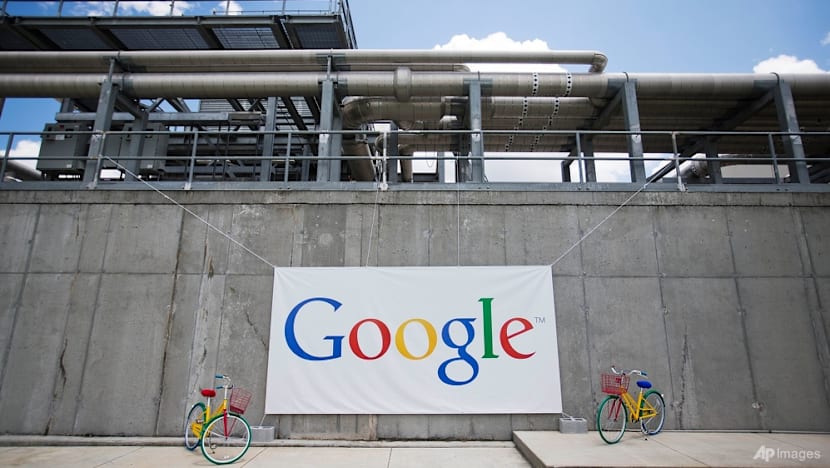 A banner hangs during a ceremony announcing a proposed $300 million expansion of Google's data center operations Tuesday, June 2, 2015, in Lithia Springs, Georgia. (Photo: AP/David Goldman)
So why is India actively courting AI data centres, even as other countries grow more cautious?
One reason lies in the country’s data protection policy and localisation strategy. As part of its AI mission, the government is advocating for the processing and storage of data generated by Indian users within the country.
According to a local report, India generates around 20 per cent of the world's data, yet hosts just 3 per cent of global data centre capacity.
Geopolitical risk management is another factor, said Faisal Kawoosa, chief analyst at technology research firm TechARC.
The Trump administration has imposed tariffs of up to 50 per cent on Indian goods - among the highest worldwide - and tightened H-1B visa applications, limiting opportunities for Indian talent to work in the US.
AI data centre investments, therefore, represent a strategic win for India, said experts.
They are “sticky investments” for US tech giants, as they involve heavy, long-term infrastructure commitments that are difficult to exit, said Kawoosa.
Unlike offices, which can be shut down quickly if geopolitical pressures mount, large-scale AI data centres require substantial capital investment and physical infrastructure, making them far harder to relocate or abandon, he added.
THE WINNERS AND LOSERS OF INDIA’S DATA CENTRE BOOM
India’s semiconductor industry, which the government has been trying to scale up, is one of the biggest beneficiaries of AI data centre investments.
While high-end chips will continue to be imported from companies such as Nvidia and AMD, data centres are expected to generate substantial local demand for lower-cost, mature semiconductors.
“It means more compute power, more storage, and, crucially, greater impetus for Indian tech companies to rethink how chips integrate across the entire hardware stack,” said Shashwath TR, co-founder and CEO of Indian semiconductor firm Mindgrove Technologies.
“This goes beyond advanced chips to all the surrounding infrastructure, from power and thermal management to networking and other specialised uses.”
To capture this opportunity, AI companies like OpenAI, Perplexity, and Anthropic are courting Indian customers with free or heavily discounted subscription plans - aiming to scale first, and monetise later.
Industry players believe that with India’s large pool of software developers, this could spur a wave of new AI-powered apps and services, similar to how Android became the foundation for a vast array of smartphone applications worldwide.
There is also a practical reason for this expansion. AI firms need data centres close to where data is generated to train models and process large volumes of user information, which explains why many US tech companies are investing in domestic infrastructure.
However, analysts caution that serious questions remain about the environmental and humanitarian costs of this growth.
India already faces acute water stress and constraints on energy supply.
Water use by data centres in the country is expected to more than double, from 150 billion litres in 2025 to 358 billion litres by 2030, according to insights from Mordor Intelligence.
Coastal cities such as Mumbai and Chennai are considered attractive locations due to their proximity to subsea cables and existing data centre clusters.
Yet both cities are already prone to water shortages and struggle to meet the needs of residents and businesses.
Electricity constraints pose a similar risk.
India’s data centre electricity demand is expected to grow by almost fivefold by 2030 from 2024 levels, according to an S&P Global report.
These developments could increase reliance on fossil fuels, particularly coal, which already accounts for nearly 50 per cent of India’s electricity generation.
“The Indian government seems to be in discussions over this and working with these Big Tech players to figure out a plan,” said analyst Kawoosa.
CAN INDIA BUILD A GREENER DATA CENTRE MODEL?
As countries elsewhere grapple with the environmental, water and energy costs of rapid data centre expansion, the question is whether India can learn from their experiences and chart a more sustainable path.
Singapore previously imposed a three-year suspension on new data centres, lifting the moratorium in 2022 as it shifted its focus towards more sustainable projects.
In Malaysia’s Johor state, companies were asked to suspend the expansion of water-cooled data centre projects “until mid-2027”, as authorities grapple with drought and mounting pressure on water supplies.
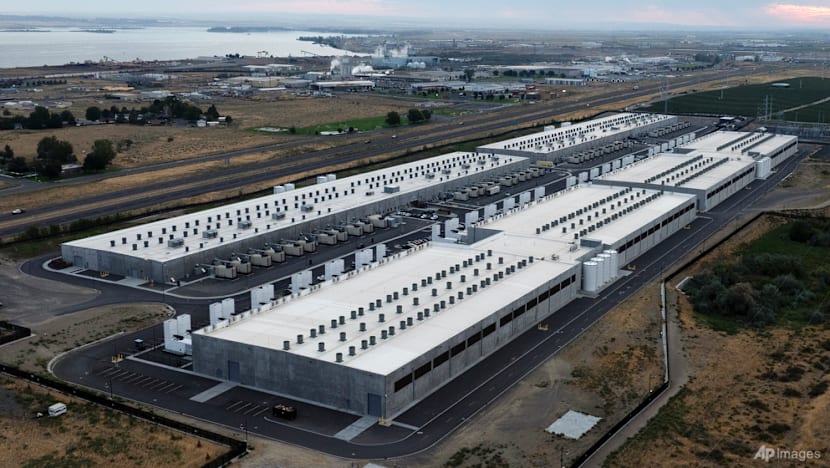 Amazon Web Services data center is visible on Aug. 22, 2024, in Boardman, Ore. (Photo: AP/Jenny Kane)
Kohli of the Startup Policy Forum said Malaysia’s decision underscores the risks of expanding too quickly without coordinated infrastructure planning.
“The lesson isn’t to slow down,” she said, “but to plan and execute smartly”.
She added that Indian authorities are already moving in this direction: “A national data centre policy is under discussion, and states such as Tamil Nadu and Maharashtra have embedded green and sustainability norms early.”
“With the right coordination across power, water, zoning and governance, India can set a global benchmark for scaling digital infrastructure responsibly and durably,” said Kohli.
She also pointed to innovation emerging from within India’s tech ecosystem.
“Indian startups, such as Vigyan Labs, are already developing intelligent energy optimisation solutions, paving the way for low-carbon digital infrastructure and greener data centres.”
Water management, however, remains a major challenge. While the use of non-potable water is expected to become standard for data centre cooling, it may not be sufficient to meet growing demand.
This is where desalination could play a critical role.
Chennai currently operates three desalination plants, with a fourth expected to be completed this year. Mumbai, meanwhile, announced in December 2025 that it will build its first desalination plant.
Energy presents an equally pressing issue.
Making renewable electricity a mandatory source for data centres would significantly reduce their environmental footprint, but doing so would require India to rapidly scale up its renewable energy capacity to meet rising demand.
Kawoosa said the sector has “long-term potential for growth in India”, but added that how effectively concerns over resource constraints and environmental risks are managed remains to be seen.