 3 months ago
88
3 months ago
88
SINGAPORE: The smartphone ban in secondary schools appears to be effective so far, with more students interacting with one another, teachers and students told CNA.
"Before, a lot of people used to play video games on their phones, they didn’t really talk to each other," said Secondary 3 student Dyuthi Bhatt, whose school just implemented the enhanced measures this year.
"They used to sit around in the canteen and just huddle over one phone. There was no communication.
“But now, since the ban has been implemented, a lot more people have been talking to each other, the canteen is livelier and I don’t really see phones around.”
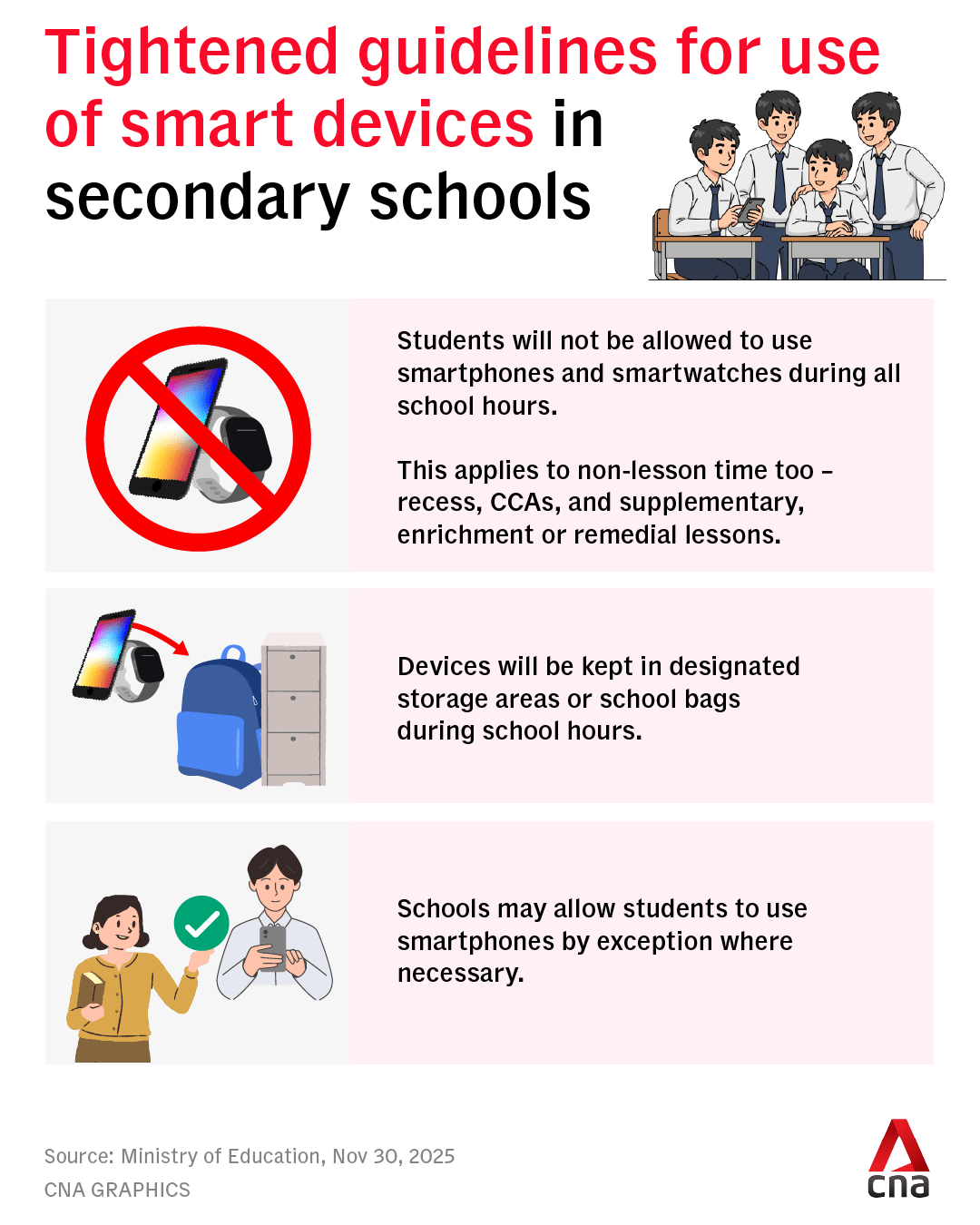
Since the start of the new school year, secondary school students have been forbidden from using their smartphones outside of class time, including recess and co-curricular activity hours.
This move was announced in November last year by the Ministry of Education (MOE).
At the time, MOE said the plan was for students’ devices to be kept in designated storage areas or school bags during school hours, with some schools already adopting these enhanced measures before the announcement.
Under previous guidelines, secondary school students were not allowed to use smartphones or smartwatches during lesson time.
Previously, students at Dyuthi’s school used to leave their phones in a box on the teacher’s table during class time, which meant that students could take back their phones whenever they had free time.
Now, they leave their phones in their lockers at the start of the day and take them out only at the end of the school day, she said.
While many of her peers have said that they miss having their phones, they added that they are grateful for the new rules because now they get to talk to more people and make friends.
Personally, she has found it easier to focus in class.
“Normally, I would be looking at my phone and wondering what’s coming, what messages do I have? But now, since it’s in my locker, I don’t really think about it anymore.”
Secondary 2 student Lucas Phillips’ school introduced the measures last year. “Last year, before we all had to go for assembly, we had to keep our phones inside our own lockers with all our books.”
They are only allowed to take their phones out of their lockers after school hours. During CCA hours, students are allowed to have their phones in their bags, but are not allowed to use them, the 13-year-old told CNA.
He used to receive notifications for messages from his mother when he wore a smartwatch to school, but was told he could not wear it anymore this year.
This has not caused any miscommunication issues so far. His mother Jasmine said that she would contact the general office or his teachers if she needed to reach him urgently.
“I think everyone’s kind of okay with it because we’ve got used to it since primary school, not using the phone during recess. (It’s) not really much of a change,” Lucas said, adding that teachers and student councillors patrol the classroom floors during recess.
“I find it better because at least we won’t be that antisocial.”
Secondary 2 student Nathaniel Gan said that his classmates are not in favour of the ban but are “slowly getting used to it”.
He added that there is better interaction during recess, with more students playing soccer or basketball together compared to before.
SMALL MINORITY FLOUTS RULES
In Dyuthi’s school, teachers conduct checks and patrols to make sure that students do not sneak their phones out of their lockers.
Despite this, some students still use their phones in common areas before morning assembly, Dyuthi said, adding that she has seen groups get scolded and their phones confiscated.
"There is this minority group who still use their phones in the classrooms when the teachers aren’t looking … These people aren’t really scared of what the teachers are going to do.
"They know the consequences, but they still do it, it’s that kind of situation."
These students get past the rules by leaving their phones in their bags instead of in their lockers, and teachers do not check the lockers, Dyuthi added.
At his school, if students are caught flouting the rules, their phones will be confiscated for one month unless their parents request it to be returned, Lucas shared. “I don’t know anyone who got caught.”
Nathaniel said most of his classmates have been following the new rules, although there are a few – about five out of 40 – who continue to use their smartphones.
“The teachers check if we have our handphones with us by asking us to put our handphones in a cupboard,” said the 14-year-old, adding that this takes place before assembly.
Those whose phones are not in the cupboard will be questioned and asked to provide a “reasonable explanation” for why they did not put their phones inside, he said.
On CCA days, students have their phones with them during lunch, but are still not allowed to use them.
"The discipline master will come with a bag to find people using their phones and will confiscate them until the end of CCA," Nathaniel said.
If students are caught using their phones when they should not be, their devices are confiscated until the end of the day. A second-time offender will have their phones confiscated for two days.
"OUT OF SIGHT AND OUT OF MIND"
Secondary school teachers who spoke to CNA said that students have been compliant with rules and that they have not faced major challenges in enforcing the ban.
All the teachers agreed to be interviewed for this article on condition of anonymity, as they are not authorised to speak to the media.
At Adrian’s school, students previously would store their phones in personal lockers. This year, they surrender their phones in the morning to teachers and the phones are stored in a cabinet with a digital combination lock.
“It’s a teacher-led process, where previously it was more independent,” he said. “At the end of the last lesson, normally, we could just leave. Now we have to stay back for a couple of minutes (to return the phones).”
While a few students have been mischievous and tried to tamper with the lock, Adrian said that the ban has been effective and there have been no “major issues”.
“I think it (the ban) definitely helps students, especially having the phone out of sight and out of mind,” said Adrian.
Another teacher, Ryan, said that while the school he teaches at had already banned mobile phones, the MOE announcement gave the school's policy some backing.
Before, students would still use their phones before or after class, or during recess – certain teachers would also be less strict about the rule.
“When you come down on them for this, it makes you the unpopular teacher, especially if no one else is doing it and you’re the only one enforcing it," he added.
"It quickly becomes tiring and you’re constantly subjecting yourself to criticism and unhappiness from the children who are caught."
Now, the blanket ban is more straightforward to enforce, he added. The lockers where the students put their phones are in a central area, so any teacher walking past can catch students who are trying to sneak their phones out.
“But there isn't wholehearted buy-in when it comes to this. So there are a fair number of them who will really wish to avoid the rules if they can," said Ryan.
Secondary school teacher Samuel told CNA he has not seen any students with their phones.
“Last time we would see, especially among the upper secondary students, their eyes looking under the table (at their phones). This time, we have their fullest attention,” he added.
Given that previous guidelines had been in place before the current blanket ban, students have “accepted that this is the way it is”, said another teacher, Sara.
“They didn’t really have those ‘withdrawal symptoms’ because they were used to it,” she added.
However, it does not mean that students have completely forgotten about their phones. Sara said: “At the end of the (last) lesson, they are really just waiting for you to open the locker.”