 3 months ago
111
3 months ago
111
In partnership with the National Council of Social Service
SINGAPORE: When former army colonel Yee Kok Meng told his wife he wanted to leave the Singapore Armed Forces for the social service sector, she nearly fell off her chair.
After years in uniform, rising to chief of staff, he wanted to serve in a different way.
Today, as the central cluster and strategic development director at the Movement for the Intellectually Disabled of Singapore (MINDS), he helps to transform its centres into one-stop hubs for people with intellectual disabilities and for their carers.
“It’s definitely very different. Within the SAF, it has a lot of resources,” said the 50-year-old. “For the social service sector, we lack resources, so we have to find creative ways to resolve challenges.”
 Former journalist Michelle Zhu, who is thinking of joining the social service sector, being shown round a MINDS regional hub by Yee Kok Meng.
He is not alone in having traded familiar uniforms or classrooms or offices for work that is demanding yet rewarding — and deeply human.
These professionals show that joining social service, from frontline roles to behind-the-scenes work, is not about giving up something but discovering what else you can give. Here are three reasons they joined the sector and want to stay on.
1. THEY CAN DRAW ON THEIR STRENGTHS TO MAKE A DIFFERENCE
Many who join social service are not looking for a complete restart but a chance to use their skills in even more meaningful ways. For Yee, his analytical and systems-thinking background helped him reimagine how community support could be delivered.
“When I look at things, I’ll try to … solve them in the most efficient and effective manner. And the social service sector has a lot of challenges, which can use this systemic thinking,” he said.
WATCH: Making a mid-career switch — Can the social service sector give me what I want? (11:44)
At the HCA Hospice Care, former car mechanic Amos Goh, 52, has applied his practical know-how to patient care.
With help from a friend in a workshop, he developed a prototype for a walking frame that patients could use to push themselves up when seated, taking some of the strain off patient care staff.
“I … explained what it was I wanted. (My friend) then ordered the material for me and created (the prototype),” said Goh, who feels satisfaction “as long as (patients) are happy”.
Over at the Muslimin Trust Fund Association, Singapore’s oldest active Muslim charity, Nishani Hassan’s years of experience in corporate communications became an asset.
Now an assistant director of marketing and communications, Nishani is proud of how she crafts annual reports that build accountability and trust with donors and volunteers.
“I wanted … something that allows me to connect with the community,” said the 40-year-old. “And to be able to contribute my skill sets to the sector that I’m passionate about is a double win for me.”
In the case of Rachel Lim, the team lead in Touch Community Services’ Reablement Programme — which helps older adults regain independence after a functional decline — what she loves most is to “create a positive impact in the life of seniors”.
The programme was showcased at last year’s National Occupational Therapy Conference and has seen a rise in enquiries.
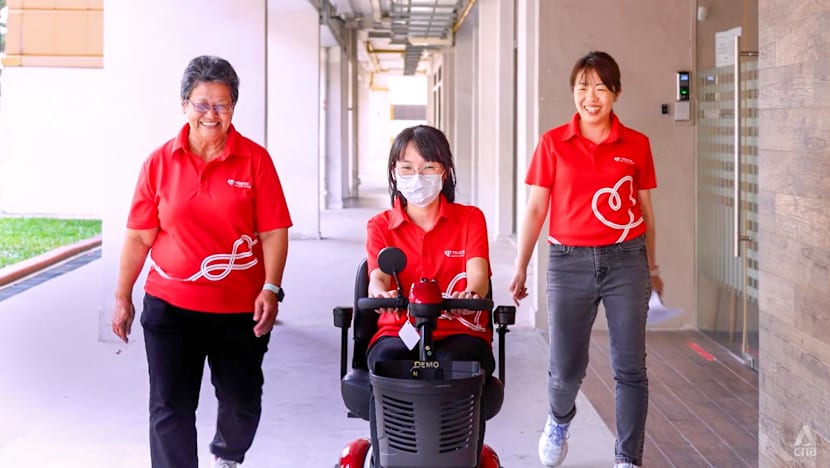 Rachel Lim (right) and members of her team testing a mobility scooter.
Lim, who is also the non-profit organisation’s head of therapy, spoke of her joy, too, in working with like-minded folks with the same mission.
“We get to work with people from all walks of life. We get to build teams,” she said, “(and) improve their capability to serve others.”
Siti Adriana Muhamad Rasip is another who loves building rapport with people. Until recently she was the deputy executive director at the South Central Community Family Service Centre, where she started Kitchen Connections, a community initiative connecting residents through cooking.
“We don’t only see (community) members as recipients of support but also contributors,” said the 32-year-old, who is also co-founder of the Empowered Families Initiative, which invests in low-income families.
“Social service, I think, is far from boring,” Adriana added. “As long as you have the heart, and you have the interest and the passion, there’s a lot for you to contribute.
“You don’t have to start with something big. You can just start off with very small steps, like volunteering for a cause that you’re passionate (about) and slowly inch (your way) into the sector.”
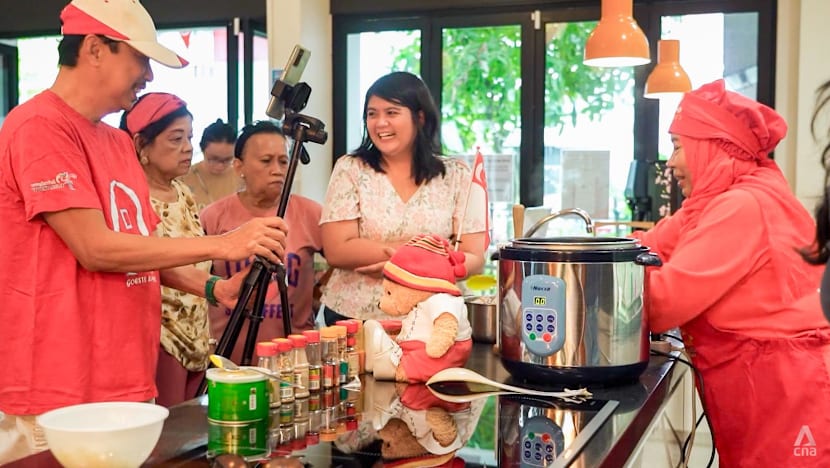 Siti Adriana Muhamad Rasip (second from right) sharing a light-hearted moment with residents during a Kitchen Connections session.
2. THEY CAN SHAPE OPPORTUNITIES FOR THEIR CAREER
The social service sector also offers pathways for growth. Professionals can specialise, move into management, build expertise in multiple settings and help to shape services from the ground up.
Tan Sze Ying, 36, a senior clinical psychologist from the Singapore Association for Mental Health (SAMH), grew with the Sun Ray scheme, a National Council of Social Service (NCSS) leadership programme for professionals to rotate around agencies and gain exposure.
She was placed in a family service centre, then the Community Psychology Hub — a unit sited within the charity, SG Enable — and now the SAMH, where she supervises clinical psychologists and contributes to sector learning through research.
She recently presented her team’s findings related to youth mental health at the Singapore Mental Health Conference, one of many platforms where practitioners share lessons from the field with others.
WATCH: Misconceptions about social service careers — Millennials and Gen Z debunk common myths (9:08)
“Growth doesn’t just mean promotions,” said Tan, who has been in social service for about 10 years. She thinks the opportunity to continue improving her skill set and to “help mentor (others) along the way” are equally as valuable.
Ng Shou Jin’s career path also shows how potential is nurtured in the sector. As a former music teacher, she met students facing complex challenges who sparked her interest in the social service sector.
“(My students) taught me about the importance of human connection and how we need to look past people’s behaviours and circumstances to see them as unique individuals with their own strengths and passions,” said the 32-year-old.
With no formal social work background, she drew on her communication and people skills, progressing from trainee to volunteer manager at New Hope Community Services in two years.
She was selected last year for the NCSS’ 40-Under-40 programme, which grooms future sector leaders, and is pursuing a part-time master’s degree in social innovation at the University of Cambridge with her current organisation’s support.
“I’ve learnt many different things, from event management to connecting and networking with people at a deeper level, to … strategic planning for the organisation,” said Ng, the senior manager for impact and service innovation at HCSA Community Services.
3. THEY FOUND VARIED ROLES AND A SUPPORTIVE WORK CULTURE
Some people working in social service stay on in the sector precisely because it offers a range of roles to suit those with different needs at various points in their careers.
This was of crucial importance for Chloe Khaw, who spent three years as a social worker at Care Corner Singapore, where her husband, Joshua Khoo, is also a social worker.
WATCH: Life as a couple in social service — How we make it work (10:12)
“The emotional space that we needed after work … was very important,” said Khoo. “If both of us needed that, how to create enough space (for our marriage)?”
So his wife moved into human resources at the non-profit organisation. This is one of more than 30 roles available in the sector, from social work to counselling to corporate support.
The move gave her more predictable hours and family time, which is especially helpful now that they have a baby. “(Otherwise), I’d also have to work nights sometimes,” she said.
Today, as an assistant manager (people and organisation development), she focuses on improving workplace well-being by ensuring that staff are holistically cared for so they can be at their best when they take care of their clients.
Behind The Work: Life In Social Service — Watch Episode 1 below
An introduction to Singapore’s social work ecosystem, following multiple practitioners through daily casework while establishing initiatives beyond frontline duties.
“Being in the social service sector doesn’t only mean that you’re a social worker,” Khaw said. “There are so many different social service professionals at the back end who make an equal amount of contribution.”
Indeed, many people enter social service because of its meaningful work. But it “can be emotionally draining”, noted Tan. “The unintentional mindset is: ‘I want, and I need, to save everybody.’”
So it helps when there is a supportive work culture.
At Fei Yue Community Services’ child protection specialist centre, Heart@Fei Yue, assistant senior social worker Sabrina Ang regularly conducts case reviews to help younger staff build confidence and competence in handling cases.
“Supervision is super important,” said the 29-year-old. “When risk is involved (and) young children are involved, I think we’re very careful.”
Behind The Work: Life In Social Service — Watch Episode 2 below
We see emerging initiatives and professional growth, as social service professionals balance new programmes, leadership roles and ambitions with ongoing case pressures.
It is part of a culture of mutual care she treasures. “(Our team is) very close, and that’s the biggest strength,” Ang added.
“The management does encourage everyone to know that you aren’t handling your cases alone. It’s always about team spirit.”
Singapore Muslim Women’s Association (PPIS) social worker Zunairah Seron, who provides counselling support to families, shared that her supervisors ensure work-life balance. “Mental health support (is) available for us if we need it,” she added.
Nishani, meanwhile, has sometimes worked extra hours but has been allowed to take time off as a result. “Employers play a very big part in making the journey worthwhile,” she emphasised.
Intervention on their part is also important when emotional fatigue does creep in. Vimel Rajoo, the director of Shine Children and Youth Services’ corporate services and development group, recalled a former boss encouraging him once to “learn to say no”.
Behind The Work: Life In Social Service — Watch Episode 3 below
We conclude with the outcomes of their goals, revealing impact, setbacks and growth as social service professionals reflect on change, resilience and purpose in their work.
“As much as we want to help our client, there’s only this much that we can do because we’re human ourselves,” he said.
“We need to have time (to) recharge, refocus, realign and come back to you in a better state so that we can problem-solve together.”
Find out more about the Social Service Tribe and discover key roles in the social service sector.