 2 months ago
68
2 months ago
68
SINGAPORE: Ask Mr Vareck Ng what good design is, and he will point to a chair. No instruction manual. No second-guessing. You just sit down, and it works.
Likewise, good wayfinding signs in a transport system should guide commuters intuitively.
“Imagine if things in the city are so seamless that it is as easy as sitting down on this chair," he said. "That would be fantastic. And that, to me, is what good design is about.”
The 23-year-old has spent the past few years applying that philosophy to Singapore's public transport system – by designing and installing his own wayfinding signs in places where he believes the official ones fall short.
He calls himself Singapore's "guerrilla wayfinder".
His journey into unsanctioned signage began with frustration at Orchard MRT station. When the Land Transport Authority (LTA) introduced its new transit signs for the Thomson-East Coast Line, exits were labelled with numbers instead of letters and landmarks. Finding his way to Lucky Plaza became an exercise in confusion.
“There are certain points which are a bit too vague or unclear. And I know that these things can be made better,” he said.
Singapore regularly ranks among the world's best for public transportation infrastructure. Yet Mr Ng argues that top-down planning, however effective at delivering large-scale projects, inevitably misses the gaps that everyday users encounter.
He used to complain about such issues online.
“Then I realised that I actually have the power to change things in my community. I feel empowered by seeing other people doing the same,” he said.
THE FIRST BIG PROJECT
He began with small projects, such as putting up signs along the Lorong Halus park connector, where directions between Pasir Ris and Punggol were unclear.
A bigger project presented itself when Mr Ng was pursuing a diploma at Nanyang Technological University (NTU) in 2024. He noticed that campus bus stops lacked signs showing which buses stopped where.
"As a freshman, I saw it as stepping into a restaurant and having no menu at the start," he said. "So I went to the wrong bus stops, and then just to see the bus fly by the bus stops, especially when it's late at night."
Frustrated, he decided to take matters into his own hands.
Mr Ng spent three to four months designing new signs, tweaking them based on feedback from students at bus stops. He took inspiration from the Circle Line map and icons used in Kuala Lumpur's transport system.
When the last bus departed, he would cycle around campus in the early hours of the morning to put up the signs.
Some signs lasted less than a day. Others remained for months. Whenever one came down, he put up another.
Eventually, Mr Ng approached NTU directly. A university spokesperson confirmed that the school engaged with him several times to discuss his proposals.
"All campus installations must meet safety and infrastructure requirements, and his ideas were considered within these guidelines," the spokesperson said.
Ultimately, the proposals were dropped and he was told students could simply use Google Maps. After Mr Ng graduated, however, the school reached out again – although by then he was working as a music teacher and no longer had the capacity to take on the project.
"But if I were a student and the school was receptive to it, I'd be super happy to just make the signs for them," he said.
“YOU GOT PERMISSION?”
Mr Ng went on to make wayfinding signs for the public, starting with Marine Parade MRT station.
There, two bus stops had the same bus stop number, with no clear indication of which buses stopped where. So, he made and installed signs.
Going from putting up signs on campus to the public space was “scary”, he said.
“You're doing it in public view, you can get into trouble for a lot of things. Particularly, you can get caned for vandalism. That is one thing I'm very well aware of,” he said.
In Singapore, vandalism carries a fine of up to S$2,000 (US$1,540) or imprisonment up to three years, and three to eight strokes of the cane.
“But at the same time, I was asking myself: what are my morals and what am I doing this for? What are my values? And for me, if it's to serve the public better, then I'll just do them.”
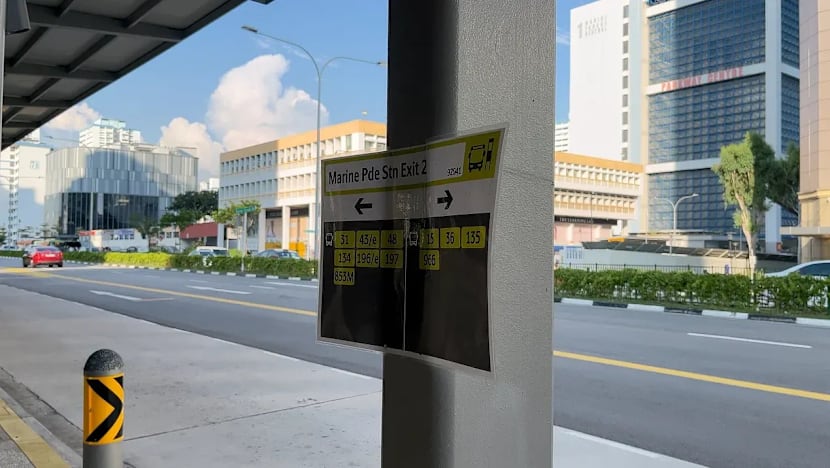 The sign put up by Vareck at Marine Parade MRT station. (Photo: Vareck Ng)
He estimates he has completed at least 10 wayfinding projects, although he has "lost count".
People often ask: “You got permission?”
Mr Ng smiled and said: “I usually put up the signs first. If they benefit commuters, then they usually stay. So I'm quite happy with that way of working.”
He doesn't track which signs remain.
"Usually I just put it up, take a photo and say: 'Okay, this is my gift to commuters along the way', and I just hop on the next bus and carry on with my journey."
A LOVE FOR TRANSPORT
Mr Ng, a percussionist by training, has no formal training in graphic design. But he grew up in a family of artists – both his parents work in the arts and his younger sister is pursuing a diploma in communication design.
While his interest in wayfinding signs only started a few years back, his love for the transport system goes way back.
When he was just three, he would spend car rides quietly observing the streets outside, said his mother, Mdm Karyn Lee, 54.
“Being in the car, he wouldn't want to choose the nursery booklet … he’d be flipping the street directory,” said the art therapist. “By five and six, he was very familiar with all the roads in Tampines.”
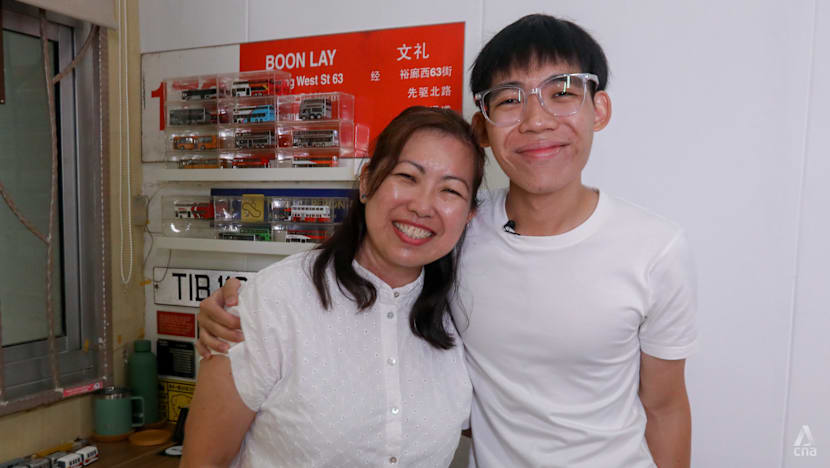 Vareck Ng and his mother, Karyn Lee, on Nov 18, 2025. (Photo: CNA/Mak Jia Kee)
His room is filled with transport-themed items: self-designed postcards, handmade bus models and transportation signs collected from Singapore and abroad.
He has no ride-hailing apps on his phone, and they have long sold their family car, his mother said.
“When I'm curious about something, I just want to deep dive into it, find out more. And then I fell into the transportation rabbit hole a bit too deeply, so now it's a bit hard to reverse out of it, but here I am,” he said.
SEEDING A MOVEMENT
Despite his passion for transport, Mr Ng is unsure if wayfinding design will ever become a full-time job.
“If the opportunity comes, I would love to work on it to help people with wayfinding. Of course, there are a thousand and one things that I love to do, and the main constraint is time.”
Outside of transport, he enjoys long runs, cycles frequently and plays at least a dozen instruments.
He is also active on social media, under the handle Tehsiewdai, where he advocates for better transport systems and posts about his wayfinding journey.
He has received "nasty" comments and messages, he said. The criticism was especially difficult early on, when he was unaware of others doing similar work.
"I've been doing things that have been out of the safe and proven path for so many years. So it is a lonely journey. It is a tough journey, but I would say it's a very fulfilling journey."
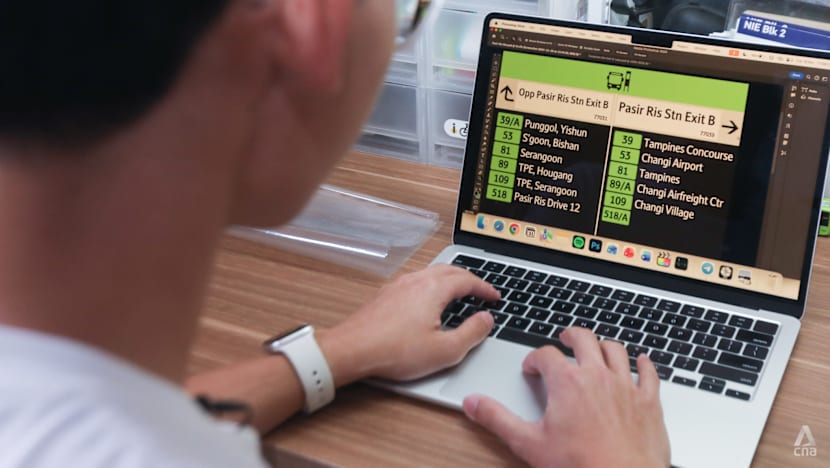 Mr Ng working on a wayfinding sign in his room on Nov 18, 2025. (Photo: CNA/Mak Jia Kee)
For now, his wayfinding work continues.
Already, he has seen more signs being put up by other members of the public. The Marine Parade sign he installed has since been replaced with an official one.
But the impact, he said, is not about how many signs stay up. Instead, it is like “planting a seed into the soil”.
"You won't see the effects on day one, but you might see it maybe one year down the road, 10 years down the road," he said. "If more people get involved in the community – wayfinding or not – I think it's a net positive to everyone."