 2 months ago
72
2 months ago
72
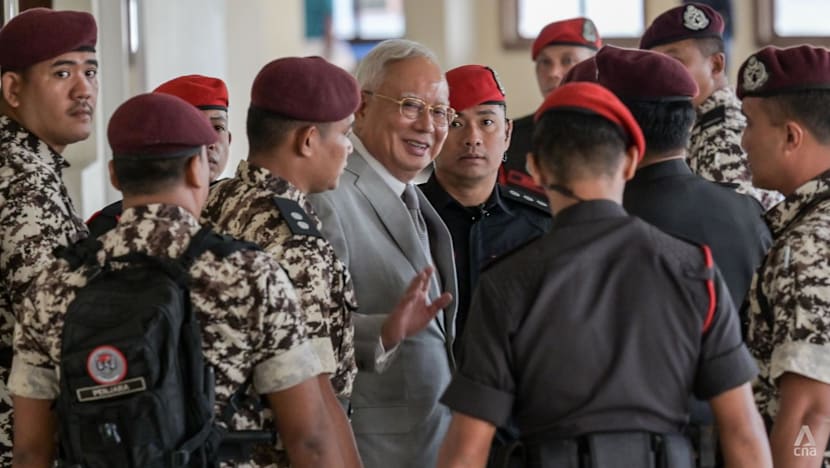
Former prime minister Najib Razak arrives at the Kuala Lumpur Courts Complex ahead of his scheduled court case on Dec 22, 2025. (Photo: CNA/Fadza Ishak)
New: You can now listen to articles.

This audio is generated by an AI tool.
PUTRAJAYA: Former Malaysia prime minister Najib Razak was on Friday (Dec 26) found guilty of abusing his power by the Kuala Lumpur High Court in his long-running 1Malaysia Development Berhad (1MDB) case.
Najib – who was prime minister from 2009 to 2018 - was charged with four counts of abuse of power and 21 counts of money laundering involving RM2.2 billion (US$544.6 million) allegedly misappropriated from the state investment fund.
The alleged offences were committed between 2011 and 2014.
The judge had yet to deliver the full verdict and sentencing.
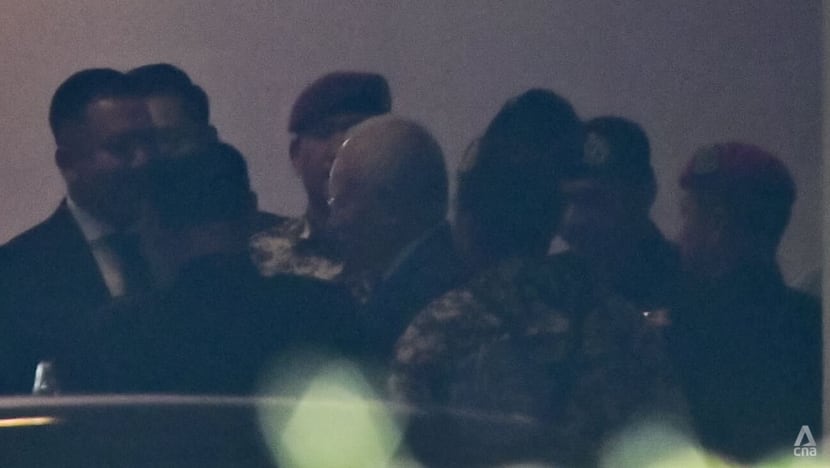 Former Malaysia prime minister Najib Razak was seen leaving through a tunnel at the Putrajaya court in a vehicle after proceedings adjourned at noon on Dec 26, 2025. (Photo: CNA/Fadza Ishak)
Judge Collin Lawrence Sequerah delivered his decision on the first four charges of abuse of power on Friday afternoon, and was still reading out his judgment on the money laundering charges.
"The contention by the accused that the charges against him were a witch hunt and politically motivated were debunked by the cold, hard and incontrovertible evidence that pointed towards the accused having abused his all-powerful position in 1MDB, coupled with the extensive powers conferred upon him," said Sequerah.
This comes just four days after the court had rejected the former premier’s bid to serve the remainder of his prison sentence for a different case under house arrest. Friday’s decision by Sequerah came after a trial that had stretched across 302 days over a period of six years.
The 72-year-old Najib is currently serving a six-year prison sentence in Selangor’s Kajang Prison for the first set of abuse of power and money laundering charges linked to 1MDB.
On Friday, Najib arrived in a silver sport utility vehicle at around 8.25am to the chants of “Hidup Bossku” - or “Long Live, Bossku” - from over 30 supporters who were present at the Palace of Justice amid tight security. Bossku is the moniker given to Najib by his supporters.
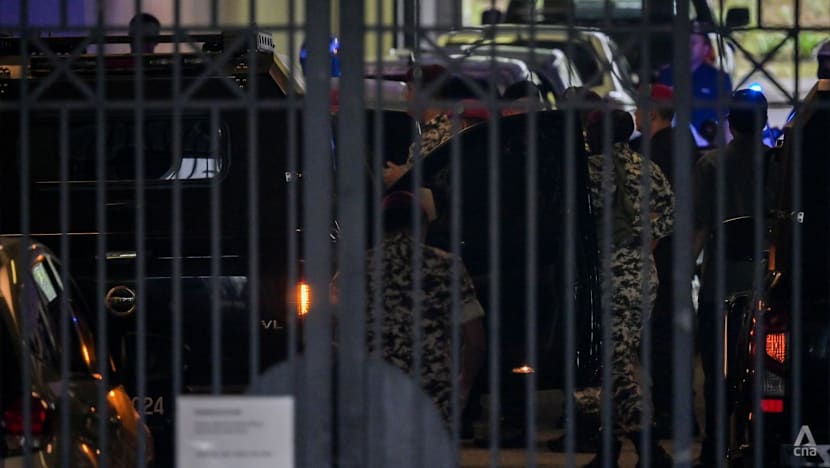 A motorcade and security officials escorting former prime minister Najib Razak were seen arriving at the Palace of Justice in Putrajaya on Dec 26, 2025. (Photo: CNA/Fadza Ishak)
MORNING SESSION IN COURT
Sequerah - who has since been elevated as a Federal Court judge - began reading his judgment at around 9.15am. He told the court that he will be reading only the broad grounds of judgment.
The judge started the morning session by rejecting the defence’s argument that the prosecution’s case was faulty.
In particular, he dismissed the defence’s claims that the Malaysian Anti-Corruption Commission had failed to “show genuine efforts” to trace Jho Low, seen as the mastermind behind the scheme to plunder the country's investment vehicle.
“There is little doubt as to the well-known public fact made available to the wider media, both nationally and internationally, that Jho Low has yet to be brought before the relevant and appropriate courts in this country and abroad, to face the demands of justice,” Sequerah said.
“To ignore this fact would be akin to a hermit living as a recluse in the far-most corners of the globe and in an inner and dark cave unreached by the outside world. I therefore see no reason to depart from my earlier findings that Jho Low is a person who cannot be found.”
Najib has repeatedly said he was misled by 1MDB officials and fugitive financier Low, who has been charged in the United States for his central role in the case. Low, whose whereabouts are unknown, has denied wrongdoing.
But Sequerah described Low as close to Najib - he detailed their yacht holidays together - and an adviser who directed 1MDB dealings on the former premier’s behalf.
“All these pieces of evidence, outlined as above and taken cumulatively, cannot be described in any other manner except that it revealed an unmistakable bond and connection between the accused and Jho Low,” he said.
Sequerah added: "The evidence clearly points to the fact that this was no coincidence, but was evident of a relationship in which Jhow Low operated as a proxy or agent of the accused, with regard to the running of the affairs of 1MDB."
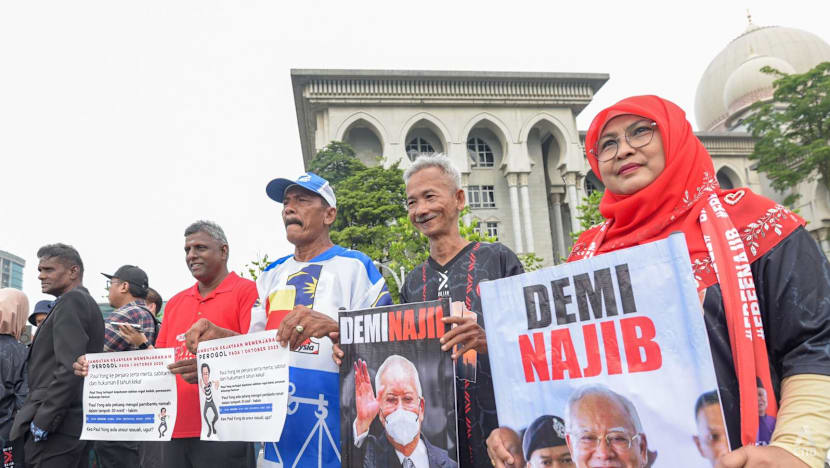 Supporters of former Malaysia prime minister Najib Razak is seen here holding placards at the Palace of Justice, Putrajaya on Dec 26, 2025. (Photo: CNA/Fadza Ishak)
The judge then went over the defence’s case, zeroing in on what he called the “Arab donation defence” - that the money Najib received in his accounts was purportedly a political donation from Saudi royalty.
The judge dismissed letters produced by Najib allegedly originating from the Saudi royal family on the donations, saying they were not corroborated by other documentary evidence and were probably forgeries.
It was reported that Najib had received around US$680 million in his personal bank account.
“The fact that the accused’s explanation vacillated between attributing the funds as coming directly from (former Saudi) King Abdullah to later attributing them as emanating from the royal family, in general, does not further the cause of the defence with regard to the legitimacy of the funds,” he said.
“The evidence, when taken cumulatively, cannot but tend to the conclusion that the four Arab letters were, in fact, forgeries.”
Sequerah said there was no “credible, contemporaneous or reliable documentary evidence” that directly connected the large sums deposited into Najib’s personal accounts to King Abdullah or any member of the Saudi royal family.
“It defies reasonable belief that, given the colossal amount remitted into the account of the accused in the form of political donations, that there was no evidence of proper and transparent accounting, taking into account the political party which was headed by the accused at the time was not some fly-by-night rookie political entity, but a party - UMNO - that was at the time Malaysia's largest political party, having its roots established as far back as 1946,” he said.
When Najib was prime minister, he was president of the United Malays National Organisation (UMNO), the Barisan Nasional (BN) lynchpin party he still holds considerable sway over. BN is now part of current premier Anwar Ibrahim’s unity government.
Sequerah adjourned the court at 12.15pm for a lunch break and Friday prayers. Court then resumed at 3pm.
Najib was first charged on Sept 20, 2018, and his trial began on Aug 28, 2019.
In October last year, the court ruled that the prosecution had established a prima facie case against Najib and ordered for him to enter his defence. The defence then began its case on Dec 2, 2024 with Najib himself taking the stand in his defence.
The corruption trial ended only in mid-November this year.
Najib’s lawyers had argued that monies that flowed into Najib’s bank accounts were donations he had received from Saudi Arabia and were not funds obtained through illegal means.
But the prosecution highlighted that the funds were deposited into Najib's personal accounts subsequent to major 1MDB transactions.
Each abuse of power charge carries a sentence of up to 20 years’ imprisonment and a fine of either five times the amount of the bribe or RM10,000, whichever is higher.
Each money laundering offence carries up to five years’ imprisonment and a fine of up to RM5 million.
If either side files an appeal, the execution of the court ruling could be delayed pending the outcome of the appeal.
On Monday, the Kuala Lumpur High Court had rejected Naib’s bid to serve the remainder of his prison sentence for his SRC International case conviction under house arrest. The charges involved the transfer of RM42 million from SRC International - a former 1MDB subsidiary - into his personal bank accounts in 2014 and 2015.
Justice Alice Loke’s decision marks the latest development in Najib’s legal bid for house arrest that began in April 2024. The defence has indicated it will file an appeal.
Najib’s lead counsel Shafee Abdullah also said that Najib could seek a fresh pardon from Malaysia’s current King, Sultan Ibrahim Iskandar. Shafee had also claimed that Monday’s decision may have taken away the Malay Rulers’ full discretion of pardon and clemency.
“Today’s decision has taken away the fullest prerogative of mercy of not only the (King) but the Malay Rulers and governors,” he told reporters.
Malaysia’s Attorney General’s Chambers has since rebutted Shafee’s claims.
The claim is “not true at all and does not reflect the actual grounds given by the High Court”, the AGC said in a statement on Tuesday.
The AGC said the High Court ruling on Monday had reaffirmed the power of pardon is a prerogative of the king, as guaranteed under Article 42 of the federal constitution.
It also warned against attempts to incite or disrupt public order through misleading interpretations of the court's judgment, reported news outlet New Straits Times.
The AGC said it is committed to defending the royal institution and upholding the constitution.
This is a developing story. Refresh for updates.