 2 months ago
103
2 months ago
103
The danger of an unstable Bangladesh should not be underestimated, says former foreign correspondent Nirmal Ghosh.
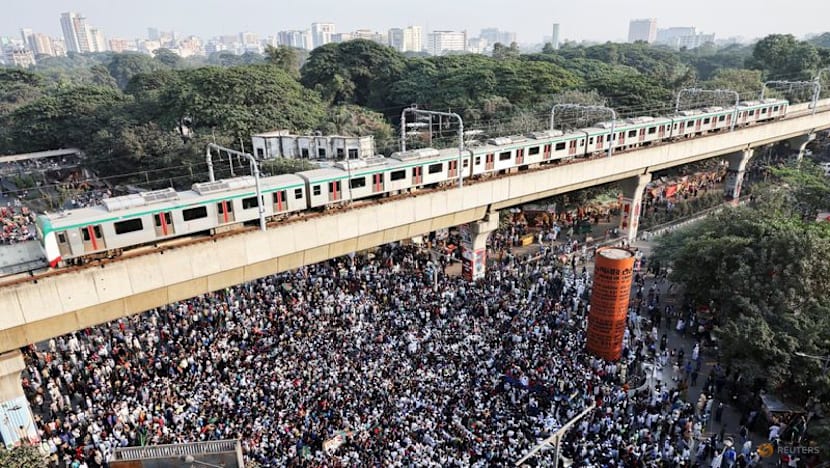
Supporters block the Shahbagh Square as they protest, demanding justice for the death of Sharif Osman Hadi, a student leader who had been undergoing treatment in Singapore after being shot in the head, in Dhaka, Bangladesh December 19, 2025. (Reuters/Mohammad Ponir Hossain)
New: You can now listen to articles.

This audio is generated by an AI tool.

SINGAPORE: Bangladesh is scheduled to hold a general election on Feb 12, 2026 – about a year and a half after the deadly clashes that led to the fall of then Prime Minister Sheikh Hasina – with hopes for some political stability.
But tensions are running high again in the wake of the targeted assassination in Dhaka of 32-year-old Sharif Osman Hadi, a prominent leader of the 2024 student uprising that drove Hasina from power. Hadi, who was airlifted to a hospital in Singapore, died six days later on Dec 18.
Politics in Bangladesh has often been violent; this election will be no different.
With Islamist political groups becoming more vocal and an anti-India wave intensifying, the concern now is what Bangladesh could well morph into.
The outcome will reverberate across the region, defining not just bilateral relations between Bangladesh and India, but broader geopolitics in South Asia and with China.
INDIA-BANGLADESH BREAKDOWN NOW DEFINES THE CRISIS
The India-Bangladesh relationship has been the biggest casualty in post-Hasina turmoil.
It plunged particularly dramatically on the afternoon of Aug 5, 2024 when the embattled Hasina resigned and fled to India. She is very unlikely to be extradited to Bangladesh, where she was sentenced to death in November for her crackdown on student protestors that killed hundreds.
To make things worse now, mobs are blaming Hadi’s killing on India and intensified their violence with arson attacks on major newspapers accused of being pro-India. A Hindu man was lynched. Another prominent student leader Motaleb Sikder was shot in the head on Dec 22.
But the breakdown with India has been long in the making. Persistent narratives in Bangladesh and India have downplayed the other’s role in Bangladesh’s independence: India believes Bangladesh has not been sufficiently grateful, and Bangladesh resents India’s condescension.
In the past year, India has also undertaken forced deportations of allegedly illegal Bangladeshi immigrants, which critics have called out for lack of due process.
Since the fall of Hasina and her Awami League party, some Bangladeshi politicians have been ramping up anti-Indian rhetoric. Both countries have put out acrimonious diplomatic notes. Vestiges of secular or Hindu Indian and even Bengali culture have been attacked and trashed.
This current wave of anti-India sentiment is provoking backlash in almost equal measure in India, completing the shredding of the relationship.
TIES WITH CHINA, PAKISTAN ARE UNSETTLING FOR INDIA
While ties with India cool, Bangladesh seems to be warming up to China and Pakistan.
This has fed growing concern that India may have miscalculated by backing Hasina and Awami League over the decades. It contributed to resentment of India among those that opposed her increasingly authoritarian rule.
Bangladesh’s interim leader Muhammad Yunus’ trip to China in March may have been intended to rebalance Bangladesh from the Hasina regime’s pro-India tilt, but it also seemed to signal a closer chapter in Dhaka-Beijing relations.
During this trip, China, already Bangladesh’s largest trading partner, committed US$2.1 billion in loans, investments and grants to Bangladesh. This was followed in June by a trilateral meeting in Kunming between the foreign secretaries of Bangladesh and Pakistan and China’s vice-minister for foreign affairs.
The new Bangladesh that is emerging is also much closer to India’s erstwhile foe Pakistan than the Bangladesh of Sheikh Hasina and her Awami League party.
In November, a Pakistani naval ship anchored off Bangladesh's Chattogram on a four-day goodwill visit. It was the first since 1971, when Pakistan’s army came with a very different mission – to crush political dissent in what was then East Pakistan.
Yet Hasina had been a stabiliser in a hostile environment, keeping radical Islam at bay, maintaining civil-military balance, protecting minorities, and keeping Bangladesh economically and geopolitically predictable.
Years of suppressed grievances and internal tension have been building up since Bangladesh’s founding in 1971, between secularists and religious conservatives and between the civil state and the military and security agencies.
With the Awami League now suppressed, the Bangladesh Nationalist Party (BNP) is widely expected to win enough of a mandate to form and lead a government after the February election. BNP leader Tarique Rahman, eldest son of former Prime Minister Khaleda Zia, could emerge as the next prime minister.
The hardline religious party Jamaat-e-Islami Bangladesh (JIB), once banned by Hasina, is seen to have grown in strength since her fall, and will also need to be accommodated. How well the JIB does in the election, will indicate the direction in which Bangladesh is heading.
It would also show the nature and scale of the challenge the BNP, if it comes to power, would face in steering a middle course both internally and internationally.
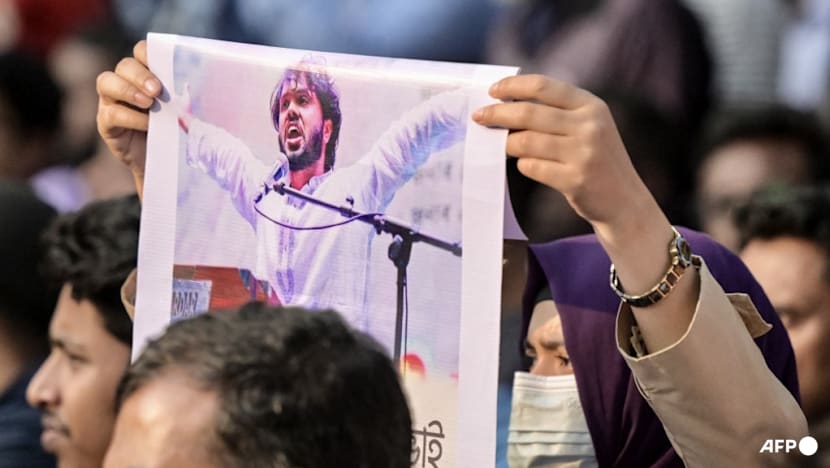 An activist holds a poster of Sharif Osman Hadi, senior leader of the student protest group Inqilab Mancha, who was shot outside a mosque, during a demonstration to condemn the attack in Dhaka on Dec 15, 2025. (File photo: AFP/Munir Uz Zaman)
GEOGRAPHY LEAVES LITTLE CHOICE
But neither India nor Bangladesh can escape geography and the geopolitical reality of requiring a stable neighbourhood: Bangladesh is virtually encircled by India with a 4,000-km border, except for a short 271km stretch shared with Myanmar (which has its own problems with the latter’s persecution of the Muslim Rohingya, millions of whom remain in camps in Bangladesh).
India’s northeast is distant from New Delhi both culturally and geographically, vulnerable to interference from groups in Myanmar, and claimed in part by China.
India's challenge is that developing the potential of its northeast as a bridge to mainland Southeast Asia, requires a stable Bangladesh.
Bangladeshi politician Hasnat Abdullah, a leader of the newly formed National Citizen Party (NCP), warned at a rally in Dhaka last week that if Bangladesh is destabilised, “the fire of resistance will spread beyond borders”, threatening to give refuge to separatists of India’s northeast states.
This did not go down well in New Delhi. Indian analysts worry that the rift with Bangladesh is vulnerable to exploitation by China and Pakistan.
India’s response in this moment must be based on “calibrated and principled engagement that is both legally sound and strategically farsighted,” wrote Harsh Vardhan Shringla, a former Indian Ambassador to Thailand, Bangladesh and the United States, and now a nominated Member of India’s upper house, last week in a Delhi-based newspaper.
Dr Aparna Pande, a senior fellow at the Hudson Institute in Washington DC who focuses on India and South Asia, told me: “At the end of the day, once the elections happen, India will talk to whichever government it is – because India cannot afford to have a Bangladesh which is adrift forever and goes to China.”
In the run-up to the election, the violence may well get worse.
But the crisis also offers a larger lesson in an increasingly fragile regional order, which in recent months has seen two cross border conflicts (India and Pakistan, Thailand and Cambodia) and a continuing, long running civil war (in Myanmar). The danger of an unstable Bangladesh should not be underestimated, both for its own people and also for the wider region.
Nirmal Ghosh, a former foreign correspondent, is an author and independent writer based in Singapore.