 3 months ago
133
3 months ago
133
This will be the last visible total lunar eclipse worldwide until Dec 31, 2028.
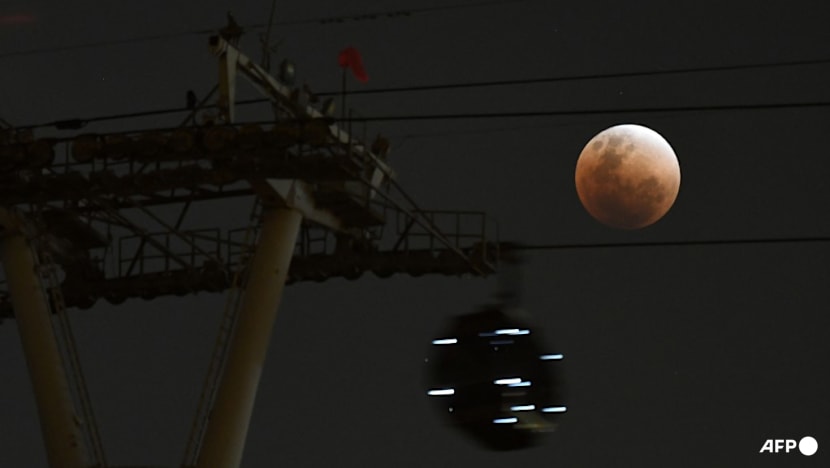
A cable car gondola moves past as the moon is seen during a lunar eclipse, referred to as the "super blue blood moon", in Singapore on Jan 31, 2018. (File photo: AFP/Roslan Rahman)
New: You can now listen to articles.

This audio is generated by an AI tool.

SINGAPORE: A red moon is expected to rise over Singapore on Mar 3, with a total lunar eclipse set to occur.
Such eclipses happen when the Moon is plunged fully into the dimmest core of Earth’s shadow. This causes it to take on a red or orange glow as the Earth’s atmosphere scatters away shorter wavelengths, like blue, letting longer and warmer tones slip through.
“The celestial event on Mar 3 will be a total lunar eclipse,” said The Observatory at Science Centre Singapore on Friday (Feb 6).
This coincides with the 15th day of Chinese New Year and marks the last visible total lunar eclipse worldwide until Dec 31, 2028, it said in a press release.
The centre will hold a special viewing event for the eclipse. It will include expert-hosted sky viewing sessions with high-powered telescopes, planetarium shows explaining the lunar eclipse and family-friendly activities.
“Our astronomy educators will guide you through this spectacular event as the moon takes on a rich, reddish hue,” said Science Centre.
Entry to the viewing event is free and on a first-come, first-served basis. Participants can pre-register from Feb 20, while onsite registration will also be available on Mar 3 from 6pm at the centre’s main entrance.
“Fifteen telescopes will be available for guests to view the eclipse at 30x magnification, with additional telescopes set up progressively as the Moon rises,” said Science Centre.
The telescope viewings will be available on a first-come, first-served basis, it added.
“For safety and logistical reasons, only the provided telescopes may be used during the session,” said the centre. Guests are not allowed to bring their personal telescopes to the event.
Attendees can also expect live screens along the queue lines, projecting the eclipse with commentary from the centre’s educators.
“For those unable to attend, a livestream of the eclipse will be available on the Science Centre’s YouTube channel,” said the centre.
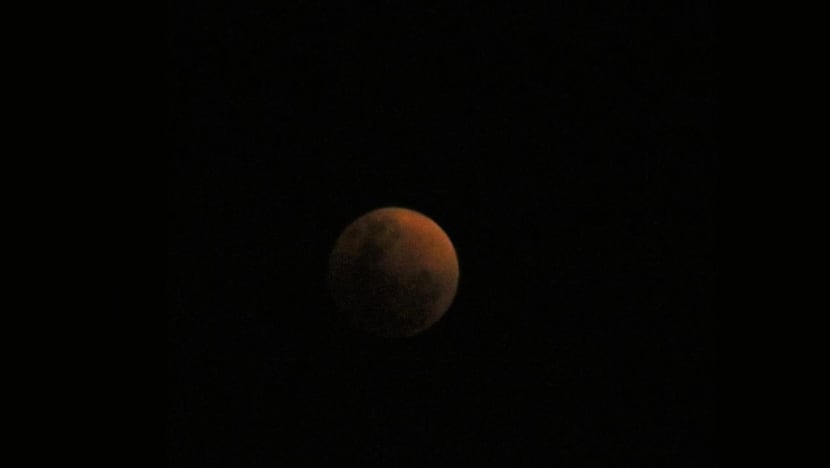 A picture of a total lunar eclipse in Singapore in 2018. (File photo: Facebook/SCOB - Science Centre Observatory)
A special bundle priced at S$4 (US$3) per person will also be available. It will include telescope viewing and a live planetarium show at Science Centre’s Omni-Theatre. The shows are at 5pm, 5.40pm, 8.10pm, and 8.50pm.
"The night sky offers additional wonders with bright constellations including Taurus, Orion, Canis Major, and Gemini," said Science Centre.
"Jupiter will be visible until late evening, while Saturn can be seen in the western sky until midnight."
WHAT TO EXPECT
The eclipse will occur from moonrise at 7.15pm till 9.17pm, when its partial phase ends, said Science Centre.
“The best viewing window from the Science Centre would be 7.47pm onwards,” it said.
Timeline for the eclipse
- 7.15pm: Moonrise
- 7.33pm: Maximum eclipse. The Moon will be very low, and one will need a clear horizon, unobstructed by trees and buildings, to see it rising.
- 7.47pm: The fully eclipsed moon will be visible from Science Centre Singapore until 8.02pm.
- From 8.02pm: The moon will slip out of Earth's inner red shadow, and it will get gradually brighter.
- 9:17pm: The Moon will be in the outer part of the Earth's shadow and be fully visible.
Collapse Expand
During the eclipse, the Earth moves directly between the Sun and the Moon during the full moon phase, and its shadow will steadily cover the Moon’s surface.
The Moon’s brightness will dim before taking on a reddish hue. The dustier the air, the redder the Moon’s makeover, said Science Centre.
“From Singapore, we might be able to see the Moon only when it reaches maximum eclipse or later,” it said.
“We will see a red moon rising from our horizon and it will get brighter as it moves out of Earth’s umbra (innermost shadow) gradually.”
The phenomena will be visible to the naked eye, but binoculars or telescopes can enhance the experience, it said.
Observers to seek darker locations, ideally with an unobstructed view of the eastern horizon, it advised.
“Singapore’s weather conditions and frequent cloud cover can also affect visibility of this occurrence. As such, observers should also check the weather forecast for clear skies.”
Total lunar eclipses happen once every three to four years, and different parts of the world might see different phases of the eclipses.