 3 months ago
130
3 months ago
130
JAKARTA: Indonesia may withdraw from the Board of Peace led by United States President Donald Trump if goals such as advancing Palestinian independence are not met, said its foreign minister Sugiono.
Speaking to reporters on Tuesday (Feb 3), Sugiono said that President Prabowo Subianto is leaving open the option of withdrawal if the board’s direction “did not align” with Indonesia’s priorities.
“If it does not match what we want: First, peace in Gaza in the immediate term; then peace in Palestine more broadly, and ultimately Palestinian independence and sovereignty,” Sugiono told state news agency Antara after accompanying Prabowo to a meeting with more than 40 Islamic leaders and representatives from Islamic organisations.
During the meeting at the Presidential Palace in Jakarta, Prabowo explained Indonesia’s rationale for joining the board and invited questions from clerics and scholars.
“Ultimately, (the main goal) is the independence and sovereignty of Palestine,” said Sugiono, who is also from Prabowo’s Gerindra party.
Organisations present at the meeting include Muhammadiyah, the Indonesian Ulema Council and Nahdlatul Ulama, according to Tempo.
Besides Sugiono, several cabinet members were also present, including State Secretary Prasetyo Hadi, Religious Affairs Minister Nasaruddin Umar, and Cabinet Secretary Teddy Indra Wijaya.
Sugiono also said the Board of Peace is not yet fully operational.
“We also don’t know where its office is and what its secretariat is like. It’s still in the process,” he said, as quoted by Tempo.
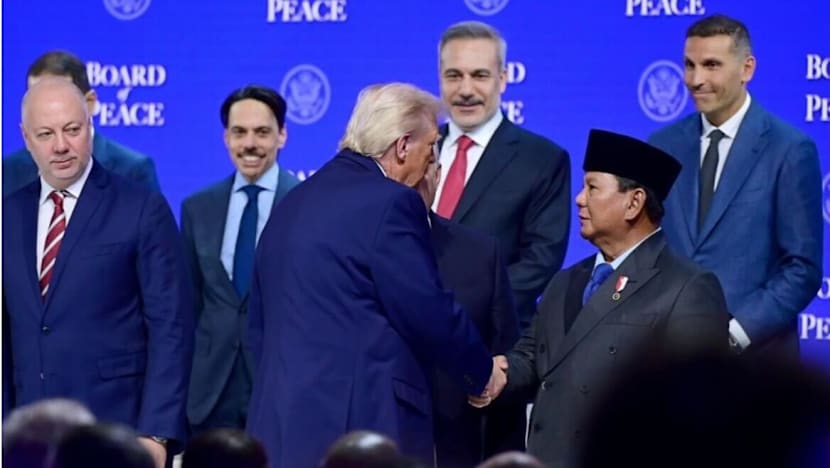 US President Donald Trump and Indonesia President Prabowo Subianto at the launch of the Board of Peace in Davos, Switzerland on Jan 22, 2026. (Photo: Instagram/@presidenrepublikindonesia)
The Board of Peace was initially established to ensure that post-conflict reconstruction in Gaza proceeds effectively.
However, a draft of its founding charter suggests the council’s future role will not be limited to the territory. The White House had said there would be a main board, a Palestinian committee of technocrats meant to govern devastated Gaza and a second "executive board" that appears designed to have a more advisory role.
Indonesia announced on Jan 22 it would accept an invitation to join the Board of Peace through a joint declaration by the foreign ministers of several Muslim-majority countries, namely Türkiye, Egypt, Jordan, Pakistan, Qatar, Saudi Arabia and the United Arab Emirates.
The move, although seen by some as a diplomatic opportunity for the country, has also sparked concerns among experts over foreign policy risks and potential domestic fallout – namely, the risk of being drawn into a pro-American orbit that prioritises the US president’s agenda.
Cholil Nafis, deputy chairman of the Indonesia Ulema Council, said Prabowo had reassured on Tuesday that Indonesia would not hesitate to distance itself from the Board of Peace if its actions diverged from the country’s principles.
”(He said) if we join the Board of Peace, we are not obliged to go along when they do not align with our views. Second, if no changes can be made, he (President Prabowo) is prepared to withdraw from the board,” Nafis told reporters, describing his understanding of Prabowo’s comments at the meeting.
Nafis added that he had expressed his scepticism about the initiative, cautioning against any potential deployment of Indonesian peacekeeping forces that could end up confronting Palestinians seeking independence.
“We do not want a false peace while the Palestinian people remain under occupation,” he was quoted as saying by Antara.
The Indonesian Ulema Council had previously urged the government to withdraw from the US-backed Board of Peace, saying that it does not side with Palestine.
The council had also criticised the requirement to pay membership fees to join the Board of Peace and accused the institution of promoting what it described as an “illusory peace” that fails to recognise Palestine as an occupied nation, Antara reported.
At another meeting with former foreign ministers on Wednesday, Prabowo clarified that Indonesia is not obligated to contribute the proposed US$1 billion contribution to the board.
“The US$1 billion refers to a reconstruction fund for Gaza and is not mandatory,” conveyed Cabinet Secretary Teddy, as quoted by Jakarta Globe.
“If a country pays, it becomes a permanent member, but if it does not, membership lasts for three years.”
Teddy added that Indonesia has not made any payment to the board to date, noting that participating countries are free to contribute or opt out.