 1 month ago
90
1 month ago
90
SINGAPORE: Temasek Holdings wants to more than double its exposure to artificial intelligence-related assets, the state investor said on Wednesday (Jul 8) as it announced its results for the financial year.
AI-focused investments currently make up 6 per cent of its entire portfolio, and the company plans to increase it to up to 15 per cent by the end of the financial year ending Mar 31, 2031.
Temasek said the rapid advancement of AI is a “pivotal phase” that will create vast new opportunities.
In a presentation of Temasek’s AI exposure, chief executive officer Dilhan Pillay said its portfolio currently includes several AI businesses, including Nvidia, TSMC, Anthropic, OpenAI, Microsoft and Tencent, among others.
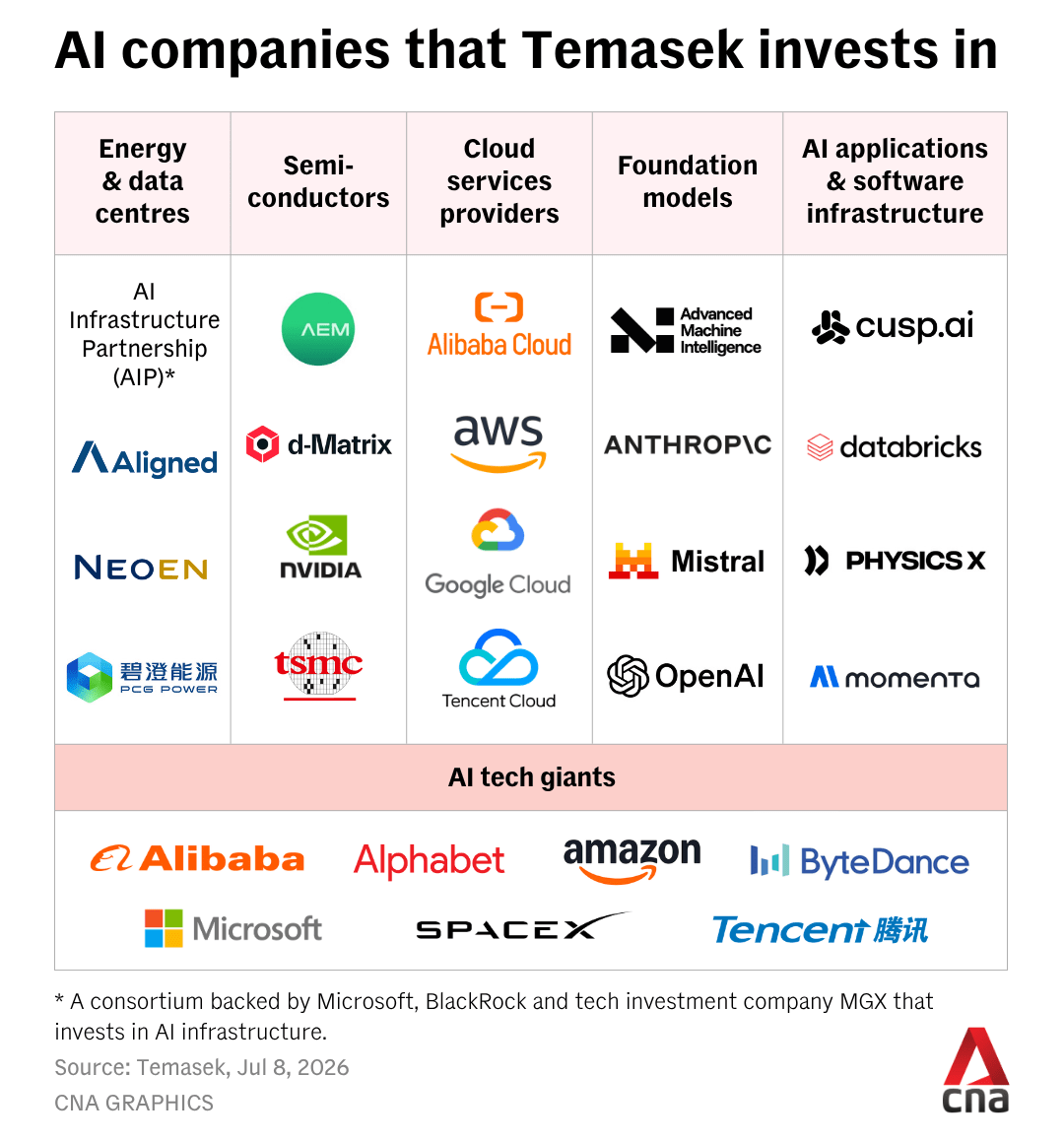
These existing investments can be categorised into five areas: energy and data centres, semiconductors, cloud services providers, foundational models and AI applications and software infrastructure, he said.
Temasek said it will focus on these areas when deploying more capital.
“Within these five areas, some companies are leaders in one area, and some are vertically integrated across multiple areas, creating a flywheel effect,” said Mr Pillay.
Companies such as Amazon, SpaceX and Alphabet operate as vertically integrated mega-caps, said the firm, which previously announced plans to triple its AI investments from US$25 billion presently to US$75 billion by 2030.
Mr Pillay added that Temasek’s investments reflect the company’s view of AI as a structural, long-term driver of value creation.
Mr Chia Song Hwee, chief executive officer of Temasek Global Investments, said in a briefing with reporters that its progress toward the 15 per cent target will not be linear, and will depend on investment opportunities along the way.
Asked how Temasek decided on the 15 per cent share, he said there is a natural growth expectation and it was a capital allocation decision that is “realistic”.
The 15 per cent target excludes the AI-related exposure of Temasek Singapore-based portfolio companies.
SPEEDING UP AI ADOPTION
For the remaining 85 per cent of the state investor’s portfolio, Mr Pillay said they “must be focused on AI adoption for competitiveness”.
“While it is important for us to invest in AI-innovative companies, which may well become scaled enterprises, the rubber hits the road in AI adoption,” he said.
This was echoed by Mr Nagi Hamiyeh, president of Temasek Global Investments.
When investing in any company, Temasek will be asking an “obvious question”, he said. “Are they beneficiaries or are they laggards when it comes to AI?”
The real value is going to come from the adopters, he said.
To build long-term value across its portfolio and wider ecosystem, Temasek is also seeking to tap AI to enhance its own decision-making, while also working on AI adoption with its Temasek portfolio companies, he said.
These are Singapore-based companies, including CapitaLand, DBS and Mapletree Investments, that Temasek is a major shareholder of. Temasek typically holds a minimum shareholding of 20 per cent in these firms.
President of Temasek Singapore Png Chin Yee said these portfolio companies are encouraged to “very actively” think about what AI means for their business models, how they can better serve customers and what new revenue streams may emerge.
Leaders of these firms were also brought to the US and China for AI immersion programmes, said Ms Png, who is also chief financial officer of Temasek International.
“It's important for us to know what the possibilities are, but at the same time, I think we need to be very clear that our AI transformation has to bring our people along with us,” she said.
Mr Pillay noted that Temasek’s Singapore-based portfolio companies employ around 400,000 people globally.
“This means we have a responsibility to ensure that we remain people-centred and people-led, not just as a company, but across the ecosystem,” he said.
“We believe in AI’s promise, but we also take the risks seriously. We want to empower our people to harness AI, not be replaced by it.”
RISK OF AI BUBBLE?
Asked about the risk of an AI bubble, Mr Chia said there will be volatility and “periods of overvaluation” as the technology develops and evolves.
“But one cannot stay away from investing because of those risks. What we need to do is to make sure that we understand the risk and we have a way to manage the risk,” he said.
The AI overvaluation risk was most recently flagged by Mr Chia Der Jiun, managing director at the Monetary Authority of Singapore.
Speaking at a forum in China last month, he said the returns on investments in AI are uncertain, adding that global economic growth and equity market valuations could slow sharply or reverse if investment assumptions are reassessed.
Temasek’s Mr Chia Song Hwee noted that for some big companies that Temasek is invested in, they have multiple business lines besides AI.
For example, a semiconductor company may have AI products, but also sell to other market segments.
He also said that the exposure to AI is a natural extension to the digitisation trend that Temasek has been investing in.
Technology, media and telecommunications makes up about 25 per cent of the portfolio, and the 15 per cent of AI exposure will be a part of that, he said.
Overall, the company believes this amount of exposure to AI is manageable, and that it can ride through market volatility, he said.
“It is very hard to time and very hard to manage this short-term volatility. We just need to make sure that we have the ability to deal with the change in market direction from time to time,” he said.
Some AI companies that Temasek has a stake in have also gone public or are planning to, added Mr Chia.
“We expect in a year or two, this portfolio will be highly liquid rather than highly private … so hopefully that will help us address some of the concerns,” he said.
FOCUS ON INFRASTRUCTURE, PRIVATE CREDIT
Besides AI, Temasek also set targets to grow its exposure to core-plus infrastructure and private credit.
For core-plus infrastructure, related assets now make up 1 per cent of the portfolio. Temasek hopes to increase that to up to 5 per cent by Mar 31, 2031.
Core-plus infrastructure refers to investments in energy-transition assets and digital infrastructure such as data centres. These have typically slightly higher returns than traditional infrastructure projects such as rail networks or gas pipes, Temasek said.
“We see compelling opportunities in ageing infrastructure and grid modernisation, renewable and nuclear energy, energy storage, and breakthrough decarbonisation technologies,” the company said.
For private credit, Temasek wants to grow its exposure from 2 per cent to 5 per cent by Mar 31, 2031.
From a portfolio construction perspective, private credit is valuable because it provides good returns, balances growth opportunities like AI and does well in a high inflation environment, said Mr Rohit Sipahimalani, chief investment officer of Temasek International.
Despite concerns about defaults surrounding private credit, it remains an important asset class, said Mr Gabriel Lim, executive director and chief executive officer of Seviora Holdings, an investment company wholly owned by Temasek.
He said it’s important to consider factors such as how the deals are structured and the quality of the collateral.
Pointing to a private credit fund by SeaTown, which is owned by Seviora, Mr Lim said: “We have good governance, we have good collateral.”
The fund is performing well and can be scaled up, but in a disciplined, careful manner, he added.