 2 months ago
100
2 months ago
100
JAKARTA: Suranti could not hold back her tears when House of Representatives Speaker Puan Maharani struck the gavel to pass the Domestic Workers Protection Law (UU PPRT), a legal umbrella she had fought for over more than two decades.
After years of lobbying and consultations with both the House of Representatives and the government as well as joining demonstrations and discussions with academics, Suranti’s efforts have finally paid off.
“I’m happy. Day and night, we struggled in front of (the Parliament building), enduring the heat, oh God. Today I’m happy,” said the 55-year-old domestic worker from Bogor, sobbing.
Along with other domestic workers who attended the Apr 21 parliamentary session, Suranti cheered and applauded.
“It feels like a dream. This is the struggle of marginalised women for 22 years to gain protection,” Ajeng Astuti, 47, a part-time domestic worker in South Jakarta, told CNA.
“I’m happy because now there is protection for domestic workers. All this time, we were not protected, and there was no social security,” she added.
The National Network for Domestic Workers Advocacy (Jala PRT), a civil society organisation that focuses on advocating for the rights, protection, and well-being of domestic workers, told CNA that the law contains at least four main points.
These are: recognition of domestic workers as workers; regulation of wages, working hours, and types of work; oversight of domestic worker placement agencies; and the involvement of neighbourhood leaders in mediating disputes with employers.
However, experts say the law does not fully protect domestic workers.
Several key protection elements such as working hours as well as monitoring and mediation mechanisms are not clearly regulated and may pose challenges going forward.
“The effectiveness of this law will depend on how it is implemented through more technical regulations,” said El Bram Apriyanto, a labour researcher at the National Research and Innovation Agency (BRIN).
TWO DECADES WITHOUT PROTECTION
Before the law was passed, there was no specific legal framework protecting Indonesia’s domestic workers, who number around 8 million, according to Jala PRT.
Yet many cases of rights violations and abuse have long affected workers in the sector.
In a statement in April 2025, the National Commission on Violence Against Women (Komnas Perempuan) said the domestic sphere often becomes a grey area that conceals physical, psychological, economic, and sexual violence against domestic workers.
There is currently no centralised system for tracking violence trends against domestic workers.
However, a domestic workers’ organisation, the Sapulidi Domestic Workers’ Union (SPRT), said that it received 1,103 reports of violence from its members in 2025.
This figure is higher that Jala PRT’s reports, which averaged about 800 cases of violence per year from 2021 to 2024 and about 600 cases per year from 2017 to 2020.
According to Jala PRT, some workers experienced unpaid wages, dismissal, or wage cuts when they fell ill and could not work.
They were unable to claim health insurance, often did not receive wage increases despite years of service, and were not entitled to severance pay.
These figures are believed to represent only the “tip of the iceberg”, as many cases go unreported.
One of the most recent cases occurred just a day after the law was passed, on the night of Apr 22, involving two domestic workers, R, 26, and D, 15, in Central Jakarta.
R is now fighting for her life in intensive care at Mintohardjo Naval Hospital, while D tragically lost her life after both jumped from the fourth floor in a desperate attempt to escape alleged abuse by their employer.
Police named three suspects in early May: the employer and two recruiters, for alleged wrongdoing including child exploitation, unlawful confinement, and human trafficking.
Eva Sundari, a coordinator of the Civil Society Coalition for the Enactment of the PPRT Law, told CNA that the case highlights the vulnerability of domestic workers, who have long lacked protection.
The passage of the law is seen as bringing hope to millions of domestic workers in Indonesia, most of whom are women.
Maria Ulfa Anshor, chairperson of Komnas Perempuan, added: “After more than 20 years of waiting, the state is finally present to provide recognition and clearer legal protection for those who work in private spaces and are highly vulnerable to violence and exploitation.”
The law was first proposed by civil society groups in 2004, but despite research being done by academics, civil society organisations, and ministries for years, along with multiple public consultations, it faced persistent delays due primarily to opposition from some politicians in the House of Representatives.
Some of these politicians called for more detailed deliberations.
“What actually happened so that it was not passed for 22 years?” said Jala PRT coordinator Lita Anggraini during a parliamentary meeting on March 5.
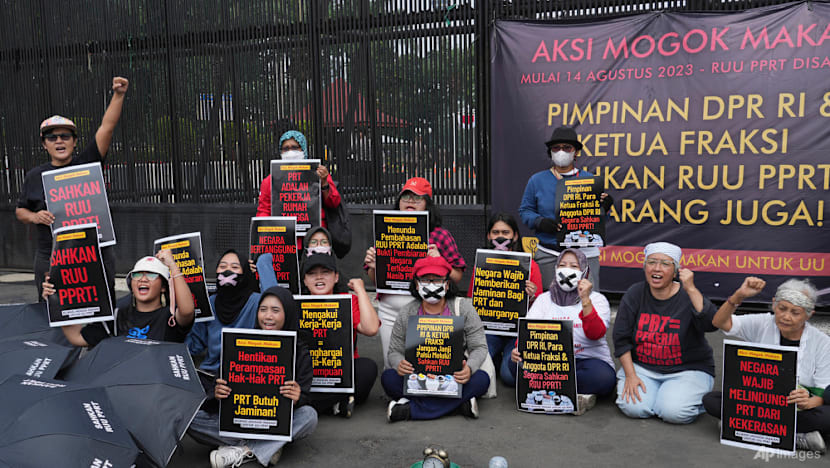 Activists hold posters during a protest and hunger strike demanding the parliament to pass a bill to protect domestic workers outside the parliament in Jakarta on Aug 14, 2023. (Photo: AP/Tatan Syuflana)
On Labour Day last year, President Prabowo Subianto had promised lawmakers that the bill would be completed within three months, but it was only passed a year later.
Bram from BRIN said the lack of political will among the government and lawmakers had been a key challenge.
“Perhaps the law was not considered important. There is also a cultural issue where domestic workers are not treated as equals to other workers. Women working as domestic workers are often looked down upon,” he said.
WHAT THE LAW CONTAINS AND ITS IMPACT
According to an analysis by the Makassar Legal Aid Institute (LBH), the law includes several important provisions that could bring change, including recognising domestic workers as formal workers and strengthening their legal standing.
This recognition allows them to assert their rights when violations occur, rather than being seen merely as “house helpers”.
Wiwik Kartiwi, a domestic worker, said she and others have often faced discrimination, such as being forbidden from sitting while working or restricted from using facilities like elevators.
“We often feel unappreciated. Even to use the lift, we are only allowed to use the service elevator,” she said.
Second, children are no longer allowed to work as domestic workers, to protect them from dropping out of school, violence, and exploitation.
The law sets a minimum age of 18 and requires an ID card and a health certificate.
According to data from the Ministry of Women’s Empowerment and Child Protection, in 2023 approximately 18 per cent of domestic workers in Indonesia were children.
Third, the scope of protected work is clearly defined, covering household tasks such as cooking, washing, ironing, and cleaning, as well as caring for children, the sick, the elderly, and persons with disabilities, and driving, caring for pets, and other agreed tasks.
Fourth, employment relationships must be based on agreements or contracts that clarify duties, rights, and obligations, helping prevent disputes and facilitating resolution.
Ajeng explained that domestic work varies from part-time to full-time and live-in arrangements, with wages ranging from 1 million to 6 million rupiah (US$57-US$342) per month, depending on the type of work.
Without clear written agreements, workers may be asked to perform tasks beyond their duties without additional pay.
Ajeng said she once worked from 4am to 10pm doing nearly all household tasks, which differed from her initial verbal agreement.
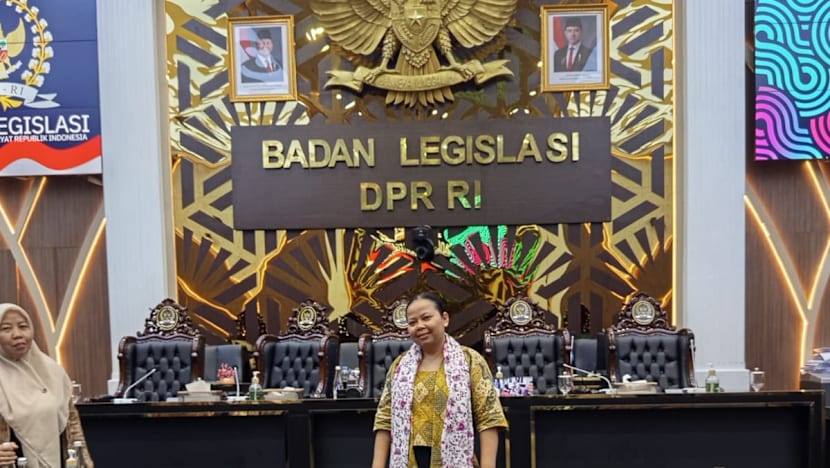 Ajeng Astuti, a domestic worker in Jakarta, at the Indonesian House of Representatives during the passage of the Domestic Workers Protection Act on Apr 21, 2026. (Photo: Ajeng Astuti)
Fifth, the law opens access to health and employment protection.
This is crucial, as data from Statistics Indonesia showed that only around 150,000 domestic workers - or less than 2 per cent - had employment social security in 2021.
Workers say recognition under the law affirms their dignity as human beings equal to other workers.
“We have long yearned for this, and now we can finally feel it. Rain or shine, we never stopped fighting for this in front of Parliament,” said Jumiyem, 52, a domestic worker from Yogyakarta who has been working for 36 years.
IS THE LAW ENOUGH?
Despite the celebrations, Bram from BRIN views the development more critically.
He said the law is still far from sufficient to fully protect domestic workers. Its enforcement will depend heavily on technical regulations yet to be drafted.
For instance, the law states that workers are entitled to “humane” working hours.
“What counts as ‘humane’? Is it eight hours a day, and anything beyond that is overtime? The term is open to interpretation,” Bram said.
Another issue is that this law still contains contradictions that could hinder its implementation in the future, said observers.
Although it requires written contracts that specify the type of work, working hours, and wages for domestic workers, the law also allows for employment relationships based on custom, family ties, and religion that are founded on unwritten agreements.
As a result, many workers remain in precarious positions and are vulnerable to exploitation.
Bram also raised concerns about enforcement involving neighbourhood heads who are not trained labour inspectors.
“There is a mismatch between the design of supervision and the reality on the ground,” he said.
Jala PRT coordinator Lita acknowledged the law is not ideal but said it accommodates about 70 per cent of the International Labor Organization’s Convention 189 on decent work for domestic workers.
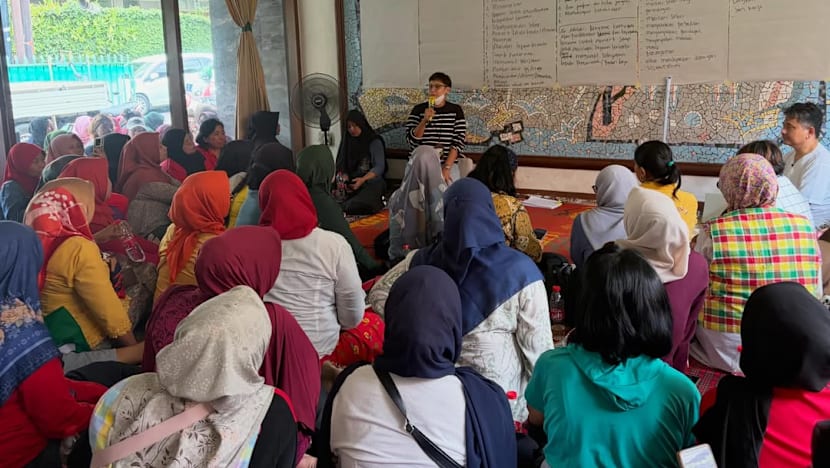 A session at Domestic Workers Union Sapulidi on Apr 26, 2026 where domestic workers are taught how to negotiate with employers. (Photo: Jala PRT)
EMPLOYERS’ REACTIONS
Some domestic workers were unaware of the law but welcomed it.
“I didn’t follow the news. I didn’t know. But if this improves our conditions, thank God,” said Rini Fitria, a 32-year-old domestic worker in Depok who has been working for five years.
Among employers, the law has drawn mixed reactions.
On social media, some expressed concerns about higher wages and potential taxes, while questioning why there is no law protecting employers.
“If such a law exists, salaries will likely rise. It’s good, but it must be realistic and not burden both sides. It should remain flexible,” said one resident, Keke, as quoted by Bloomberg Technoz.
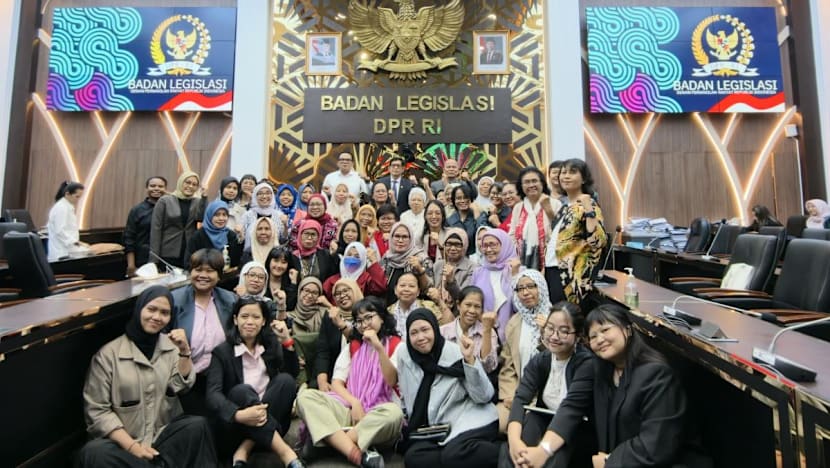 Domestic workers from various organisations celebrate the passage of the Domestic Workers Protection Act at the Indonesian House of Representatives on Apr 21, 2026. (Photo: Ajeng Astuti)
Gadizsa Zselamart, 37, a communication consultant who hires two domestic workers and lives in South Jakarta, was initially glad they finally gained legal protection.
However, after reading many news reports about the new law, her happiness turned to concern.
Now, the mother of two is worried that her domestic workers, who are in her 40s, will make excessive demands, even though she believes she already provides better pay, housing, and schedules than most employers.
“I’m worried they’ll only focus on their rights without considering their responsibilities as workers,” she told CNA.
Wiwik, the domestic worker activist, said the law protects both workers and employers through mutually agreed contracts.
“So employers don’t need to worry,” she said.
Following the law’s passage, the government has up to one year to issue implementing regulations.
“There are five government regulations that must be drafted as derivatives of the law. How quickly they are issued depends on political will,” said Lita, the Jala PRT coordinator.
These technical regulations will cover areas such as social security, supervision, and dispute resolution.
They are intended to be completed within a year, according to a parliamentary official, although activists hope the process will not drag on as long as the law’s passage did.
“If the government is willing, these regulations can be completed within three months,” Lita said.