 2 months ago
73
2 months ago
73
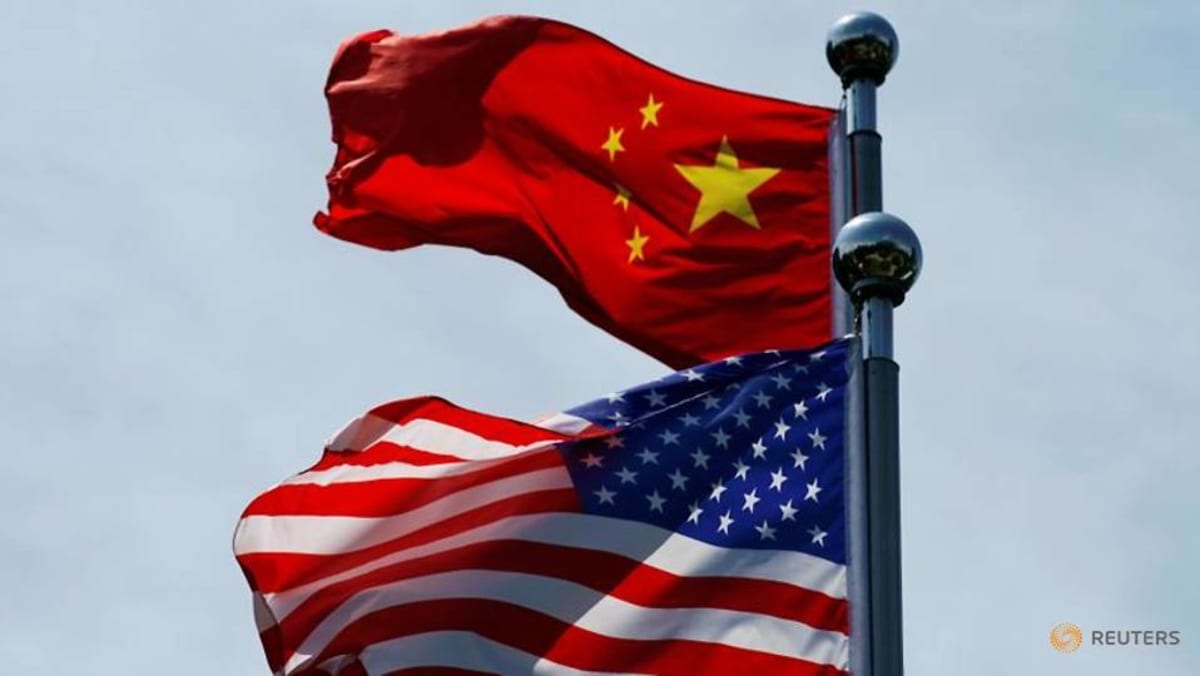
Don’t judge the Beijing summit by the lack of deals, because US President Donald Trump has once again invoked the “G2”, says former SCMP editor-in-chief Wang Xiangwei.
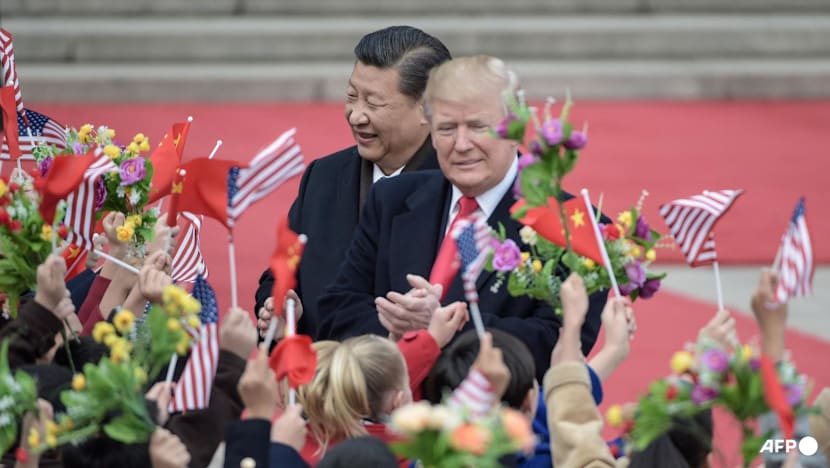
Chinese President Xi Jinping and US President Donald Trump attend a welcome ceremony at the Great Hall of the People in Beijing, Nov 9, 2017. (Photo: AFP/Fred Dufour)
New: You can now listen to articles.

This audio is generated by an AI tool.
HONG KONG: Children jumped and waved flags outside the Great Hall of the People, the Chinese military band performed YMCA at the state banquet, but there was no joint statement nor grand signing ceremony. In a symbol of systemic distrust, American officials and accompanying reporters reportedly discarded all Chinese-provided gifts, pins and burner phones before leaving Beijing on Friday (May 15).
At first glance, the summit between Chinese President Xi Jinping and US President Donald Trump offered grand optics but little concrete progress. Yet, evaluating this summit purely through immediate deliverables misses the structural shifts occurring beneath the surface of global statecraft.
Observers point to the divergent readouts issued by both governments as proof that the two leaders were speaking past one another.
Where Beijing emphasised Taiwan and a mutual commitment to building a relationship based on "constructive strategic stability", Washington’s readouts acknowledged neither. Instead, the US statement spotlighted trade, investment, fentanyl eradication and Iran.
But analysed through the lens of realpolitik, the summit signalled the arrival of a "new normal" – a bilateral paradigm with China recognised as America’s peer, simultaneously competing and cooperating on equal footing.
“THE TWO GREAT COUNTRIES”
The mechanics of the summit defy the narrative of failure.
The fact that the leaders spent nearly nine hours together in various settings was enough to inject stability into global markets. Just one year prior, the two countries were locked in a tit-for-tat tariff war that threatened to decouple supply chains and spooked the global economy.
While Beijing spared no expense in lavishing pageantry upon Mr Trump, the underlying message was one of strength, not subservience.
From the Chinese perspective, this trajectory was already set. The breakthrough happened last October during their previous encounter in Busan, South Korea, when Mr Trump revived the term "G2" to describe his relationship with Mr Xi.
Mr Trump repeated the moniker during a post-meeting interview in Beijing with Fox News: “It’s the two great countries, I call it the G2.”
The summit also threw the contrasting leadership styles of the two men into sharp relief. Mr Trump approached it with his signature transactional diplomacy, prioritising personal rapport and a delegation of businessmen seeking immediate deals. And crucially, he did not return to Washington empty-handed.
Beijing fed his appetite for transactional victories by agreeing in principle to major purchases of US agricultural products, energy and Boeing aircraft, alongside enhanced law enforcement cooperation against counter-narcotics and electronic scams. More importantly, the two sides established a "Board of Trade" and a "Board of Investment" – formalised mechanisms designed to prevent sudden economic escalations.
In contrast, Mr Xi projected the persona of a statesman with long-term vision and historical depth.
He invoked the historical warning of the Thucydides Trap to propose his new framework of "constructive strategic stability". According to Chinese officials, including Foreign Minister Wang Yi, this framework entails promoting cooperation as the mainstay, keeping competition within proper limits and differences manageable, and seeking peaceful coexistence.
A RHETORICAL SHIFT?
Nowhere was this Chinese strategy more visible than on the issue of Taiwan.
Mr Xi explicitly framed the Taiwan question as a make-or-break red line for bilateral relations, warning that mismanagement would cause the two titans to "collide or even come into conflict". US officials maintained that Washington's policy on Taiwan remains unchanged.
The status quo of “strategic ambiguity” was probably the best outcome. But Mr Xi’s warnings appeared to have resonated with Mr Trump.
In a subsequent Fox News interview, Mr Trump referred to Taiwan ambiguously as "a place, because nobody knows how to define it" and openly questioned the strategic wisdom of "travelling 9,500 miles to fight a war".
He stated: "I am not looking to have somebody go independent." In Beijing and Taipei alike, these words were taken as a diplomatic blow to Taiwan’s ruling Democratic Progressive Party (DPP) and leader William Lai.
The immediate test of this rhetorical shift lies in whether Mr Trump will sign off on or withhold a pending US$14 billion arms package to Taiwan.
Intriguingly, Mr Trump said he had discussed the arms sale “in great detail” with Mr Xi. This would go against a 1982 pledge to Taiwan by then President Ronald Reagan not to consult Beijing on arm sales to the island. Mr Trump had also described the weapons sale as "a very good bargaining chip" in negotiations with Beijing, adding that he was holding the sale "in abeyance" because "it depends on China".
A PROJECTION OF STRENGTH
For those seeking further evidence of China's projection of strength, they needed only to look at the diplomatic calendar immediately following Mr Trump’s departure. Beijing confirmed that Russian President Vladimir Putin would arrive for a state visit on Tuesday (May 19).
While the proximity of the two visits was technically coincidental – Mr Trump's trip having been delayed from March due to the US-Israeli war against Iran – the sequencing was anything but.
It was an astute showcase of Beijing as an indispensable geopolitical pivot point, hosting the American president one week and cementing its strategic partnership with Moscow the next.
With Mr Xi and Mr Trump scheduled to meet at least three more times this year, more hard bargaining will define the coming months. But for now, Beijing has the advantage of setting the tone for future meetings.
In 2010, under President Hu Jintao, China first floated the concept of "a new model of great power relations" to promote mutual respect, an initiative Xi Jinping renewed in 2013.
For over a decade, successive US presidents dismissively ignored the offer. Today, with China operating as a peer, Washington no longer has the luxury of looking away.
Wang Xiangwei is a former Editor-in-Chief of South China Morning Post. He now teaches journalism at Hong Kong Baptist University.