 3 months ago
110
3 months ago
110
The new attraction, Edenya, houses hundreds of animal and plant species in a year-round equatorial climate.
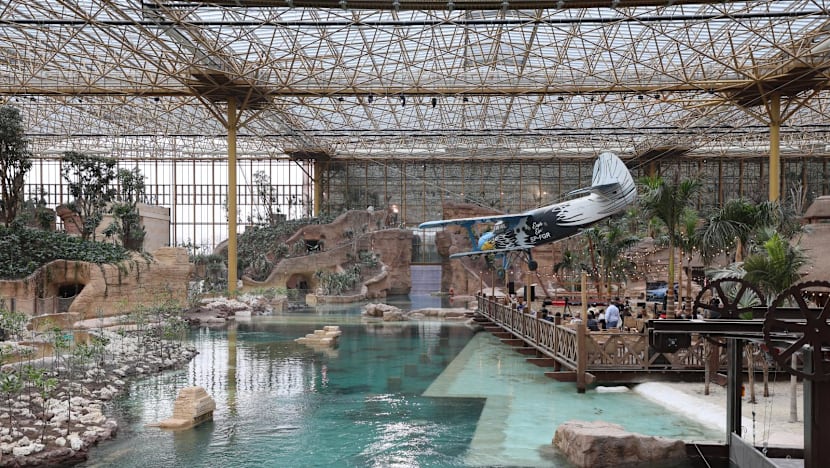
The 4ha attraction maintains a year-round equatorial climate, housing hundreds of animal and plant species across interconnected tropical landscapes. (Photo: Pairi Daiza)
New: You can now listen to articles.

This audio is generated by an AI tool.

BRUGELETTE, Belgium: Even in the depths of winter, visitors to Belgium’s renowned Pairi Daiza zoo can now step into the heart of the tropics.
After five years of construction, the zoo has unveiled Edenya – the world’s largest tropical greenhouse – a glass-covered canopy spanning 4ha, roughly the size of six football fields.
The habitat, which opened this month, connects multiple tropical environments, from rainforests and rivers to beaches and cliffs, in a single ecosystem.
AN IMMERSIVE EXPERIENCE
Built at a cost of about US$230 million, Edenya offers visitors an immersive rainforest experience spread across five different viewing levels.
From the upper walkways, the full scale of the greenhouse comes into view, though the ecosystem itself is still evolving.
Over time, the trees are expected to grow tall enough to reach those upper levels, gradually transforming the interior into a dense jungle.
Hundreds of animal and plant species have already been introduced, with more arriving in the coming months.
Among them are Peruvian squirrel monkeys, which leap through the foliage nearly 10,000km from their native Amazon rainforest.
Alongside them are a Komodo dragon, alligators, chameleons, sloths, tapirs and porcupines, among others.
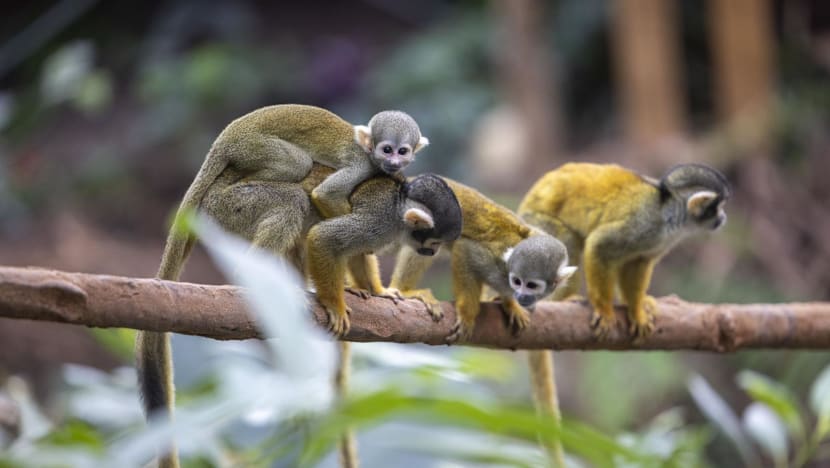 Peruvian squirrel monkeys at Edenya. (Photo: Pairi Daiza)
A 17m-high waterfall forms the centrepiece of the attraction, with a jaguar inhabiting the area at its base.
According to Edenya’s website, there are nearly 1,800 plant species and more than 5,000 cacti and euphorbias spread across the greenhouse.
Rare specimens include the coco de mer, native to the Seychelles, and two direct descendants of the Buddha tree.
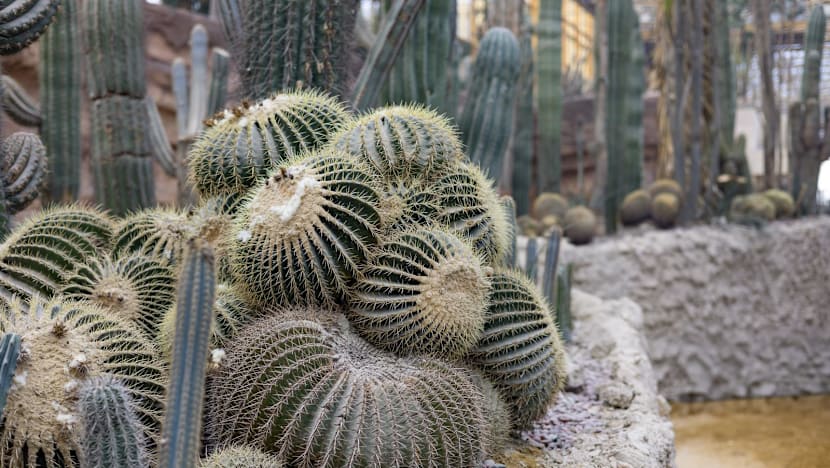 There are nearly 1,800 plant species and more than 5,000 cacti and euphorbias spread across the greenhouse. (Photo: Pairi Daiza)
CONSERVATION AT ITS CORE
Many of Edenya’s animals are linked to international conservation programmes, with the Pairi Daiza Foundation supporting species including the Komodo dragon, West Indian manatee, Parson’s chameleon, loggerhead sea turtle and jaguar.
Pairi Daiza founder and president Eric Domb said the goal is to foster an emotional connection between visitors and the natural world.
“When you make emotion possible in beautiful weather conditions all year round in this cold country and you show beauty, tenderness, kindness, something slowly changes in the hearts of the people and then you can really start to be in a protective mood,” he told CNA.
In total, more than 200 animal species are expected to inhabit Edenya.
Some species will be introduced gradually, with animals such as manatees and certain fish arriving later when conditions are most optimal to ensure their well-being and adaptation.
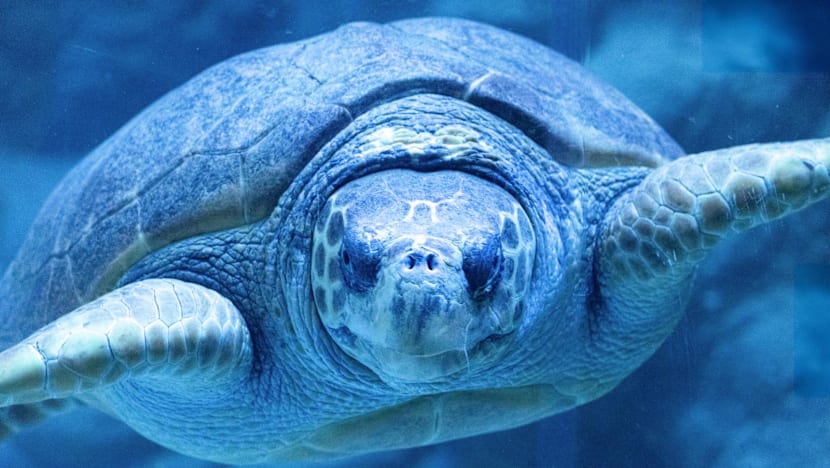 A loggerhead sea turtle at Edenya. (Photo: Pairi Daiza)
RECORD-BREAKING ATTRACTION
Guinness World Records has officially recognised Edenya as both the largest tropical greenhouse and the biggest covered zoological ecosystem in the world.
Adjudicator Anouk de Timary described it as “a unique project”.
“It’s not only a very large building but a continuous structure climatised with tropical plants and animals in the same ecosystem,” she added.
Beyond its scale, Edenya is being promoted as a showcase of sustainable design and engineering.
The entire greenhouse is temperature-controlled to replicate conditions found in the equatorial belt, ensuring a stable tropical climate year-round.
It is protected by a custom-designed glass canopy that is five times more insulating than a conventional greenhouse, allowing it to maintain a minimum temperature of 18°C.
Climate regulation is achieved through a combination of intelligent ventilation, misting systems and heat pumps.
The site is powered entirely by solar energy generated from photovoltaic carports, while a geothermal project is also underway to increase energy independence.
Edenya’s opening marks the latest chapter in Pairi Daiza’s evolution since its establishment in 1994 into a series of immersive themed worlds, ranging from polar landscapes and African plains to Asian-inspired habitats housing elephants and giant pandas.