 3 months ago
77
3 months ago
77
The country’s first post-coup election phase has concluded, but analysts say the process is unlikely to deliver meaningful political change.
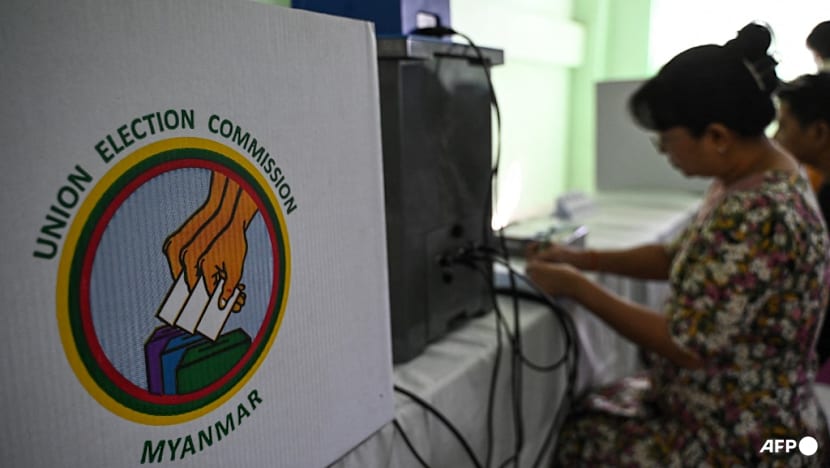
Members of Myanmar's Union Election Commission prepare a voting station a day before the start of the country's general election in Yangon on Dec 27, 2025. (Photo: AFP/Nhac Nguyen)
New: You can now listen to articles.

This audio is generated by an AI tool.

The first phase of Myanmar’s military-led election took place on Sunday (Dec 28), but analysts say the polls are unlikely to deliver meaningful political change amid low voter turnout, the exclusion of parts of the country and an expected outcome.
The election – held over three phases with the next two on Jan 11 and 25 – is the nation’s first since the military junta seized power in a 2021 coup.
The process has drawn criticism for a framework that ensures continued military influence in parliament, including restricting voting to areas where the military maintains varying degrees of control.
“It’s a democratic charade,” said Philip Robertson, director of Asia Human Rights and Labour Advocates, a Bangkok-based labour and human rights group.
“(The junta) is just going through the motions … rather than some sort of exercise that could result in meaningful political change.”
A LOW BAR FOR LEGITIMACY
Myanmar’s military authorities have insisted the election is legally valid even if voter turnout remains low.
But Robertson said such a legal framework does not amount to genuine legitimacy.
“They’ve set up the legal arrangement (but) it’s a very low bar,” he told CNA’s Asia Tonight. “That’s a big difference from having a legitimate election that’s accepted by the Burmese people.”
The military-endorsed Union Solidarity and Development Party is fielding the largest number of candidates and is widely expected to dominate the polls.
But regardless of the outcome, a military-drafted constitution already dictates that a quarter of parliamentary seats be reserved for the military, Robertson noted.
This has created a “glide path to a military government that will wear civilian clothing”, he said, noting that former generals are also contesting seats.
TURNOUT TELLS ITS OWN STORY
Christopher Lamb, former Australian ambassador to Myanmar and a former president of the Australia Myanmar Institute, said reports of low turnout are particularly striking given the extent of state control in voting areas.
He noted that the military had tried to suppress criticism of the vote, including detaining people who questioned the election’s credibility. These efforts appear to have been unsuccessful in convincing people to go to the ballot boxes, he told CNA938.
Voting will take place in just 265 of Myanmar’s 330 townships over the three phases.
These townships were selected based on the military’s ability to guarantee security and prevent disruption, Lamb said.
“They've selected areas which they pretty much control. And that's why a low voter turnout in those areas is particularly noteworthy,” he said.
“Even in the areas where they’ve got full control … they still can’t produce a high voter turnout, and that’s unusual in the case of Myanmar, because the people are thirsting for the return of some form of democracy to their country.”
While the actual number of voters is still unknown, Lamb noted that low turnout would cast doubt on the validity of the election, but that would likely be brushed aside by the military rulers.
Myanmar’s voters, he added, have had experiences of credible elections, particularly in 1990 and 2015.
In the 1990 general election, the National League for Democracy (NLD) led by Aung San Suu Kyi secured an overwhelming victory but was prevented by the military from taking power.
In 2015, the NLD again won a landslide, leading to Myanmar’s first civilian-led government in decades after the military-backed administration stepped aside.
In the most recent election in 2020, the NLD once more secured a decisive victory, a result the military rejected before seizing power the following year.
The party was dissolved by the military-controlled election commission in 2023 after refusing to re-register under new junta rules, effectively barring it from contesting the current polls.
REGIONAL ACCEPTANCE IN DOUBT
While some of Myanmar’s neighbours appear ready to accept the election outcome, others remain sceptical.
“China is preparing to accept this, India as well,” Robertson said. “But beyond those two major countries, many others are still on the fence.”
The Association of Southeast Asian Nations (ASEAN) – the regional bloc which Myanmar is a member of – remains divided, with countries such as Malaysia and the Philippines taking a more critical stance, he noted.
ASEAN has also not sent a formal election observer team, which reflects procedural constraints and a lack of consensus within the bloc, Lamb said.
“There is very little in the way of formal delegations,” he said, adding that even observers from Belarus, Russia and China are operating under tightly controlled arrangements.
“In some cases, they won't see any irregularities because they won't be allowed to. In some other cases, observers might well see irregularity, but they won't be able to take it further.”
“That’s not a recipe for an independent observation,” he said.
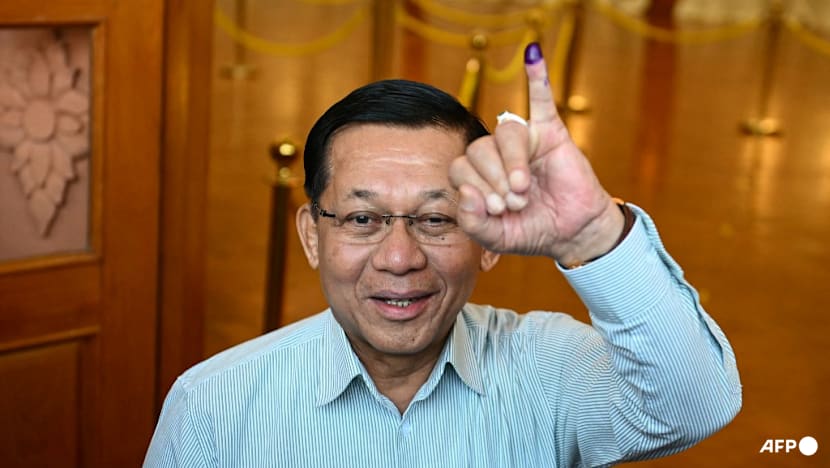 Myanmar's junta chief Min Aung Hlaing shows his inked finger after voting at a polling station during the first phase of Myanmar's general election in Naypyidaw on Dec 28, 2025. (Photo: AFP/Sai Aung Main)
LITTLE HOPE FOR CHANGE
Analysts have expressed doubts that the election would ease conflict or advance ASEAN’s stalled Five-Point Consensus, which junta leader Min Aung Hlaing agreed to in 2021 before effectively abandoning it.
“The military has not shown any sign of abiding by the five-point plan, and I don’t see how this election is going to change that,” Lamb said.
Robertson said regional governments will demand concrete actions, not promises.
“There has to be real unilateral reforms coming from whatever government comes out of this election … because we've seen time and time again that the Myanmar military is prepared to just make things up in pursuit of their own political objectives,” he added.
For now, the strongest signal is coming from inside Myanmar itself.
“The Myanmar people are the real experts about their government and their military,” Robertson said. “And their lack of confidence in this election is telling.”