 3 months ago
104
3 months ago
104
When I tell people I can cook, it doesn’t mean I do.
Sure, if I absolutely must enter the kitchen, my food will be edible. It may not win any Michelin stars, but neither will it be on Singapore Food Agency’s blacklist. It will be sustenance even if not satisfaction.
The whole shebang of preparing a meal from scratch, from ideation to plating, invariably reminds me of one of life’s harsh truths: Just because you can do something doesn’t mean you should.
So when I was invited to a festive cook-off with OpenAI Singapore in early December that promised to show how ChatGPT could help with planning and cooking for the holidays by getting attendees to participate in a mock culinary contest, I was, obviously, sceptical.
Unless the artificial intelligence (AI) chat bot literally dons an apron and seasons my chicken for me, it is just a backseat driver. I need less, not more, chatter when I’m trying to remember if I’ve salted my pasta.
But I often tout the common refrain, “I want AI to do my dishes and laundry”, which proposes that in its ideal state, AI should grant us more time for the work we love by taking on the chores we don’t.
I wanted to give ChatGPT a chance to prove it could indeed help with my most hated chore. After all, I was obsessed with Netflix's Culinary Class Wars, so perhaps making the leap from couch to kitchen wasn't that unimaginable.
At the very least, I hoped its often-sychophantic persona would hallucinate that I was reality TV material so I’d be motivated to prove it right.
A PROMISING START?
The rules were straightforward – or as straightforward as they could be for people who should’ve never passed Home Economics in secondary school.
Attendees were split into groups of four to five for the cook-off, which was held at The Providore Cooking Studio.
Choosing six ingredients from what was provided, each group had to create and cook a dish that could feed one to two, based on a randomly assigned theme. And we had 45 minutes to complete everything.
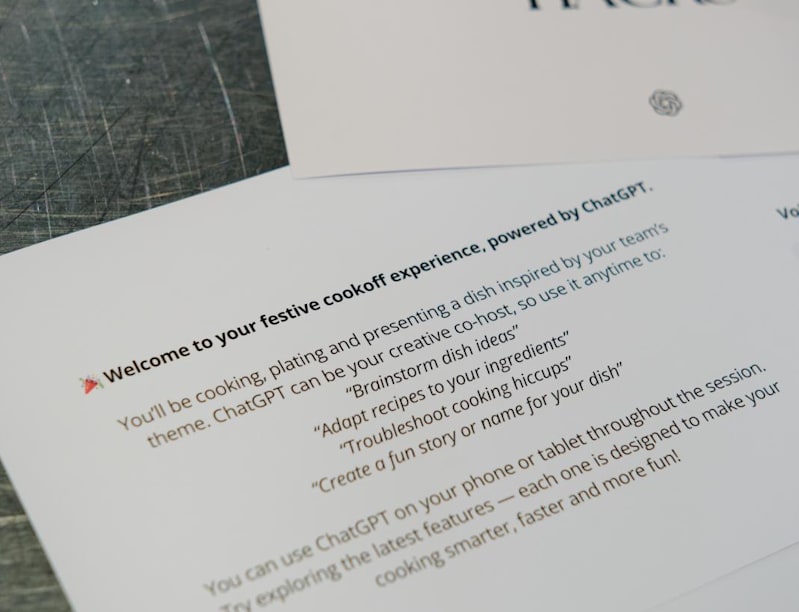 Attendees were encouraged to use ChatGPT's "kitchen hacks" to help with cooking. (Photo: OpenAI Singapore)
But first, a quick round of ice-breakers. There was, really, only one thing we needed to know when cooking with strangers.
“I can cook,” one of my teammates offered – a promising self-introduction.
“...Well?” I clarified.
Affirmative. She laughed, amused, as if there could’ve been any other answer.
My group’s theme was “Christmas Eve celebration”, which sounded broad enough for us to flex our creativity, until I realised that was also the problem.
What cuisine did we want? What was the base protein? Did we have a carb in mind? What were the rest of the ingredients? What about the overall flavour? None of us knew quite where to start.
Amid our flurry of questions, someone suggested salmon carbonara. He had experience making the dish. Yes, that could work, the rest of us happily concurred, before realising we had skipped our ChatGPT consultation.
COOKING WITH CHATGPT (AND AN EXISTENTIAL CRISIS)
Each station was given an iPad with ChatGPT. We were encouraged to use it from the ideation stage, never mind that we already had our idea.
Like rule-abiding Singaporeans, we fell in line. I turned to our ChatGPT prompt guide, which would seem unnecessary to those who knew their saucepan from their stockpot. But I was categorically not that person.
For cooking a quick meal, for example, the guide suggested: “I have 20 minutes. Suggest one easy but impressive dinner using everyday ingredients – and write it as a step-by-step recipe. To serve two.”
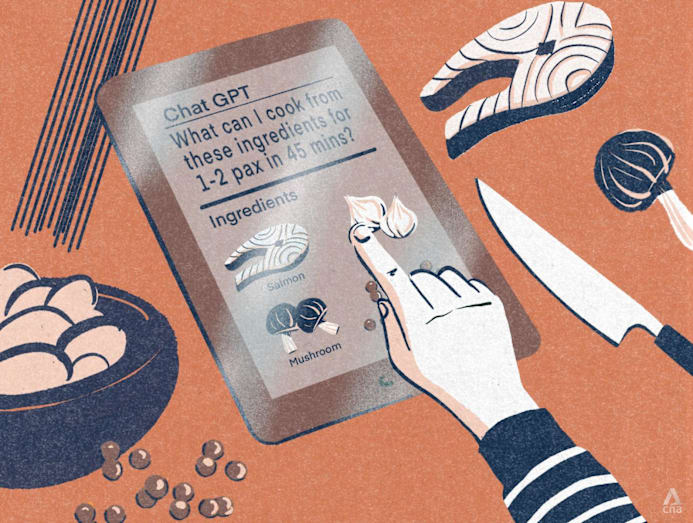 Each team was encouraged to use ChatGPT to plan and create a dish based on certain constraints. (Illustration: CNA/Jasper Loh)
Tweaking that prompt seemed a good place to start. We gave ChatGPT our constraints and uploaded a photo of our ingredients – and it delivered a wall of choose-your-own-adventure style text.
It seemed AI was aiming for a culinary collaboration, with each clarifying question wrapped in verbose prose. Did we want Asian or Western cuisine? How did we prefer to use the ingredients? Were we were going for an umami flavour? Did we want a twist on classic Singaporean fare?
I felt a familiar strain of impatience, usually triggered by automated customer service voice messages, slowly creeping in.
But maybe, too, it was simply a case of good old imposter syndrome. I needed to understand the basics of cooking, and probably even like it to some degree, to make ChatGPT work for me. Its questions only revealed how much I didn’t know and, admittedly, wasn’t exactly interested to learn.
The irony is, trying to use AI to be a better cook made me feel like I was disrespecting the craft. I lacked a fundamental love for the process that was required for my food to be enjoyable, even if it were edible in the end.
So for now, the only instructions I trusted came from the human who had happily suggested salmon carbonara.
COOKING WITH PEOPLE
Now my team’s unofficial leader, he was tasked to oversee the entire process, ensuring we delivered a palatable dish at least.
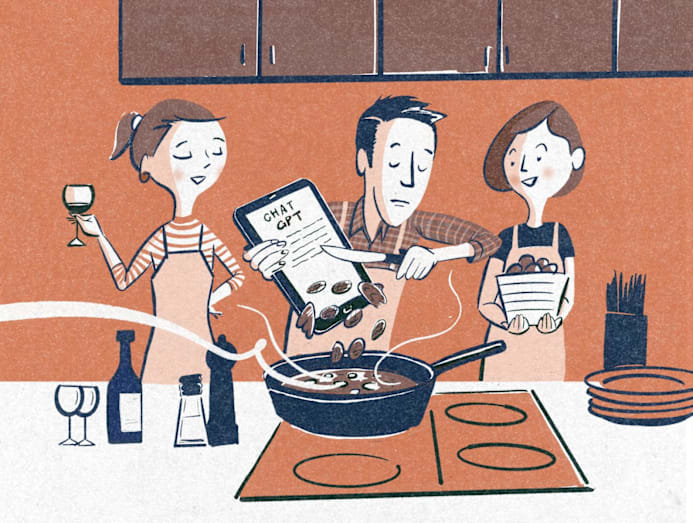 Working with strangers and ChatGPT to cook a dish was certainly a once-in-a-lifetime experience. (Illustration: CNA/Jasper Loh)
First came the division of duties. One teammate diced the mushrooms and sliced the bread into croutons for the topping. Another seasoned the salmon, while someone else whisked the eggs into a silky base sauce.
I took charge of boiling the pasta, assuming I couldn’t mess up the simplest task.
But it soon became clear, through a teammate’s gasp, that I could. My lifelong method of adding the pasta before the water had fully reached a rolling boil was incorrect.
Doing this prevents the pasta from cooking evenly and encourages it to turn gummy, as I learnt that day, in my 30s, after years of declaring that pasta was my “best” dish.
I wasn’t sure what was more humbling: Having done it the wrong way my entire life, or never having seen a problem with that.
Once each ingredient was prepared, our team leader took over the final cooking, tossing the pasta with mushrooms and the egg-based sauce, occasionally loosening it with a pour of pasta water.
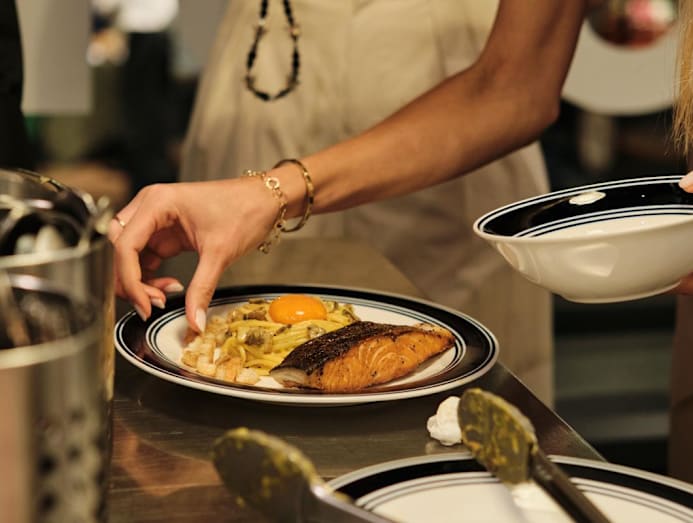 Plating our dish after 45 minutes. (Photo: OpenAI Singapore)
Compared with my turn at the stove, the contrast in our culinary aptitude was stark, and it wasn't solely about technical skills.
His joy was palpable. He was fully present, comfortable with every toss of the pan, instinctive in the way he stirred the sauce. It was like being on the set of a cooking competition show, without the TV crew. This, I reasoned, is probably what people mean when they say they've reached Nirvana.
After a few taste tests, he portioned a ladle of pasta onto a serving plate for the final presentation, topped it with croutons and placed a cured egg yolk at the centre.
Only then did we turn to ChatGPT for its final contribution: A poster to describe the dish.
“THE MIDNIGHT SUN,” the chat bot named it.
“A dish inspired by winter warmth and glowing horizons. Creamy mushroom carbonara twirled into a delicate nest, finished with a radiant yolk and paired with perfectly crisp seared salmon.”
And at the centre of the poster was a glossy, perfect rendering of our messy, haphazard dish. It looked like the plastic food in restaurant windows: Immaculate, convincing and entirely beside the point.
 The final salmon carbonara, cooked among four strangers. (Photo: OpenAI Singapore)
In the end, cooking with strangers was an experience with friction and frustration. But which attempt at human connection isn’t?
Learning to work through the chaos might just be precisely what made us proud of our final creation. That, and the fact that it was downright delicious, which I suspect was because my other three teammates genuinely adore cooking.
To people like them, the labour is the love. They enjoy tweaking the recipe as they cook and thinking about how to reverse engineer the final dish.
What’s key, I believe, is curiosity to break through – probably the secret ingredient to using ChatGPT well in any circumstance.
Don't get me wrong, there is undoubtedly plenty of value in learning to cook, whether it's through YouTube, AI or a family recipe book. It is a life skill after all. But for now, perhaps I'll stick to buying food from the people who actually love making it and watching cooking competitions.
While AI can teach you why you should plan more efficiently in the kitchen and why you should try a different ingredient for a healthier meal, like any skill you attempt to master via a shortcut, it can't teach you why you're doing this at all if you don't already know.