 3 months ago
110
3 months ago
110
SINGAPORE: The drug reoffending rate declined after three straight years of increases, according to the Singapore Prison Service's (SPS) latest annual statistics on Monday (Feb 9).
The two-year recidivism rate for the Drug Rehabilitation Centre’s (DRC) 2023 release cohort was 26.1 per cent, down nearly five percentage points from 30.8 per cent the year before.
This improvement can be attributed to "the evidence-informed throughcare drug rehabilitation regime, with strong community support" from SPS' and Yellow Ribbon Singapore's (YRSG) partners, said SPS.
The recidivism rate refers to the percentage of local inmates who were jailed, detained, or received a day reporting order within two years of their release into the community.
The overall two-year recidivism rate remained low and stable, said SPS, with a slight increase for the 2023 release cohort at 21.9 per cent compared to 21.3 per cent the year before.
SPS noted that this was one of the lowest two-year recidivism rates globally. In comparison, Hong Kong's two-year recidivism rate for its 2022 release cohort was 21.8 per cent.
The two-year recidivism rate for women - at 16.3 per cent - also continued to be lower than that for men (22.6 per cent) in the 2023 release cohort.
The five-year overall recidivism rate for the 2016 to 2020 release cohorts also remained stable, said SPS.
According to its statistics, 2016 saw the reoffending rate at 41.1% before dipping to 36.6% in 2019 and then increasing to 39.3% in 2020.
"Preventing re-offending in the long term requires a sustainable ecosystem of community and family support for ex-offenders," it said.
ASSAULT RATE, YOUNG INMATES
The assault rate went up from 54.4 assaults per 10,000 inmates in 2024 to 76.7 in 2025, though this remains low compared to other correctional jurisdictions, it noted.
SPS said that there was an increase in the population and proportion of young inmates and remand prisoners in the prisons.
The population of young inmates increased by 36.2 per cent (from 307 in 2024 to 418 in 2025) and remand prisoners by 21.4 per cent (from 1,350 in 2024 to 1,639 in 2025), respectively.
"These categories of inmates tend to face more adjustment issues upon admission, are more impulsive and resort to violence when involved in disputes with fellow inmates," SPS said.
It added that this "led to an increase in assault incidences committed by young inmates and remand prisoners".
Assaults include any attack by inmates on prison officers, or assaults by inmates on fellow inmates.
SPS also said that there were no escapes from custody in 2025.
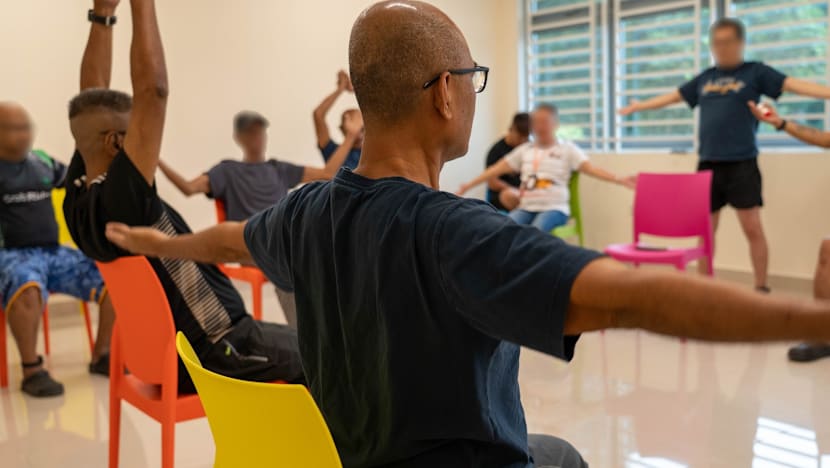 Elderly residents at Selarang Halfway House participate light exercises. (Photo: Singapore Prison Service)
SPS said it continues to work with community partners to enhance rehabilitation and reintegration programmes for drug abusers through initiatives including throughcare support, community-based programmes and differentiated drug rehabilitation regimes.
"Employment is key to the successful reintegration of ex-offenders," said SPS. In 2025, 94 per cent of inmates referred to YRSG secured a job prior to their release.
YRSG provides career facilitation services and has career coaches who facilitate initiatives to support inmates in early career planning and employment readiness.
SPS said that it and YRSG will continue to work with the Community Action for the Rehabilitation of Ex-Offenders Network, volunteers, community partners, employers, families, desistors and other government agencies to strengthen the ecosystem of support for inmates and ex-offenders.