 3 months ago
79
3 months ago
79
More than 55 million voters – about 44 per cent of the electorate – are aged between 18 and 37, underscoring the growing political weight of young people.
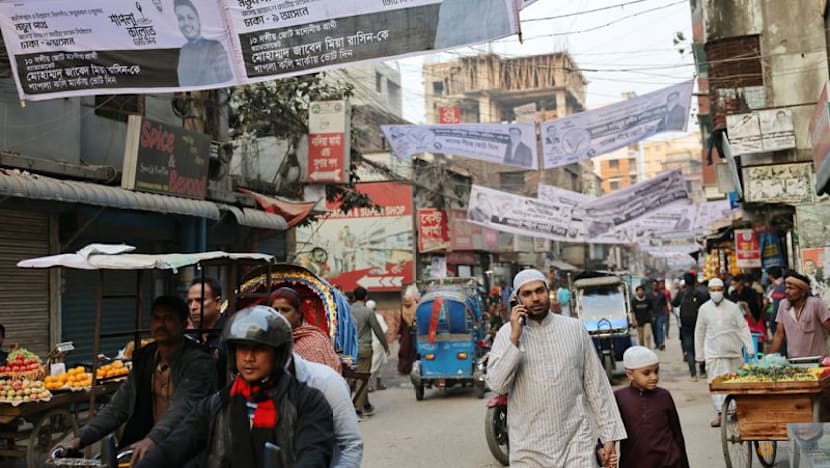
Election campaign banners of candidates hang over the streets ahead of the national election in Dhaka, Bangladesh, Feb 7, 2026. (Photo: Reuters/Mohammad Ponir Hossain)
New: You can now listen to articles.

This audio is generated by an AI tool.

DHAKA: Bangladesh goes to the polls this week in its most consequential parliamentary election, the first since a student-led uprising ousted long-time prime minister Sheikh Hasina and plunged the country into political uncertainty.
Many hope the vote will end months of upheaval and usher in a new chapter for the country’s political trajectory and international standing.
On Thursday (Feb 12), more than 127 million voters are expected to cast their ballots not only to choose a new parliament, but also to decide how the nation will be governed in the years ahead.
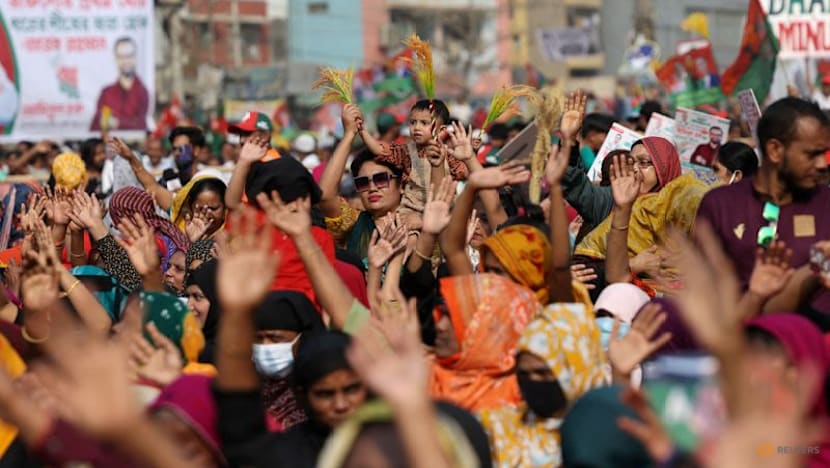 Supporters of the Bangladesh Nationalist Party wave their hands as they gather at an election campaign rally attended by the party chairman, Tarique Rahman, ahead of the national election at Pallabi, in Dhaka, Bangladesh, Feb 8, 2026. (Photo: Reuters/Mohammad Ponir Hossain)
DEFINING MOMENT FOR BANGLADESH’S FUTURE
Two dominant political forces are vying for power.
The Bangladesh Nationalist Party has returned to the political spotlight, promising redemption and renewal after years on the sidelines.
Across the divide stands a coalition centred around Jamaat-e-Islami, an Islamist movement positioning itself as the standard-bearer of meaningful change.
At stake are 300 elected seats in parliament and a referendum on the July National Charter, a document that lays the foundation for sweeping political reforms following the student-led revolt in 2024.
The uprising, which ended Hasina’s rule in August 2024, has been widely described as the country’s democratic rebirth.
Now, the ballot box will test whether that promise can be realised, said observers.
“What’s at stake here, fundamentally, is questions about democratic repair (and) democratic legitimacy – how the conduct of this election takes place, issues of turnout, issues of what the result is,” said Imran Ahmed, a research fellow at the National University of Singapore’s Institute of South Asian Studies.
“It puts to question deep political and ideological tensions at the heart of the country – about where Bangladesh is going, about the identity of Bangladesh.”
Around 40 million people are expected to be voting for the first time.
For the first time in its history, Bangladesh will also allow postal voting, extending participation to millions of citizens living and working overseas.
YOUTH VOTE SEEN AS CRUCIAL
The youth vote is widely seen as crucial to the outcome of this election.
More than 55 million voters in Bangladesh – about 44 per cent of the electorate – are aged between 18 and 37, underscoring the growing political weight of young people.
Many were at the forefront of the 2024 protests, driven by deep frustrations ranging from unequal access to jobs to a political system they felt had long excluded them from decision-making.
Now, these young Bangladeshis are preparing for another turning point.
“It’s going to be a free and fair election for us,” said Sadman Abdullah, a student leader at Dhaka University. “People have been hoping for it for so long.”
While the race remains dominated by traditional forces such as the Bangladesh Nationalist Party and Jamaat-e-Islami, the demonstrations a year and a half ago have given rise to a new political actor – the National Citizen Party (NCP) led by 27-year-old Nahid Islam and other student activists.
But whether that protest momentum can be translated into stable democratic governance is in question.
“All the politicians should understand that if we students and general people will rise up, we can get down (to the streets) again,” said youth activist Tanvir Ahmed.
He added that he hopes whoever forms the next government will ensure equal opportunities for all.
Young voters say they will be watching what comes after election day – not just who wins, but whether the political alliances formed can deliver the accountability they demand.
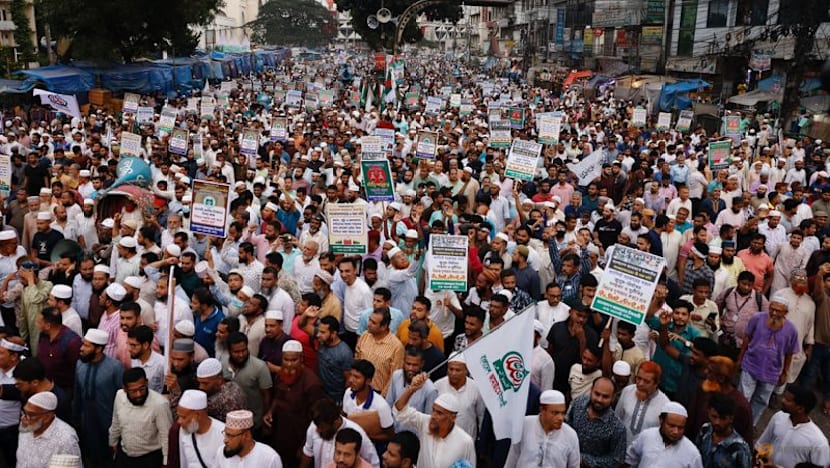 Supporters of Bangladesh Jamaat-e-Islami take part in a protest rally in front of the Baitul Mukarram National Mosque in Dhaka, Bangladesh, Sept 18, 2025. (Photo: Reuters/Mohammad Ponir Hossain)
SIGNIFICANT CHALLENGES REMAIN
Voters face twin decisions at the ballot box: choosing who should lead Bangladesh out of its turbulent recent past, and whether to endorse reforms that could reshape the political system.
Beneath the political theatre lies a sobering reality, said experts. Whoever wins will inherit an economy under strain, with youth unemployment, rising living costs and deep public mistrust in political institutions posing immediate challenges.
Analysts warn that failure to deliver tangible improvements could prolong instability rather than bring the closure many Bangladeshis are hoping for.
Beyond the country’s borders, the stakes are just as high with the international community watching closely.
A credible democratic transition is seen as key to restoring Bangladesh’s diplomatic standing and influence in South Asia.
“For the last one and a half years, we’ve been waiting for the sort of a legitimate government to actually take up the reins, especially because the path had been paved for Bangladesh to actually have a bigger say in the region,” said Yanitha Meena Louis, an analyst at the Institute of Strategic and International Studies Malaysia.
“That is why it’s so important for this election to actually yield a democratically elected government, because it will pave the way for engagement in the next few years vis-a-vis Bangladesh and regional powers like China and India, and with the rest of the world as well.”