 5 hours ago
3
5 hours ago
3
The move will allow authorities to issue mediation directions that can legally compel disputing neighbours to attend mediation sessions.
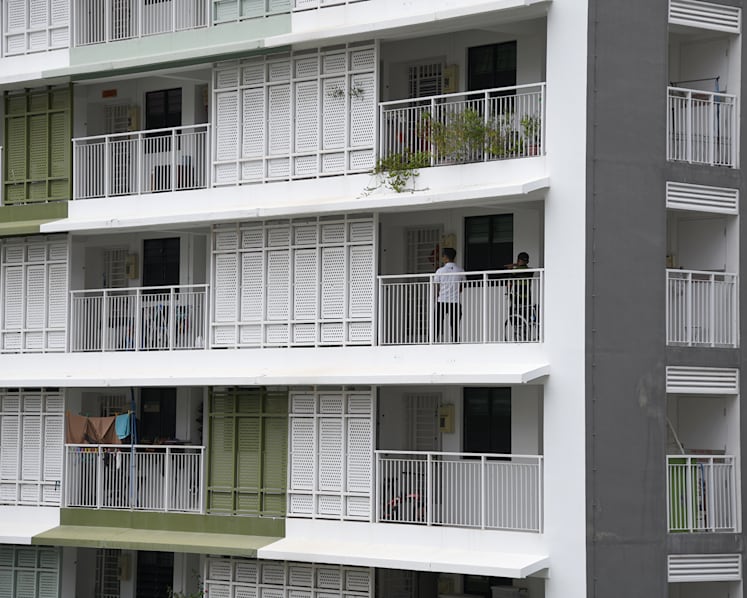 Residents seen along the corridor of a HDB block in Singapore. (File Photo: CNA/Calvin Oh)
New: You can now listen to articles.

This audio is generated by an AI tool.

SINGAPORE: A government unit empowered to investigate severe neighbour noise disputes will be expanded nationwide from Sep 1, 2026, following a successful pilot in Tampines.
A framework compelling disputing neighbours to attend mediation will also be implemented across Singapore, three ministries said in a joint press release on Friday (Aug 28).
Originally introduced in November 2024 as part of a broader scheme to manage community disputes, both moves were first piloted in Tampines in April 2025.
To address noise-related disputes, especially those that involve excessive and prolonged noise that causes "significant distress" to multiple residents, officers from the Community Relations Unit (CRU) were given legal powers in Tampines to take statements from relevant parties and issue orders where appropriate. This will be expanded islandwide from Sep 1.
CRU officers will continue to deploy noise sensors - used to collect objective evidence on the direction, timing and intensity of noise - where necessary to support investigations.
"The pilot has shown that early intervention, directed mediation at the Community Mediation Centre, and targeted action by the CRU can work together to resolve disputes more effectively," said the Ministry of Culture, Community and Youth, the Ministry of Law (MinLaw) and the Ministry of National Development (MND).
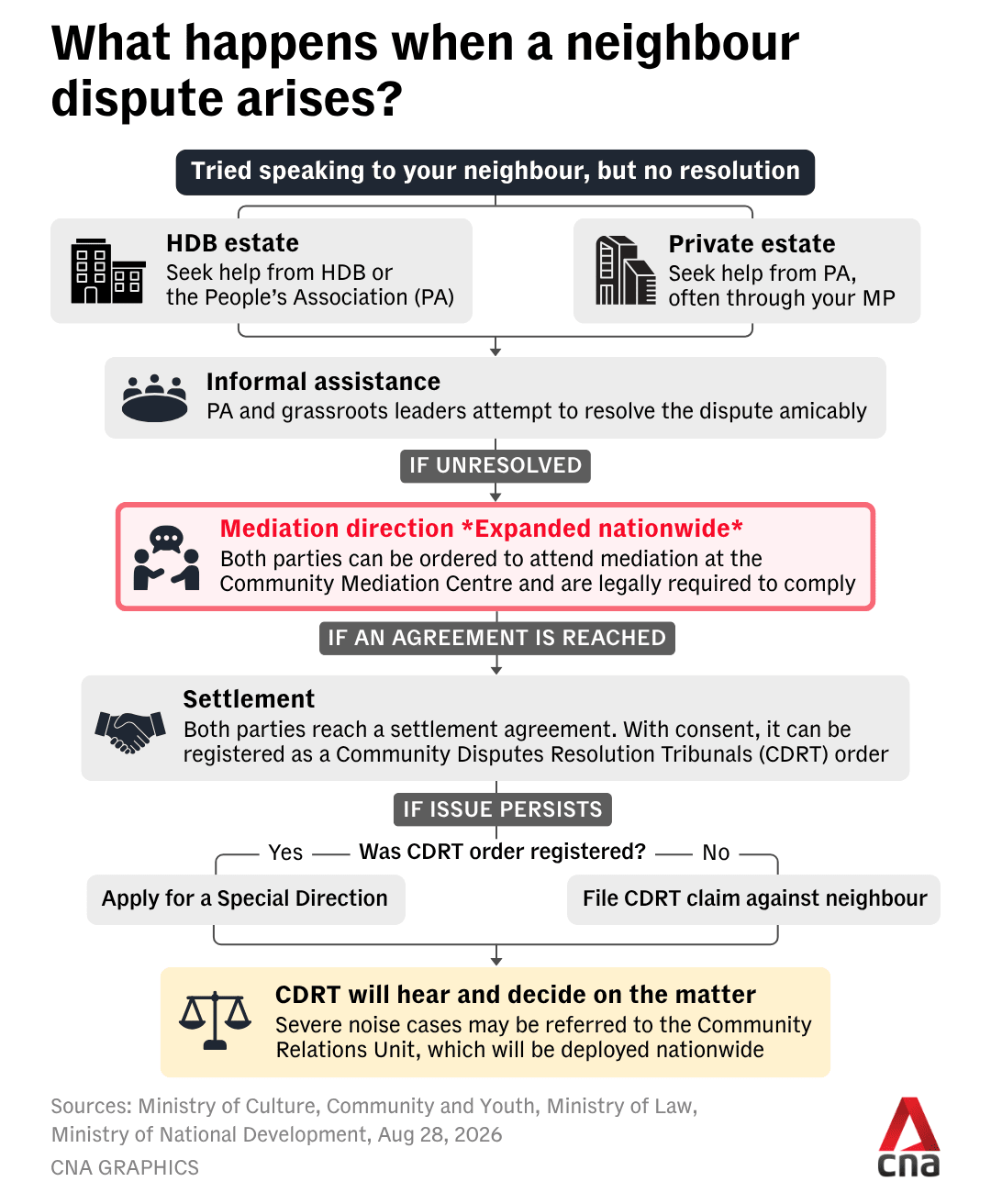
Under the new mediation framework that takes effect from Sep 1, disputing neighbours issued with a mediation direction will be compelled to attend mediation sessions at the Community Mediation Centre.
This is enforceable by law and must be complied with, said the three ministries. Non-compliance with a mediation direction can result in a fine of up to S$1,500 (US$1,180).
Ultimately, building harmonious neighbourhoods is a shared responsibility, the statement said.
"Strong communities are built when neighbours treat one another with consideration, respect, and understanding; and when neighbours come together early and resolve their differences in an amicable manner."
The issue of community mediation came into focus last year following a fatal incident involving neighbours in a noise dispute in Yishun.
Ms Nguyen Phuong Tra, 30, had applied for mediation with her neighbour, Koh Ah Hwee, but the mediation did not take place as Koh did not respond to the invitation.
Koh, 66, was charged with Ms Nguyen's murder following the incident at Block 323 Yishun Central on Sep 24 and the case is pending.
More recently, 59-year-old Ng Swee Seng was charged with the murder of another man, said to be his neighbour, at a block in Lengkok Bahru.
MEDIATION FRAMEWORK
The Housing and Development Board (HDB) and the People's Association (PA) will be authorised to issue mediation directions in public housing estates, while PA will be able to do so in private housing estates.
If both parties reach a settlement at the Community Mediation Centre, they can, with mutual consent, apply to register the settlement as a Community Disputes Resolution Tribunals order.
This would allow for simpler and faster enforcement where necessary.
In 2025, 1,676 voluntary mediation cases between neighbours were registered across Singapore. Of these, 317 proceeded to mediation, with 250 resulting in settlements.
Another 1,198 cases were not mediated because one or both parties declined or did not respond.
For noise disputes islandwide, 994 cases were registered for voluntary mediation in 2025. Of these, 205 proceeded to mediation, with 167 resulting in settlements. Another 688 did not proceed to mediation because one or both parties declined or did not respond.
As for the nationwide deployment of the CRU, the unit will cover both public and private housing estates and focus on a small number of cases involving excessive and prolonged noise that causes significant distress to multiple residents.
While they currently have legal powers in Tampines, from Sep 1, CRU officers will be able to take statements from disputing neighbours and other persons who may assist with investigations.
They can also issue warnings and abatement orders requiring people to stop a noise nuisance. Failing to comply with an abatement order is a criminal offence.
In response to CNA's queries, MinLaw and MND said that the CRU team will be expanded to about 18 public officers. The team had 15 members when it was first announced.
"We will monitor caseloads and operational needs as the framework is implemented, and review resourcing as needed," the two ministries said.
Good neighbourly relations "cannot be legislated or enforced into existence", the joint press release added.
"The first and best response to neighbour disputes remains direct communication, mutual understanding, and mediation."
CRU intervention will be reserved for the most severe noise cases, after neighbours and agencies have exhausted other avenues to resolve a dispute, or where the circumstances warrant such intervention.
"This will also ensure that CRU resources are directed where they are most needed," the three ministries added.
WHAT THE TAMPINES PILOT FOUND
A total of four mediation directions were issued during the Tampines pilot, which began on April 1, 2025.
Two resulted in both parties attending mediation and reaching settlement agreements.
In another case, both parties attended mediation but could not reach an agreement.
"The case was subsequently referred by HDB to CRU, which has engaged the family to be more mindful of noise from their activities at home. The situation has since improved," the three ministries said.
In the remaining case, the person who provided the feedback failed to attend mediation and was issued a warning. The person later withdrew the case.
During the pilot, the CRU managed nine neighbour noise cases, out of which five were assessed to involve severe neighbour noise.
Following intervention by the authorities, the noise nuisance in most of these cases has reduced or stopped, while one case remains ongoing.
These cases highlighted the complexity behind some serious neighbour noise complaints.
The ministries said that four cases involved people with mental health conditions, suspected mental health conditions or special needs.
The CRU worked with the Agency for Integrated Care, Institute of Mental Health and Family Service Centres to engage the individuals and their families.
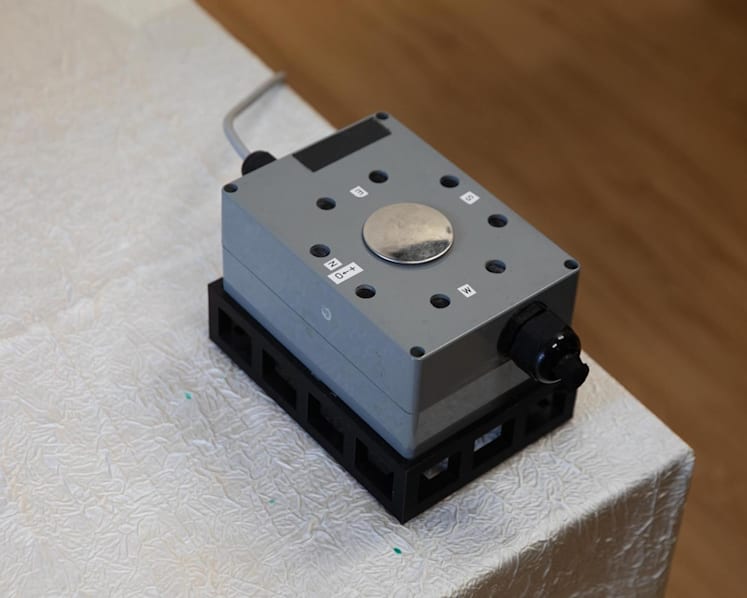 A noise sensor used to collect objective evidence regarding severe noise disputes among neighbours. (Photo: CNA/Ili Nadhirah Mansor)
According to the ministries, these efforts helped facilitate assessment, treatment and more consistent follow-up in most cases, addressing underlying causes of the noise and reducing the impact on neighbours.
In one case, where noise was deliberately used to disturb neighbours, the nuisance stopped following joint intervention by the CRU and partner agencies.
THE CHALLENGES OF MEDIATION
Two Community Mediation Centre mediators, who have each volunteered for more than two decades, spoke about the challenges they face in helping neighbours resolve disputes.
Master Mediator Michael Chew Yew Kuen and Executive Master Mediator P Thirunal Karasu have each mediated more than 200 cases, achieving settlement rates of about 70 per cent and 90 per cent respectively.
Both said noise was one of the most common disputes they encountered between neighbours.
"While the issues may differ from case to case, what I have often seen is that concerns and frustrations can build up when neighbours do not communicate with each other," both Mr Chew and Mr Thirunal said.
"Sometimes, the issue that first brings the parties to mediation is only one part of the dispute. There may also be misunderstandings that have developed over time."
The duration of a dispute and how the relationship between neighbours has evolved can also make cases more challenging, Mr Thirunal said.
One case Mr Thirunal successfully mediated involved neighbours living directly above and below each other.
The downstairs neighbour complained of recurring noise including heavy footsteps and furniture being moved at night, which frequently disturbed his sleep. The upstairs household said some of the sounds were unavoidable daily activities and that they had already tried to reduce the disturbance.
The neighbours initially went through voluntary mediation and reached a written settlement agreement but the downstairs neighbour later returned to the Community Mediation Centre because he felt the noise had continued.
By then, communication between the two households had deteriorated and both sides felt frustrated and misunderstood.
Mr Thirunal and a co-mediator brought the parties together again. A member of the upstairs household eventually acknowledged contributing to some of the noise and apologised, while both sides agreed on clearer channels of communication and additional measures to reduce door and footfall noise at night.
Mr Chew said that neighbours may enter mediation with strong emotions but that mediators had to remain calm, neutral and impartial.
"Where appropriate, we may speak to the parties separately if emotions are high or if there are matters that they may not be comfortable sharing in a joint session," he added.
Mr Chew said there could be different reasons why some cases do not result in a settlement agreement, including disputes that have persisted for some time.
"Parties may be frustrated or distrustful and have fixed views about what has happened or what they expect the other party to do.
"Sometimes, the underlying issues may also be deep-seated, making it difficult for the parties to find common ground," Mr Chew said.
Even so, mediation can still give the neighbours an opportunity to hear each other's concerns, clarify misunderstandings and narrow the issues between them, he added.
Asked what neighbours should do to resolve disputes early and avoid the need for mediation, both said neighbours should try to communicate directly and raise their concerns early before the disagreement escalates.
"Sometimes, what one neighbour experiences may not be something the other neighbour is aware of," Mr Chew said.