 3 months ago
128
3 months ago
128
SINGAPORE: Pointing to WhatsApp messages between a Bloomberg reporter and a property expert, Manpower Minister Tan See Leng said on Friday (Apr 10) that the reporter had suggested a quote to the expert that later featured in the article.
"I find it very disappointing that a journalist can write in such a manner and working for such a reputable agency (such as) Bloomberg, whom I've always respected all this while," said Dr Tan in a defamation trial that he and Home Affairs Minister K Shanmugam brought against the news agency.
Bloomberg and its reporter, Mr Low De Wei, are embroiled in the trial centred around Mr Low's article about Good Class Bungalows (GCBs) that also referred to transactions involving the properties owned by both ministers.
The article had cited Mr Alan Cheong, executive director of research for Singapore at real estate consultancy Savills Singapore in an article headlined "Singapore Mansion Deals Are Increasingly Shrouded in Secrecy".
Mr Cheong was quoted as saying "the problem with opacity is the fallout from public perception is much worse than the actual problem" and that "things may go out of control if there are no checks and balances".
In response to the allegation, Bloomberg's defence lawyer Senior Counsel Sreenivasan Narayanan said that looking at the WhatsApp messages, any reasonable person would have realised Mr Low was checking with his source about what was actually said "rather than putting words in his mouth".
To this, Dr Tan said he could not tell what Mr Sreenivasan was suggesting, saying this was what he read and the "sequencing speaks for itself".
When Mr Sreenivasan pressed that it was "quite clear", Dr Tan said: "I don't know. Because obviously, the journalist has very different standards when it comes to asking me."
Testifying on the fourth day of the trial, Dr Tan described how Mr Low had written to his press secretary for comment, saying he planned to report a "broader story" on the "off the radar" GCB transactions, citing Dr Tan's S$27.3 million GCB purchase in Brizay Park in 2023 that was not caveated.
A caveat is a legal document lodged with the Singapore Land Authority to register a person's interest in a property. It is meant to protect a buyer's interest against a property after signing an option to purchase or sales and purchase agreement, preventing the seller from selling to another party.
'WHAT WAS THERE TO COMMENT?'
Dr Tan said that he "really didn't know what was there to comment" and explained that he received many media queries as a minister.
"Now if I'd known that actually his broader story included all these details about how people are trying to hide, trying to cloak, trying to keep it secret and how it is then linked to money laundering and what happens in other jurisdictions as well as the fact that there was no mandatory disclosure, there's no checks and balances, I would not have taken it lightly.
"I would have sought legal advice immediately," said Dr Tan.
He said Mr Low's email to his press secretary "was just like checking (a) box".
When Dr Tan saw the published article, he said he was "very disturbed" and felt it had a "very clever, selective use of paragraphs, sequencing" that was "pernicious", "subtle" and "destructive".
Asked by Bloomberg's lawyer, Dr Tan agreed that Mr Low had been very up front to say his transaction would be described as "off the radar".
However, he said it was "surreptitious", with the veteran medical practitioner using the analogy of skin cancer removal to illustrate why he said so.
"If I want to remove a skin cancer, I don't just look at the skin cancer. I have to understand the entire holistic approach to that particular patient, and in this particular setting, I don't think that people would just look at a one-liner and completely ignore what the entire article is trying to talk about or insinuate," he said.
DAVINDER SINGH GRILLS BLOOMBERG EDITOR
After Dr Tan finished his turn on the stand in the late morning, Bloomberg called its first witness, Ms Madeleine Lim, who is a senior executive editor of Bloomberg News.
In his cross-examination, Senior Counsel Davinder Singh, who represents both ministers, grilled Ms Lim at length about Bloomberg's editorial actions, including the removal of a paywall to the article that "aggravated the libel".
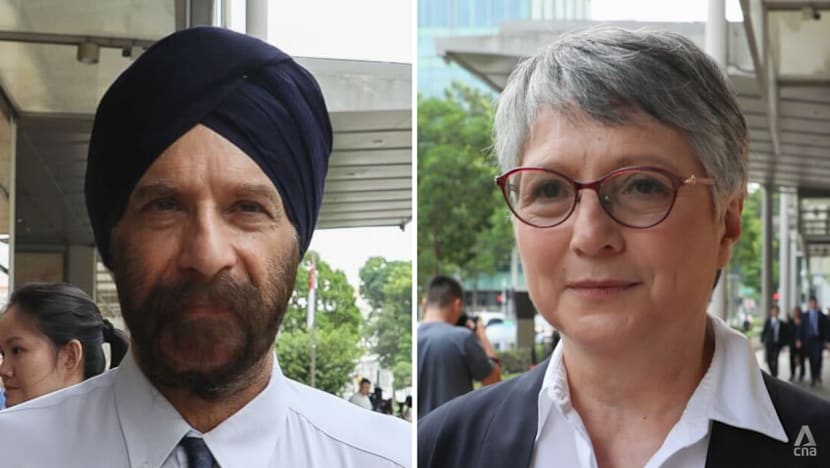 Senior Counsel Davinder Singh (left), lead lawyer for Ministers Tan See Leng and K Shanmugam, and Bloomberg editor Ms Madeleine Lim at the High Court on Apr 10, 2026. (Photos: CNA/Alyssa Tan)
To this, Mr Singh showed Ms Lim an email she sent to other Bloomberg staff around Christmas 2024. In the email, she asked for the story to be made publicly accessible "given we would like people to be able to read it and judge for themselves".
This was after Bloomberg received correction directions from the Protection from Online Falsehoods and Manipulation Act (POFMA) office to put up certain correction notices on the article.
In Ms Lim's affidavit, she had said that the paywall was lifted to comply with the correction directions.
She testified that the notice could not be prominently displayed on Bloomberg's website as the paywall cut most of it off.
However, Mr Singh suggested to her that the real reason the paywall was removed was because Bloomberg wanted the public to read the story and Bloomberg's statement defending its report.
"I put it to you that based on these documents, that in doing that, Bloomberg aggravated the libel," said Mr Singh.
Ms Lim disagreed.
He also charged that the paywall removal was so that "Bloomberg could tell the world" that it did not accept the Singapore government's position, and that it was challenging it.
"You wanted to be seen to be standing up to the government of Singapore," said Mr Singh.
Ms Lim disagreed again.
SOURCE CONFIDENTIALITY?
Mr Singh also took issue at how Bloomberg "withheld" internal emails that were requested by the ministers for the trial. The emails were later produced following a court order.
Responding, Ms Lim testified that she felt the emails were "not material" to the case.
She explained how Bloomberg's newsroom works - with various people chipping in with story ideas and tips.
"Ultimately, we did not write a story about Mr Shanmugam's home purchase, we wrote a trend story about GCBs," she said.
She also cited the issue of source confidentiality as a reason why Bloomberg did not voluntarily submit these emails as evidence.
To this, Mr Singh said the emails could have been redacted.
One of the withheld emails relates to a comment made to a journalist that Mr Shanmugam had sold his bungalow to the wife of a Chinese businessman. This businessman was referred to in court as "Mr X".
Mr Shanmugam had earlier testified that he did not know who the ultimate beneficial owner of his Queen Astrid Park GCB was. He had sold the bungalow for S$88 million to a trust called Jasmine Villa Settlement, managed by UBS Trustees.
But government agencies knew who the buyer was as the transaction had to be declared to the agencies, the minister previously said.
NAMING AND SHAMING?
In another line of questioning, Mr Singh asked if there was any intention by Bloomberg to shame the people named in its article, later citing an email by another Bloomberg news employee who had expressed concern over "naming and shaming" people who were mentioned in Mr Low's article.
"No. We write about wealthy people, that is what we do," said Ms Lim in response. "We wanted to be fair and accurate. Shaming is not what we do."
The email by Bloomberg editor Stephanie Phang had asked if the team was "OK with the tone".
"Are we looking like we have a bias against rich Chinese, for example," the email read. "Wonder if we should run by lawyers to check if we are OK naming and shaming the people in the story if their purchases were not previously known."
Mr Singh then asked Ms Lim if her evidence was that this email was not material to the defamation case, to which Ms Lim said she did not know why Ms Phang had framed it that way.
"Well, I can't judge whether it's material or not, but what I can say is ... this is part of the story process, rigorous, enforcing our editorial standards, for senior managers to look at the story and give feedback," said Ms Lim.
To this, Mr Singh pointed out that Ms Lim had previously been certain that the earlier emails relating to source confidentiality were immaterial to the case.
"But now when I ask you about materiality, you say you can't judge whether this is material," said Mr Singh.
The trial resumes on Monday with Mr Sreenivasan re-examining Ms Lim. Following that, Mr Low is expected to take the stand.