 3 months ago
139
3 months ago
139
During her second year of polytechnic, Ms Shanel Lim, then almost 18, took a pregnancy test with her then-boyfriend in a public toilet. When she saw the two lines on the test denoting a positive result, she broke down right there and then.
"I just crashed out and cried," she said.
Immediately, she made an appointment with a gynaecologist. That visit revealed that she was already approaching her third trimester.
What worried her more than the impending arrival of a newborn was the timing.
"I didn't want to add on to my already full plate," she said, citing family issues at home on top of her schooling.
She worked up the courage to tell her parents, who were initially upset. However, her mother soon shifted focus to making sure Ms Lim was eating well and getting enough nutrients for the baby.
As luck would have it, Ms Lim's estimated due date fell during her polytechnic holidays. She sat her exams two weeks before going into labour. After her one-month confinement, she went straight back to school – and quickly found herself struggling to balance education and childcare.
"The cost of raising a child really hit me like a truck," said Ms Lim. Milk powder and diapers were her two biggest expenses.
As a single mother, Ms Lim was not entitled to the Baby Bonus, a government scheme that provides cash gifts and co-savings for married couples with children.
"Children of single parents are still children of Singapore," she said.
She spent her remaining time in polytechnic picking up as many part-time retail shifts as she could outside of classes.
To get the most bang for her buck, she also diligently tracked flash sales on Shopee, made her purchases in bulk and trawled Baby Expos for deals – although even those, she found, were not that much cheaper.
Ms Lim is now 26, working as a pre-school teacher. She is concurrently pursuing a part-time degree in early childhood education.
Looking back, she told CNA TODAY that motherhood has ultimately "focused" her.
"It has pushed me to climb higher, get a better salary and provide my child with a better quality of life."
According to the Immigration and Checkpoints Authority's Report on Registration of Births and Deaths 2024, 244 babies were born to mothers aged 19 and below in 2024.
This is a 7 per cent increase from 228 the year before, and a 12 per cent rise from the 2022 number of 218 babies.
The myriad challenges of teen motherhood, however, do not look the same for everyone.
For Phoebe (not her real name), the news came at the age of 16, while on an overseas trip fresh out of completing her N-Levels.
Despite bracing herself for judgment and negative comments from people around her, none ever came.
Her small circle of friends, made up of people she had known for years, were unfazed.
They remembered her daughter's birthday, offered to help with her craft business, and checked in regularly. "I'm happy that I met them," said Phoebe, whose daughter turns three in August.
Long before the pregnancy, Phoebe had been steadily building a small beading business, making and selling key chains, crystal bracelets and other customised items.
Now, the 20-year-old has rebranded her craft business and is growing it steadily, with plans to travel to China to network with suppliers when her daughter is older.
Ms Noor Haslinda Md Sood, a senior social worker at Babes Pregnancy Crisis Support, said that despite Phoebe's experience, not all teen mothers in Singapore are spared from negative judgment.
"Things have improved so much because people are more aware. Society has become (more) accepting and understanding," she said.
"There's less blaming, less stereotyping than before, (but) the stigma is still there."
THE EMOTIONAL TOLL OF BEING A YOUNG MOTHER
Ms Hannah Chun, 41, has always had a rebellious streak. But when she found out she was pregnant at 18, she remembered feeling "a lot of fear and uncertainty".
Nevertheless, she broke the news to her family calmly with no tears.
"It was more of, 'I'm telling you, and you need to accept it'," she said.
Ms Chun said this bravado stemmed from having to step up at the tender age of 14 to shoulder the responsibility of making ends meet at home, including paying the household bills.
Because of this, when she discovered her pregnancy at 18, she had not fully registered how young she was at the time. Beneath the tough front she put up, she confessed to "a lot of brokenness" on the inside.
Having grown up in a broken family, however, the pregnancy offered her a small, unexpected joy.
"The situation with the baby's father was problematic, and I didn't know what to expect – but I was happy to have the baby," said Ms Chun.
There was just one snag: She was already waiting to serve an 18-month sentence in prison for a drug-related offence.
Ms Chun described her emotional state during her pregnancy as "unpredictable", compounded by her young age and the extent of the uncertainties she faced.
"There were moments of depression that I didn't understand or know how to articulate then," said Ms Chun.
Ms Chun gave birth while serving her sentence. Her newborn son stayed with her in prison for one month before he was sent out to be cared for by her sister and mother.
By the time she was released, he was already one and a half years old.
After prison, Ms Chun spent her days working sales jobs and her nights picking up shifts as a nightclub hostess. The goal was simple: To earn as much money as possible, but also enjoy her youth as much as she could.
"I still wanted to have fun. I didn't want to be stuck just like that," said Ms Chun.
"My childish mind was telling me: 'Just have a lot of money. You can solve a lot of problems (with money)'."
Torn between the need to provide for her son and the little quality time she could spend with him, Ms Chun spent her early 20s feeling like she wasn't a "good" mother. She was able to meet her son's physical needs – but many of his emotional ones went unattended.
Over time, Ms Chun began to notice that her son was struggling. He seemed emotionally insecure and had started acting out in school.
"I came to realise that every decision I was making was not right for my child. I was pretending to be okay, but it was harming my child," she said.
Ms Chun resolved to work on improving herself. That meant quitting her nightclub job, cutting ties with her old social circle, and learning to be with her child rather than just being productive.
"(I had to do) a lot of work learning to be a parent that's present," she said.
 An old photo of Ms Hannah Chun with her son, then aged 10. (Photo: Hannah Chun)
Today, Ms Chun has three other children with her current husband, aged seven, 11 and 14. She described herself as "a very different mother" now. Her eldest son is now 23 years old.
"The attention I give to (my younger kids) is so different from how I was with my oldest. (With him,) I was still figuring myself out."
Her husband's stable family, she added, gave her a positive template for parenting that she had never had before.
"I started to understand things differently," she said – most importantly, prioritising time spent with her kids.
Today, Ms Chun is finding fulfilment in doing volunteer work in a prison ministry and being a stay-at-home mother.
Asked what advice she would give to her younger self, Ms Chun was quick to answer: "Really work on yourself first, then work on whatever is external."
A GROUNDING PURPOSE
Immediately after leaving secondary school, Ms Catt Tan drifted through life with no direction. After failing her O-Levels, she was accepted into the National Institute of Technical Education (ITE) Certificate course but chose not to attend.
Then she enrolled in a diploma programme in professional makeup, but dropped out soon after. Soon after, she subsequently signed up for a hair course at Toni & Guy but dropped out as well.
By 18, she was working the counter of a yoghurt shop, but didn't have any thoughts or plans for the future.
Then she found out she was pregnant.
She was scared and even thought about terminating her pregnancy, but her then-boyfriend's mother advised against it.
However, her own mother took some convincing. She was upset initially, but once she saw that her daughter was determined to keep the baby, she came around.
"Now she and my son have quite a close relationship," said Ms Tan, now 32.
Within three months, she and her boyfriend were married and are still together to this day.
For the first four years of her son's life, Ms Tan was a stay-at-home mum. Her world shrank rapidly – other than a few other mothers at her son's kindergarten who were kind enough not to make her youth an issue, she rarely interacted with other adults.
"It was a little bit lonely," laughed Ms Tan. "You're at home with your kid the entire day; you just talk to your baby."
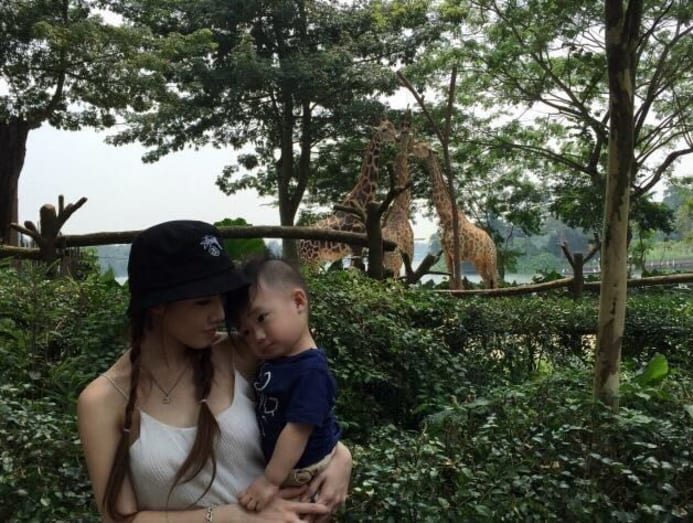 A 2014 photo of Ms Catt Tan with her son, then aged one. (Photo: Catt Tan)
In 2017, when her son turned four, Ms Tan ventured back into the working world. With the support of her husband, mother-in-law and a domestic helper, she entered the real estate business.
Returning to work after four years at home, she said, was not as daunting as it might have been for others.
Working as a real estate agent offered Ms Tan flexibility but also introduced a new kind of uncertainty. Ms Tan described herself as an introvert who had never been a natural salesperson.
"I was so young, and I didn't know if people would trust me," she said. "I had a lot of self-doubt."
Meanwhile, Ms Tan's husband, Mr Glenn Tan, had entered the tattoo industry immediately after National Service (NS) and worked at a studio before opening his own in 2017 at the age of 24.
After Ms Tan completed two years in the real estate business, her husband's tattoo business began to pick up. Soon, he found himself in need of a female artist.
Ms Tan decided to try her hand at tattooing, and never looked back. Today, she is a tattoo artist and co-owns Inkvasion Tattoo studio in Far East Plaza with her husband.
Motherhood, said Ms Tan, gave her something she had not had before: A sense of purpose.
"Some people know exactly what they want to be: A doctor, a lawyer. I didn't have any of that. I thought, 'Okay, I'll be a mum'."
Ms Tan gave much credit to the support she received from her parents and in-laws, without which the experience of teen parenthood would have been "torturous".
"I got lucky. Not everyone does," she said.
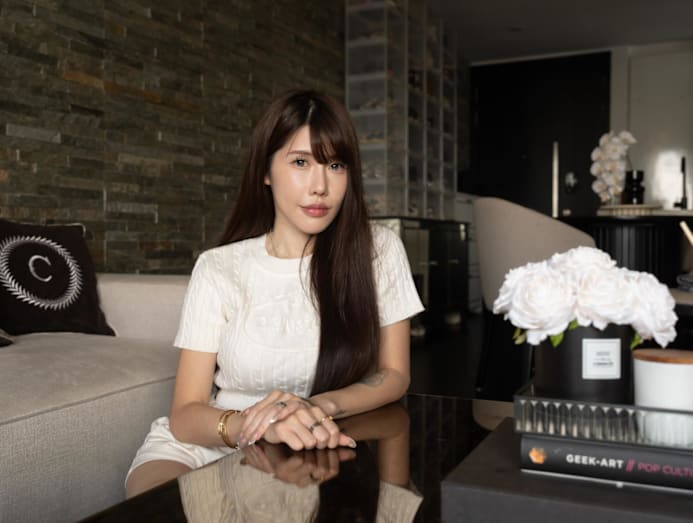 Ms Catt Tan, now 32, became a mother at the age of 18. (Photo: CNA/Justin Tan)
After spending her youth drifting through the motions, becoming a parent at a young age had also sparked a new drive in her.
For starters, she was 25 when she and her husband purchased their first flat. "If I didn't have a child, at 25 I'd probably still be at my mum's house, not caring about anything," said Ms Tan.
"Now I really want to earn as much as I can, upgrade our house, take my son overseas and show him the world.”
‘A DIFFERENT PATH’
Ms Adlin Zulaikha had barely completed her first semester at polytechnic when she found out she was pregnant. She was just 17 at the time.
Privately, she shared the news with a close friend. But to her surprise, the news spread among her schoolmates before she quite knew what was happening, even reaching the ears of students in other polytechnics.
"It was shocking, to say the least," said Ms Adlin, now 20. However, her parents were harder to face.
"(My mother) was talking a lot about adoption, even quite late into the pregnancy," she recalled. The tension with her parents lasted all the way until she gave birth.
Ms Adlin initially postponed her second semester at polytechnic, hoping to return later. But after giving birth, she realised she could not cope with attending classes five days a week while caring for a newborn.
Dropping out of school was a hard decision for Ms Adlin. Upon officially dropping out, dealing with the ensuing uncertainty proved to be even harder.
Her then-boyfriend had dropped out of school to support her during her pregnancy. After giving birth, Ms Adlin went through a few different jobs including working as an assistant teacher, but kept falling sick along with her baby.
She eventually settled into private babysitting, where she could organise her schedule around her daughter's.
The couple waited until they were both 18 to take marriage prep classes. Upon completing the course, they married in February 2025, about a year after their daughter was born.
Ms Adlin's husband is now serving NS. With him unable to earn anything beyond his allowance, she said, funds are tight.
His parents provide some assistance financially, while hers help with childcare.
"I'm grateful for my parents' help,” said Ms Adlin.
After several months spent shuttling between her family's place in Jurong and his family's flat in Admiralty, they secured a Housing and Development Board rental flat last November.
"It feels really nice. I'm in control of my own space, my own way of life," she said.
Becoming a mother at 17 also meant navigating reactions from people who were not quite sure what to make of her.
For instance, Ms Adlin joined online parenting groups hoping for guidance, only to find herself overwhelmed by rigid rules and judgment that extended to even the smallest decisions.
She recalled one incident where she asked an online group when she could start giving her daughter apple juice, only to receive a barrage of responses condemning her.
"I didn't come here to be judged. I just wanted to give my child apple juice," she said.
Taking her one-year-old baby to playgrounds and playdates was fine, but even casually mentioning that she was 19 would instantly change the atmosphere, she said.
One parent told her bluntly that she was wasting her youth on a child.
Slights and negative comments didn't come only from strangers.
Ms Adlin recalled one family member suggesting that she give her daughter up for adoption so she could earn money and study instead.
"That definitely pushed me to work harder (to provide for my child)," said Ms Adlin.
 Ms Adlin Zulaikha, 20, with her husband and daughter. (Photo: Adlin Zulaikha)
Despite discouraging encounters and exchanges, Ms Adlin made a conscious decision to look forward rather than dwell inward.
"If I'm sad all the time, (my daughter) is going to understand that I'm sad eventually, and she's going to pick up (bad) habits that I am picking up.”
She has also learned to let negative judgment roll off her back. "It's how people want to perceive me. If they want to be (nice) about it, great. Otherwise, it's okay."
A key factor in mitigating stigma such as these, said Ms Noor the social worker, is not just how society at-large treats these young mothers but the support system around each of them.
She said having family and friends to help with day-to-day struggles, for instance, can have a great impact. "It doesn't get easier, but it (can) get better."
Some stings are harder to soothe, however.
Ms Adlin confessed that she hadn't expected it to be so painful to watch her polytechnic friends graduate this year with their diplomas in hand. She had quietly applied to re-enrol in her diploma programme in January this year, but never received a reply from the school.
She's now looking at part-time diplomas and taking a Google digital marketing course on Coursera. Her sights are set on the marketing industry and on Google's Singapore office, where a campus visit once left a lasting impression.
She and her husband are also in the midst of discussions about applying for a Build-to-Order flat. Ms Adlin's other dream, she added with a laugh, is to become a radio DJ.
"It's just a longer path," she said. "Honestly, I think I have a different path set for me and, hopefully, I'll get somewhere."