 2 months ago
107
2 months ago
107
Singapore’s pledge of US$12 million (S$15.4 million) is a continuation of its earlier US$15 million contribution made in 2022.
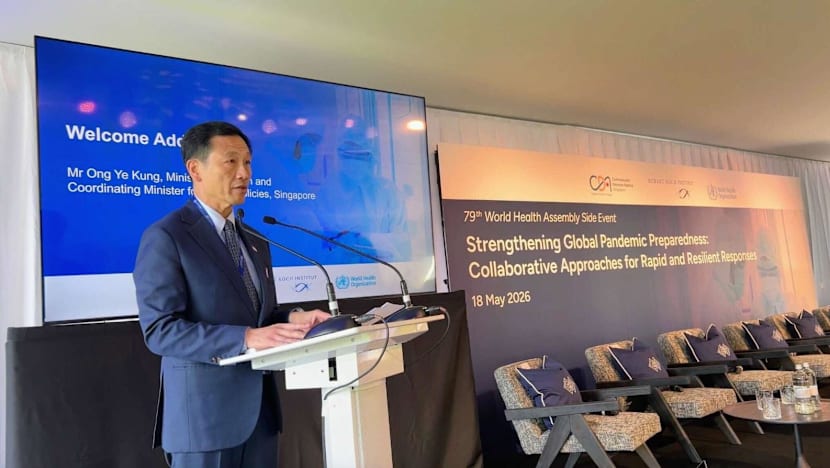
Health Minister Ong Ye Kung delivers a speech at the 79th World Health Assembly side event on strengthening global pandemic preparedness on May 18, 2026 in Geneva, Switzerland. (Photo: Ministry of Health)
New: You can now listen to articles.

This audio is generated by an AI tool.

SINGAPORE: Singapore will contribute US$12 million (S$15.4 million) over four years to the Coalition for Epidemic Preparedness Innovations (CEPI), the Ministry of Health said in a news release on Tuesday (May 19).
Singapore has been a partner of CEPI, a global partnership that works to accelerate the development of vaccines and other biologic countermeasures against epidemic and pandemic threats, since 2020.
The country’s latest pledge of US$12 million will be for the period 2027 to 2030 and is a continuation of its earlier contribution of US$15 million made in 2022.
Central to CEPI’s pandemic-beating plan is the “100 Days Mission” to develop safe, effective and accessible vaccines against new threats in 100 days.
At a side event at the 79th World Health Assembly (WHA) in Geneva, Switzerland, Minister for Health Ong Ye Kung said that the mission draws on global networks of laboratories, manufacturers, researchers and regulators.
"It is developing prototype vaccine solutions across key virus families, so that when a pandemic crisis arrives, much of the groundwork is already done," he said.
“We support these efforts through technical exchanges and research collaborations with CEPI and its partners, and continue to contribute to CEPI’s call for investment.”
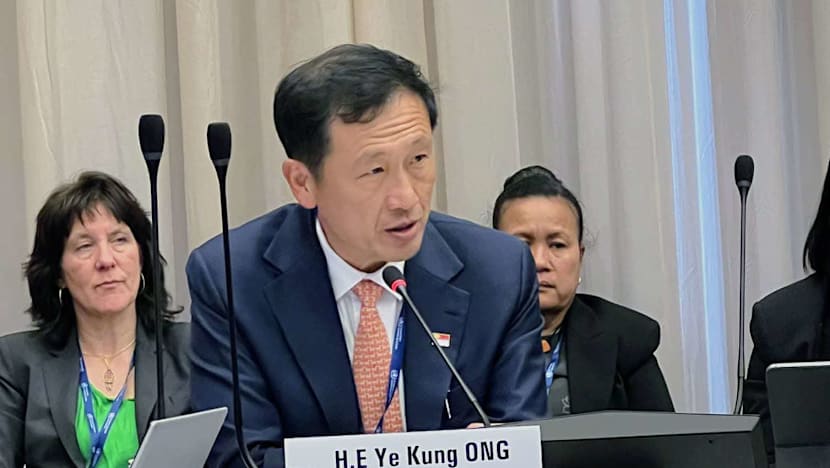 Minister for Health and Coordinating Minister for Social Policies Ong Ye Kung delivers Singapore’s speech at a CEPI side event at the 79th WHA in Geneva, Switzerland, on May 19, 2026. (Photo: Ministry of Health)
In a media release later on Tuesday, CEPI highlighted Singapore's strong innovation, manufacturing capabilities and regional reach.
"Singapore is a valued partner for CEPI across activities including preparing for regional threats, developing globally distributed RNA manufacturing design capabilities, and strengthening regulatory systems," said the coalition.
"Singapore’s leadership and continued investment in CEPI reflect a shared commitment to global health security and building capabilities that can protect populations in Asia and globally against epidemic and pandemic threats."
On Tuesday, Singapore announced stepped-up public health measures following the Ebola outbreak in Democratic Republic of Congo (DRC) and Uganda to prevent imported cases.
The outbreak has resulted in at least 131 deaths and 513 suspected cases, leaving World Health Organization (WHO) chief Tedros Adhanom Ghebreyesus "deeply concerned about the scale and speed of the epidemic".
“The WHO has declared the Ebola outbreak in the Democratic Republic of the Congo and Uganda as a public health emergency of international concern, while hantavirus infections in other parts of the world are also drawing close attention from public health authorities,” said Mr Ong.
“These are timely reminders that infectious disease threats continue to emerge and evolve.”
The European Union (EU) has meanwhile pledged €73.7 million (US$85 million) to CEPI through its Horizon Europe framework programme.
"The major new commitments made by the EU and Singapore are a vital signal of global resolve and leadership that bring us closer to realising CEPI 3.0’s transformative potential," said CEPI CEO Richard Hatchett, referring to the coalition’s five-year strategy for 2027 to 2031.
"Concurrent outbreaks of hantavirus and Ebola caused by Bundibugyo virus serve as stark reminders that the gap between the threats we face and our readiness to meet them remains dangerously wide. These investments will help strengthen the world’s disease defences so we are ready to respond rapidly and equitably to emerging viral threats.”
Separately, Mr Ong, who is also Coordinating Minister for Social Policies, signed two Memorandums of Understanding (MOUs) at the sidelines of the World Health Assembly.
The first, signed with the Philippines, will enhance cooperation in areas including primary care, health promotion, and healthcare human resource development.
The second MOU, signed with Finland, will enhance cooperation on health promotion, community care for seniors and technology in health, among other areas.