 3 months ago
157
3 months ago
157
Bali’s governor has said the most recent cases, the sexual assaults of three foreign tourists within three days last month, are isolated incidents. But some tourism players want the local government to do more.
 A woman poses in a sculpture of a giant mythical creature at the Tegallalang rice terraces near Ubud in Bali. The Indonesian island has seen a recent spate of violent crimes targeting foreigners. (Photo: AFP/Mladen Antonov)
New: You can now listen to articles.

This audio is generated by an AI tool.

JAKARTA: Some hotels in Bali are stepping up security measures after a recent spate of violent crimes, including three foreign tourists sexually assaulted in as many days last month.
Industry insiders and observers say gaps such as weak oversight of accommodation providers should be tackled to give visitors a greater sense of safety, even as Bali’s governor has maintained the island remains safe and tourism continues as normal.
The sexual assault cases, which occurred separately on Mar 23 to 25, are isolated incidents, Governor Wayan Koster reportedly said on Mar 26. Bali police have arrested three Indonesian men in connection with the crimes.
The first case involved a woman from China who was returning to Wingsu Guest House in North Kuta from a night club in an intoxicated state at around 4.30am, according to the Indonesian National Police.
She got on the perpetrator’s motorcycle but could not remember if she used an app or a traditional motorcycle taxi, the police said.
The perpetrator raped her in a grassy area in Labuansait. The police arrested the 23-year-old suspect when he returned to the guesthouse to try to return the woman’s mobile phone, the police said.
The second case, on Mar 24, involved an Australian woman who was raped by a security staff member of a Seminyak nightclub when she returned to the club for personal items she had left behind, Bali police said.
The suspect, 29, allegedly raped her in the nightclub’s toilet at around 4am, the police said. He was arrested on Mar 26.
The third case involved a Chinese national and took place in Canggu in North Kuta. The woman had returned at around 4am from a nightspot and could not find her hotel room key, according to Bali police.
She went to the front desk for help and was later sexually assaulted by the perpetrator. The suspect, 24, has been variously described in media reports as a front-desk employee and a freelance security staff member of the hotel.
At least two foreigners have also been killed in Bali in the last two months.
A Dutchman was fatally stabbed on Mar 23 while returning to his villa in North Kuta with his Indonesian girlfriend. He was attacked by two unidentified men and later died in hospital, according to the authorities, as reported by The Jakarta Post. The police were working to identify the attackers.
In February, Ukrainian tourist Igor Komarov was kidnapped and killed in the Jimbaran area by a group of foreigners while riding scooters with two friends, reported The Jakarta Post.
He was kidnapped on Feb 15. A video of him pleading for help surfaced before his body was discovered on Feb 27, about 30km from where he was abducted. The authorities have identified six suspects, who remain at large, The Jakarta Post reported.
MORE PATROLS, TIGHTER ACCESS CONTROL
Yolla Oktavia, director of talent and culture at Ayodya Resort in Bali’s upscale Nusa Dua area, said the hotel has strengthened various security measures, such as increasing patrols, installing CCTV in public areas and providing staff with training to handle emergencies and protect guest privacy.
“We also review and adjust our standard operating procedures, such as tightening access control, increasing monitoring in vulnerable areas and enhancing communication with guests,” she said.
“Most guests are still comfortable as long as they receive clear information and good service from the hotel,” she told CNA.
Hotelier Avi Purnomo, whose company operates 29 bungalows in the Sanur area, said he has not seen any significant concern among tourists, especially those staying in “well-established hotels”.
But “we are not turning a blind eye” to the recent crimes, he said. He declined to name his company, but said it maintains “strict measures”.
“For example, it is not possible for a front-office staff member to be on duty alone at night. There are always several staff members, so they cannot act arbitrarily,” said Avi, who is also chairman of the Sanur Hospitality Forum.
“We also conduct regular CCTV checks and patrols. Those are standard practices in established hotels,” he said.
 Kuta Beach in Bali on May 27, 2025. The Indonesian island is known for its surf and unique culture, but overdevelopment and the lack of oversight have become concerns. (Photo: AFP/Sonny Tumbelaka)
Bali Governor Wayan, meanwhile, has said the island’s “security, stability, tourism activities and public services continue to run optimally”.
“The Bali provincial government is committed to maintaining this trust through concrete actions, collaboration and swift responses to every issue that arises,” he said on Mar 26, as quoted by Media Indonesia.
But Avi said the local government can do more by stepping up oversight of accommodation providers.
“Accommodations are emerging everywhere without proper control, without any certification, and they are simply left as they are,” he said.
The common practice of converting residential properties into villas further complicates oversight, he added.
Evaluation mechanisms and enforcement should be stricter so that only industry players that meet standards are allowed to operate, Avi said. “There should be inspections to ensure whether these accommodations meet service and security standards, from guest check-in to check-out.”
Sapta Nirwandar, chairman of the Indonesia Halal Lifestyle Centre and Indonesia Tourism Forum, said that while the authorities should reaffirm Bali remains a safe destination, the message must be backed up by action.
“Law enforcement is crucial. The situation must be genuinely safe,” he said.
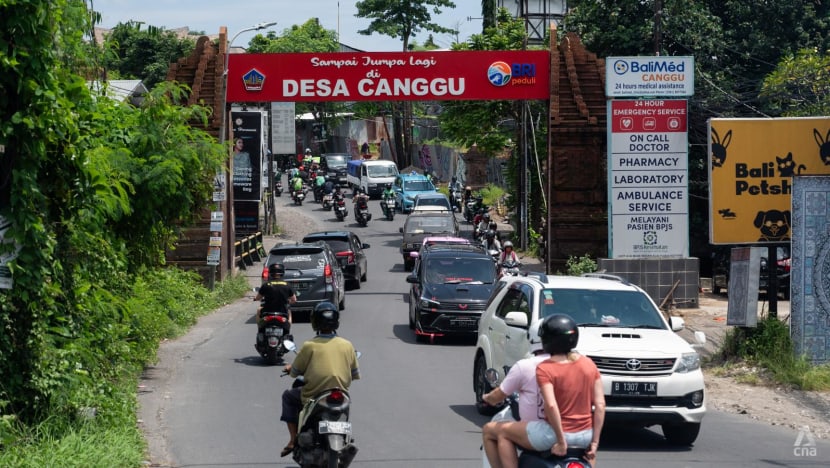 Crippling traffic is becoming the norm in Bali, especially in popular tourist areas like Canggu. (Photo: CNA/Wisnu Agung Prasetyo)
Last week, in the wake of the rape and sexual assault cases, Bali Police told tourists to take precautions and “minimise the opportunity that could cause a crime”, as its general crimes investigation director I Gede Adhi Mulyawarman put it.
“In these cases, based on the incidents and the available evidence, the perpetrators were given the opportunity to commit the crime,” Adhi said at the press conference on Mar 27, as reported by The Jakarta Post.
“For example, in some of the cases, most of the victims were going out at night alone until early morning, dressed appropriately for nightlife, and with no one around.”
Adhi denied any victim-blaming, saying: “We don’t blame anyone. Victims are still victims. We should prioritise them.”
He urged tourists to take precautions, such as by leaving night clubs before midnight, dressing appropriately and hiring official taxi drivers through apps, reported The Jakarta Post.
“If it is possible, do not go out alone after midnight,” he said.
 A traditional Balinese house with a terrace and courtyard. (Photo: iStock/m-gucci)
LAW ENFORCERS’ RESPONSE CRUCIAL
Observers said that as with other global destinations that draw a high volume of tourists, some level of crime in Bali is inevitable.
Bali attracted 6.94 million foreign tourists in 2025, a 9.72 percent increase from 2024, Antara news agency reported on Mar 28. Australia, China and India were its largest sources of foreign tourists.
According to data from the Bali police, there were 339 foreign victims of crimes on the island in 2025, a 47-per-cent increase from 230 foreign victims reported in 2024, media outlet Detik reported. Foreign perpetrators of crimes numbered 225 in 2025, a slight decrease from 230 recorded in 2024.
“The number of foreign nationals who have become victims is increasing. This is our collective responsibility,” Bali Police Chief Inspector General Daniel Adityajaya said at a press conference on Dec 30.
Theft and aggravated theft were the two most common crimes foreigners fell victim to, with 104 and 49 cases respectively, according to police data.
This was followed by 38 cases of assault, 36 cases of theft with violence and 28 cases of fraud, Detik reported.
The data was solely for cases handled by the Bali Police, Daniel said, and did not include violations that are handled by other authorities such as the immigration or national narcotics agencies.
Observers also noted that the types of crimes occurring there have shifted.
“It is not merely about the number of cases, but the type of crime is beginning to shift, from conventional crimes to more complex ones such as narcotics, violence and sexual violence,” said Taufan Rahmadi, an expert council member in the tourism sector at Burhanuddin Abdullah Centre, a research institute founded and named after a former Bank Indonesia governor.
On whether the recent spate of violent crimes could lead to a drop in tourism, observers said it was possible, but more depends on how the authorities respond.
“If Bali is not safe, it will reduce the number of people going there. Not only foreign tourists, but domestic tourists as well,” said Sapta.
Taufan said Bali’s image would be dented if law enforcers do not manage the recent cases properly.
“If the response is swift, transparent and firm, in my view it will strengthen the perception of Bali as a destination with a credible security system,” he said.