 4 months ago
152
4 months ago
152
SINGAPORE: The Singapore Police Force (SPF) on Friday (May 22) unveiled new drones to conduct aerial patrols and help officers respond to emergencies on the ground and at sea.
Called the Home Team SkyGuardian, the drones help the police cover areas that are typically harder to surveil through conventional means, such as industrial-maritime zones and remote or inaccessible locations with limited street camera coverage.
“This level of automation in police drone operations is also among the first of its kind in the world for a highly urbanised operating environment,” said Second Minister for Home Affairs Edwin Tong at the police workplan seminar.
For a start, the drones will be deployed for routine aerial patrols, along designated pre-planned flight routes, said Mr Tong, who is also law minister.
However, there will be a human officer directly involved in remote operations, added the SPF.
Eight sets of the SkyGuardian have been deployed since the start of the month in industrial-maritime areas, such as Tuas and Brani, and Singapore’s southern islands.
The drones were among the unmanned capabilities showcased by the SPF at the Home Team Academy on Friday to more efficiently support frontline officers in patrols and incident response.
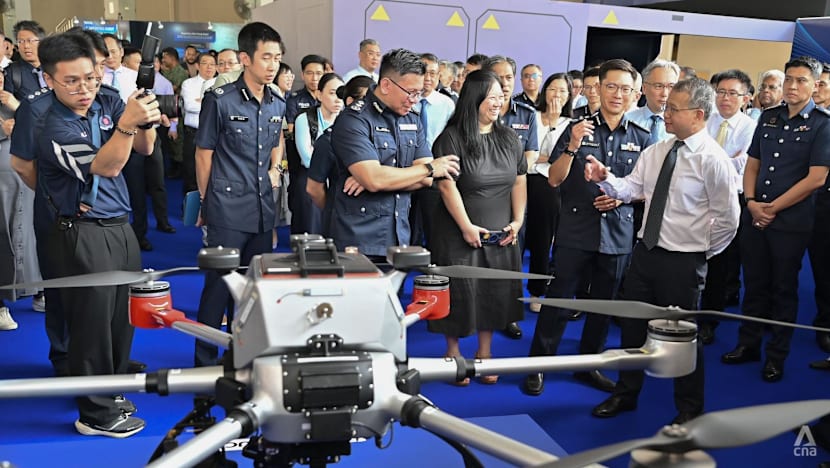 Second Minister for Home Affairs and Law Minister Edwin Tong views the Home Team SkyGuardian drone, May 22, 2026. (Photo: CNA/Alyssa Tan)
UNMANNED CAPABILITIES
Each drone comes with a drone box from which it will launch and return. The autonomous system can swap the drone’s battery pack and also equip it with different operational tools, which can also cater to the Singapore Civil Defence Force (SCDF).
These include cameras and high-definition thermal imaging systems for sensemaking and search and rescue operations. Flying at a speed of 10m per second, the six-motor arm drone weighs 40kg and can fly for 40 minutes at a time.
It also has emergency blinkers, a searchlight and a loudspeaker to support ground operations.
“This will enhance the SPF’s presence in the far corners of Singapore to deter criminal activities and provide an aerial perspective of the ground situation,” said Mr Tong.
“This new concept of patrol operations will enable faster detection of safety and security incidents, and importantly, also a faster response.”
He added that the Home Team has worked with the Civil Aviation Authority of Singapore to ensure the SkyGuardian system meets the stringent standards required for Beyond Visual Line of Sight (BVLOS) operations in urban airspace.
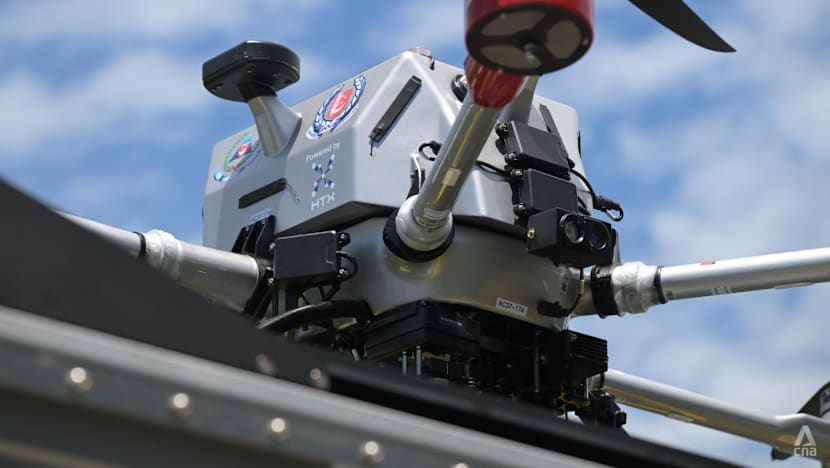 The Home Team SkyGuardian drone. (Photo: CNA/Syamil Sapari)
The police are also trialling an unmanned surface vessel to strengthen the Police Coast Guard’s maritime security operations.
Equipped with cameras, communication systems and integrated warning devices, it can operate fully autonomously, including tasks such as navigating, anchoring, avoiding collisions and berthing on its own.
This frees up officers for higher-value tasks, such as investigation and the boarding and search of other vessels.
Mr Tong observed the unmanned patrol vessel in operation in March.
“The officers who were with me that day shared that such technology will expand their operational capacity, and also help to strengthen their sensemaking of a threat situation. This in turn will enable them to respond to threats faster and more robustly,” he said.
ARTIFICIAL INTELLIGENCE
Also showcased on Friday was the SPF’s integration of artificial intelligence (AI) into its work processes to improve citizen experience and help officers navigate the complex security landscape.
It has worked with the Home Team Science and Technology Agency (HTX) to create AI products, from report lodging to post-investigation updates.
The Investigator Co-Pilot complements the SPF’s investigation case management system, CRIMES3, to let officers focus on higher-value analysis and case outcomes. A Case Summariser is also being piloted to help officers triage fresh police reports.
Moving forward, the SPF plans to let investigation officers input other evidence and findings, such as witness statements and CCTV footage, into a Summary of Facts generator.
A Case Recommender tool would also look at the evidence uncovered during investigations and assist investigators in deciding on an appropriate course of action for a case.
“Taken together, these tools enhance the efficiency as well as the effectiveness of the SPF’s investigations. Not by replacing the judgment of our officers, but really by sharpening it, and freeing up the officers to focus on what only a human officer can do,” said Mr Tong.
Another AI innovation is the Traffic Rule Analysis and Compliance Recognition (TRACER), a video analytics tool to help address traffic offences.
It can automatically identify traffic violations and pinpoint their exact timestamp in video recordings submitted by the public.
Designed with scalability in mind, the capability may also be applied to other types of video footage in future, said the SPF.
Mr Tong on Friday also lauded the police’s efforts in keeping Singapore safe and secure, noting the 25 per cent reduction in scam and cybercrime cases last year, along with the force’s efforts in major events such as the National Day Parade, Formula 1 race and Marina Bay New Year Countdown.
“In Singapore, we often take safety and security as a given, whereas in many other parts of the world, it is really not the norm,” he said.
“It is easy to take safety and security for granted here in Singapore, not just because the SPF carries out its mission well year after year, but also because it is always looking ahead to see what is on the horizon, and transforms and adapts accordingly to meet the evolving threat landscape.”