 4 months ago
143
4 months ago
143
The bloc is seeking to diversify supply chains and strengthen its global position, as it recalibrates trade relations with the United States and China.
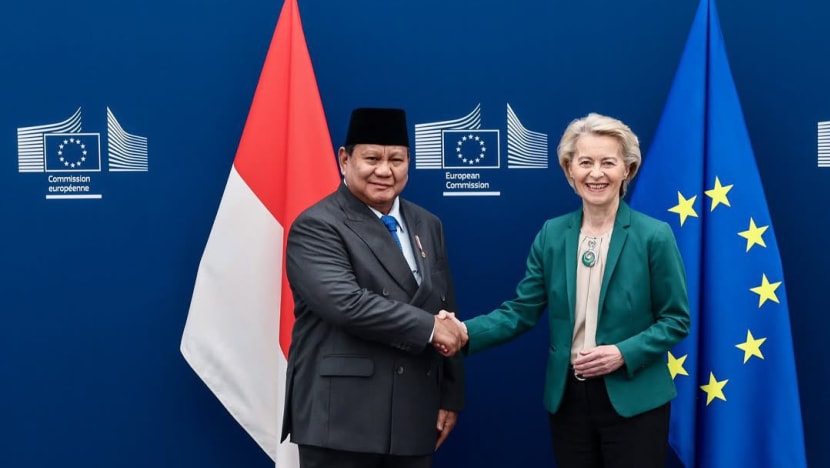
Indonesian President Prabowo Subianto and EU chief Ursula von der Leyen announced a "political agreement" to conclude a free trade deal on Jul 13, 2025. (Photo: Facebook/Prabowo Subianto)
New: You can now listen to articles.

This audio is generated by an AI tool.

BRUSSELS: The European Union is ramping up efforts to strengthen economic and strategic ties across the Asia-Pacific region, even as it recalibrates trade relations with the United States and China.
Despite this week’s breakthrough in a trade deal between the EU and the US, questions remain over where Europe fits into an increasingly fragmented global trade order.
One major milestone came earlier this year when India and the EU finally concluded negotiations on a long-awaited free trade agreement that first began in 2007.
Under the January agreement, India will cut tariffs on more than 96 per cent of EU goods exports, while the EU will remove or reduce tariffs on more than 99 per cent of imports from India.
The bloc says annual goods exports to India could more than double by 2032 as a result of the deal.
“This is the tale of two giants – the world’s second- and fourth-largest economies. Two giants who choose partnership in a true win-win fashion,” said European Commission president Ursula von der Leyen.
DIVERSIFYING SUPPLY CHAINS
But India is not the only focus of the EU’s Indo-Pacific trade push.
The bloc also concluded a major trade agreement with Indonesia last year following years of negotiations, and hopes to finalise deals with Malaysia, Thailand and the Philippines by the end of next year.
The flurry of deal-making underscores the EU’s efforts to diversify its supply chains and trading partners in the region to better weather geopolitical shocks.
The appetite for closer cooperation with Europe has shifted dramatically in recent years, said Kathleen Van Brempt, a Member of the European Parliament and vice-chair of the bloc’s committee on international trade.
At a panel discussion hosted by the Singapore-based Asia-Europe Foundation in Brussels on May 11, she noted: “They changed their minds … they said ‘Okay, (it’s) difficult with Europe with all this legislation but (Europe is) reliable, a beacon of trust.’”
The panel brought together EU officials and Asia experts to discuss cooperation in areas including trade, governance, education and digitalisation.
INCREASINGLY STRAINED TIES WITH BEIJING
A central challenge for policymakers remains balancing economic security with market openness.
China remains the EU’s second-largest goods trading partner, with trade amounting to roughly US$850 billion in 2024 alone.
But relations between Brussels and Beijing have become increasingly strained amid disputes over market access, state subsidies and Europe’s push to reduce reliance on Chinese supply chains.
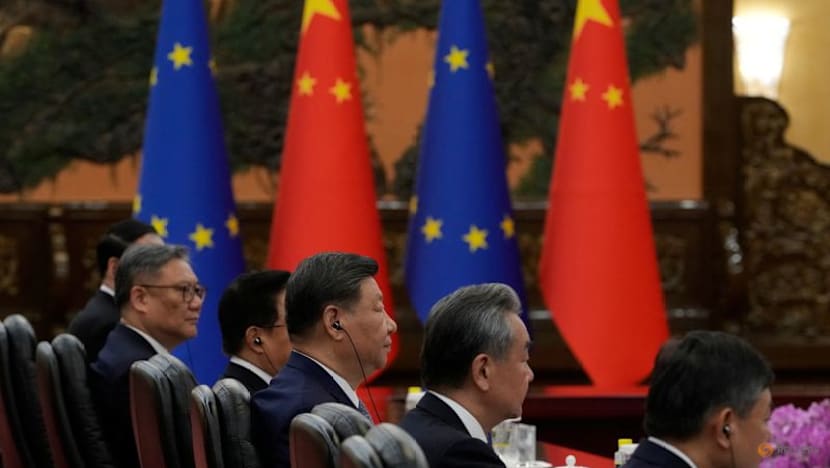 Chinese President Xi Jinping and Chinese Foreign Minister Wang Yi attend the EU-China summit at the Great Hall of the People in Beijing, China, July 24, 2025. Mahesh Kumar A./Pool via REUTERS
The European Commission says its strategy is to “de-risk” rather than decouple from China, while pursuing initiatives aimed at boosting Europe’s resilience and competitiveness on the world stage.
China, however, has said these moves amount to institutional discrimination.
Among the measures being considered are plans to phase out what the EU describes as high-risk foreign technology suppliers from Europe’s 5G networks.
Beijing has called the move protectionist, though some analysts argue there could be a degree of political posturing involved.
“We are racking up a lot of leverage and potential frictions against China, and I would say there’s only one reason you would do that,” said Hosuk Lee-Makiyama, director of the European Centre for International Political Economy – a global economy think-tank based in Brussels.
“It’s because (here in Europe), we’re forced against our will into a deal with China whether we want it or not, because Americans are doing a deal with China.”
For now, the impact of last week’s historic summit between US President Donald Trump and Chinese President Xi Jinping for Europe remains uncertain.
While an easing of tensions between Washington and Beijing could create economic opportunities, there are concerns Europe may find itself increasingly sidelined – particularly as EU-US trade relations continue to face challenges.