 2 months ago
105
2 months ago
105
SINGAPORE: In one livestream, a man repeatedly smashes his head with aluminium beverage cans while amused viewers flood the screen with likes and virtual gifts.
In another video, groups of participants lash each other’s legs and backs with hard leather belts and tree branches as the number of live viewers surges online.
These violent stunts are part of a disturbing genre in China - “brutality PK” livestreams where streamers compete on social media in real time for views and clout - often by inflicting pain and humiliation on themselves or others.
Short for “Player Kill”, a term that originated from traditional online gaming and once referred to lighthearted activities like singing contests and comedy roasts, PK livesteams have taken on a darker meaning in China.
On popular video and livestreaming platforms like Douyin and Kuaishou, some streamers carry out dangerous and often degrading acts for internet clout and even profits.
In a 40-second video seen by CNA on Bilibili, a popular Chinese live-streaming website similar to YouTube, an adult man is seen hitting a younger woman on her buttocks with a slipper repeatedly.
The video, captioned “Punishment for losing PK (battle)” - drew over 15,800 views and attracted dozens of comments.
“I can feel the pain even just by watching,” said one user, with another remarking that “hitting the buttocks is too crazy”.
Chinese cyber authorities say such content is “extremely harmful” and have launched recent action.
In Zhejiang province in eastern China, 13 people were arrested over staging abusive and degrading PK contests to attract traffic and boost earnings.
“To gain attention and virtual gifts, they performed extremely dangerous and degrading acts on camera,” read a report about the incident published by the state-owned Global Times on Apr 30.
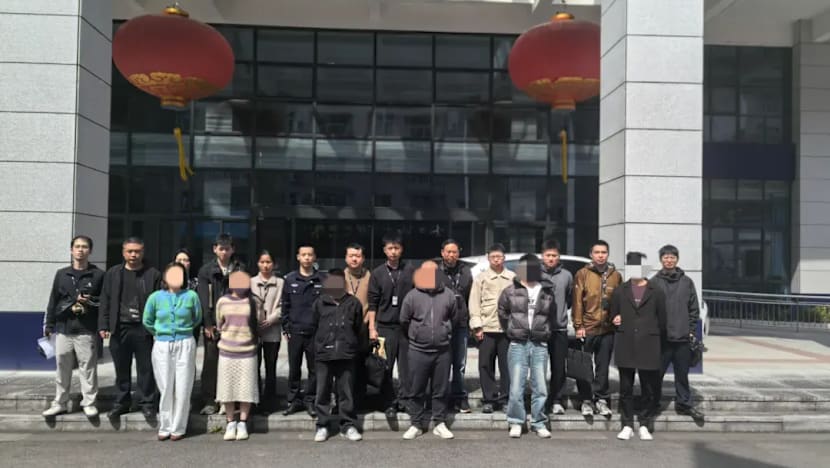 In Zhejiang province in eastern China, 13 people were arrested over staging abusive and degrading PK contests to attract traffic and boost earnings. (Photo: WeChat/Cybersecurity Bureau of the Ministry of Public Security)
Chinese cyber police took “swift and coordinated action”, the report said, adding that members of the public were encouraged to “consciously resist vulgar and violent content and promptly report illegal activity”.
“Streamers who chase attention through vulgarity and violence will face legal consequences,” read a statement released by China’s Ministry of Public Security, adding that social media platforms were required to “strengthen content censorship and adopt a zero‑tolerance policy toward rule‑violating accounts”.
“The public is encouraged to consciously resist vulgar and violent content and promptly report illegal activity to jointly safeguard a healthy online ecosystem,” the ministry said.
“SPECTACLE” OR FUELLING VIOLENCE?
China has been cracking down on cyber violence for years - imposing measures on minors like internet and gaming curfews and banning video games deemed to depict “sexual explicitness, goriness, violence and gambling”.
But despite warnings and action by cyberspace authorities, PK livestreams have been difficult to eradicate.
Last January, a married couple from Yunnan province in southwestern China were detained for making domestic violence videos to boost online traffic.
A viral video showed a frantic woman, surnamed Li, trying to escape from her husband, surnamed Cai, at home. She was eventually captured and restrained in a small room.
In another video, Li was seen sitting on the floor and sobbing, covered by a dirty quilt, while begging Cai for food.
According to Chinese media reports, the couple was placed under “administrative detention” for five days - over fabricating videos that “caused a negative impact on society”.
Cai later admitted to concocting the controversial clips to gain followers and also confessed that he had been jealous of online celebrities who made huge profits from livestreaming.
Another incident in 2025 saw four people from the southeastern Jiangxi province streaming themselves carrying out acts like stapling nails to their limbs, whipping themselves with belts and piercing their lips with pins.
The group was similarly punished for staging “vulgar livestreams”.
Disturbing and vulgar livestreaming content is “largely a result of intensifying competition within China’s livestreaming industry”, said Xu Jian, an associate professor from Deakin University.
“Audiences have become highly familiar with conventional formats like talent (shows and) performances so PK livestreamers are increasingly (staging) more sensational and exaggerated activities to attract attention,” Xu said.
“EXTREMELY DIFFICULT” TO CENSOR IN REAL TIME
Experts said many PK streamers easily bypass state censors and bans with their “strong understanding” of how platform moderation systems work.
“They often rely on euphemisms, indirect performances, or shifting interactions to private channels to avoid penalties,” said Guo Shaohua, an associate professor from Carleton College in Minnesota, noting that most social media platforms carried out moderation using AI - filtering out keywords to monitor and regulate content.
User reports are also vital for flagging inappropriate content, experts said.
Streamers who have been reported are more likely to attract “closer monitoring” by officials on platforms, said Deakin University’s Xu.
Warnings are usually issued first and those reported are required to “rectify” their content immediately, Xu said.
“But if the behaviour continues, the livestream may be terminated and the account temporarily or permanently banned,” he added.
The act of livestreaming also “unfolds in real time”, Guo said, adding that effective and thorough enforcement can prove to be “extremely difficult”.
“Creators constantly adapt their strategies to avoid detection,” he added.
In a prominent case that played out in 2023, a livestreamer on Douyin surnamed Wang, who went by the handle Bro3000, had been reported multiple times for drinking copious amounts of Red Bull and the potent Chinese liquor baijiu - mostly after losing drinking challenges.
Wang’s original Douyin account was banned for violating platform regulations but he later created new accounts and returned to the site - where he continued hosting live drinking matches.
He also covered up labels on alcohol bottles to evade site censors and eventually died after drinking four bottles of baijiu and three bottles of Red Bull.
Weeks after his death, another Chinese livestreamer, Huang Zhonyuan, died after consuming 10 bottles of alcohol in a single livestream.
But behind official crackdowns lies a deeper tension, experts said: Social media platforms are under pressure to police harmful content which at the same time, is also highly profitable.
Livestreamers can command millions of followers.
Top streamers can reportedly earn up to 40,000 yuan (around US$5875) a month through virtual gifts and audience donations - creating intense pressure to stand out in an increasingly crowded market.
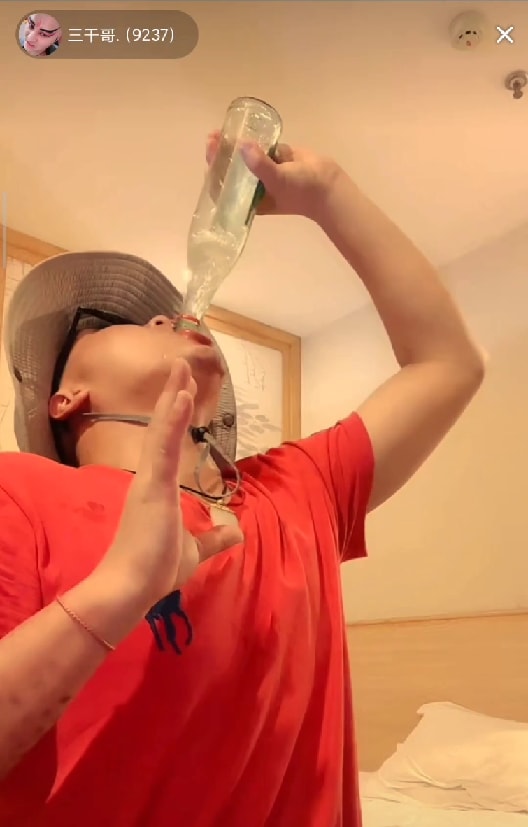 A livestreamer on Douyin surnamed Wang, who went by the handle Bro3000, was reported multiple times for drinking copious amounts of Red Bull and the potent Chinese liquor baijiu - mostly after losing drinking challenges. (Image: BiliBili/hhhhh是也)
“The more traffic a streamer attracts, the more virtual coins they receive in tips, and the higher the platform’s revenue,” an industry insider told Chinese state media agency Xinhua.
In China’s livestreaming economy, many platforms often take a cut of virtual gifts sent during broadcasts - turning spectacle directly into profit.
That creates little incentive for platforms to aggressively remove controversial livestreams unless they attract wider public scrutiny, said Wilson Wang from the University of Nottingham Ningbo China (UNNC).
“What the livestreaming platform cares about is whether you’re becoming famous enough to trigger broader attention from society, which may compel them to take action.”
“If you’re a less well-known livestreamer, normally the platform just does nothing,” Wang said.
Platforms can also be “a little passive” when implementing state policies, Wang said.
“They do have an interest in getting more profits and these vulgar PK livestreams are actually profitable,” he said.
For viewers, the appeal often lies less in the competition itself than in the spectacle surrounding it.
“It’s all about spectacle … Kind of like professional wrestling,” Wang said. “A lot of people know that it’s faked or staged. It’s not like actual boxing, but people enjoy watching it.”
Some viewers also openly urge livestreamers to escalate punishments or violence during PK battles, Wang noted.
“There are viewers who actually go: ‘Just go harder on yourself’,” he said.
“The audience would actually encourage such acts because they’re getting a sense of achievement out of that.”
In a comment on BiliBili, a user by the handle TeenageRiot, said he “simply enjoys trashy content” on violent livestreams.
Another user, Lin Qiqi, criticised social media platforms for enabling livestreamers. “There are many malicious actors stirring things up (and causing) all sorts of problems,” Lin said in a comment.
“If nothing is done to regulate this, (the internet) is going to get more terrifying.”
Some users also pointed out that there would always be viewers who enjoy watching violent PK livestreams.
Some viewers have become desensitised - expressing scepticism towards livestreamers who perform extreme acts.
One user, Beef Claypot Rice, shared that “nothing shocks him anymore” - especially when it comes to PK streamers who consume disgusting food mixtures for the camera.
“If they’re simply going to eat and then throw up, (it wouldn’t) shock me.”
“Now, if they ate and went to sleep without vomiting, that would be impressive.”