 3 months ago
149
3 months ago
149
At family gatherings, younger adults often want a degree of privacy while older relatives are looking for connection. Mother-of-two Nabilah Awang says both perspectives are valid, even if they don't always meet in the middle.
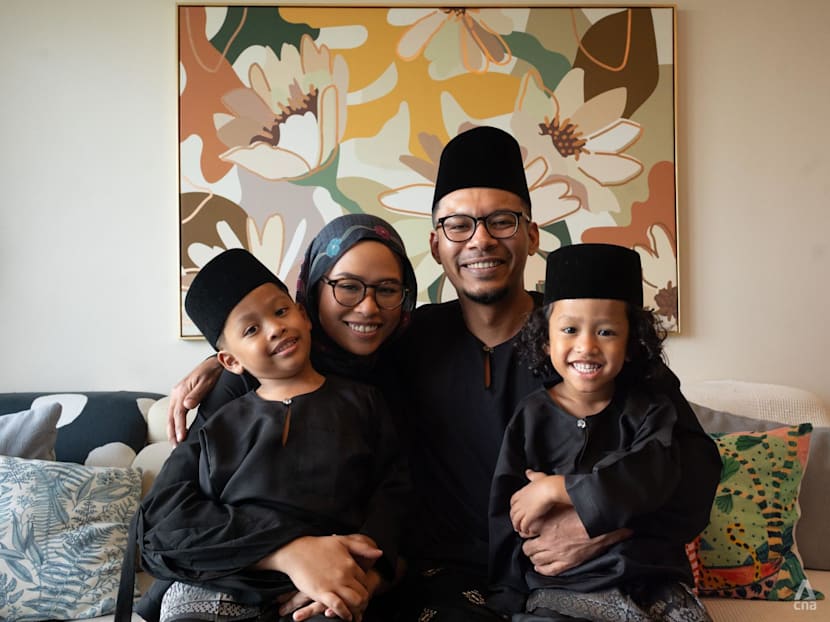
Ms Nabilah Awang with her family at home on Apr 2, 2026. (Photo: CNA/Justin Tan)
New: You can now listen to articles.

This audio is generated by an AI tool.

Every family gathering, like clockwork, the same questions from older relatives make their rounds: "When are you getting married?" "When’s the next baby coming?" "Have you gained some weight?"
At this point, it’s practically part of the menu for festive occasions such as Hari Raya, right next to the ketupat, the traditional rice cake.
This year, one relative leaned in and asked: "So, any good news or not?" before giving my stomach a not-so-subtle once-over with her eyes, as if a little weight gain must surely mean something more.
I didn’t quite know what to make of it. There was a flicker of self-consciousness, sure, but mostly it felt predictable. I have gotten used to this line of questioning.
So I did what I always do – I laughed it off and asked the relative about her work. No confrontation, no awkwardness. She wasn't offended, and I didn't have to explain myself. Win-win.
But doing this same dance every year got me thinking.
Why is it that we keep circling the same debate? Is it really harmless small talk, or does it cross a line? Should I be firmer about my boundaries, or is it easier to just let it slide?
WHEN GOOD INTENTION COMES ACROSS WRONG
The concept of "boundaries" often feels like a new-age one.
With so much conversation about them on social media, younger people today are far more aware of what it means to set boundaries and hold to them – and that is something I respect.
But I think that same awareness can sometimes make us quick to assume the worst of intentions, where even clumsy attempts at conversation from people we don't typically spend much time with in our day-to-day lives are read as deliberate overstepping.
On the flip side, older generations often see these inquiries as harmless questions, but they may not fully realise how loaded they can feel in today’s context.
Personally, I used to get triggered when older relatives would say: "Girls, please help in the kitchen", while my male cousins got to lounge in the living room.
I voiced my disagreement many times – not always very nicely, I'll admit.
But now that I'm older and able to understand that no ill intent is meant, I handle it differently. Instead of an angry outburst, I usually reply with something that subtly draws attention to being singled out, such as: "The more I stay in the kitchen, the more rendang I'm going to eat."
It usually earns a laugh, and everyone moves on.
 Ms Nabilah Awang said she has learnt to respond to personal questions with humour, keeping the mood light while gently deflecting those she would rather not answer. (Photo: CNA/Justin Tan)
To me, the perspectives of both younger people and the older generation make sense, but they do not always meet in the middle. One prioritises individual comfort while the other prioritises connection.
Both are valid, yet each can miss the other's point.
Younger people are more heavily influenced by evolving ideas of privacy and autonomy, while the older generations are shaped by longstanding practices in which questions about marriage, children and life milestones are simply part of extended family catch-ups.
This is why every year, whether it's Chinese New Year, Hari Raya or Deepavali, the same familiar questions tend to come out without fail when you're catching up with relatives you see only on these yearly occasions.
DRAWING BOUNDARIES GENTLY
This dichotomy raises a curious question: How do we respond in a way that respects both boundaries and connection?
To me, this is where intention matters.
If someone is asking from a place of comparison, pressure or thinly-veiled criticism, then yes, shut it down gently. You do not owe anyone access to your personal life just because it is a festive occasion.
But I'm not telling you to throw your songkok or any other kind of hat into the ring and go to battle.
Instead of defensiveness, try a gentler deflection. Is there a way you can find some humour in the exchange, to respond to their perhaps misguided attempt to connect rather than cut them off? Ask them about their life, their work, their kids – and steer clear of questions you would not want to be asked yourself.
The deflection method works wonders. It keeps the mood light, protects your privacy and still lets you stay in control without tension.
Or if you'd rather not go into it, my husband's fail-proof approach is to give non-committal responses: "Life is good. Kids are good. I'm good."
This satisfies curiosity without giving away too much, but if I'm being honest, I haven't yet mastered the art of it myself.
WHAT THESE QUESTIONS ARE REALLY ABOUT
If the intention is good, such as when someone is genuinely signalling care rather than judgment, then maybe we can afford a bit of grace, even if the question is awkwardly phrased or poorly timed.
And if it still feels uncomfortable, redirect. I often do this myself whenever I try to acknowledge loved ones' attempts to connect without oversharing about my life.
That's what special occasions like Hari Raya are truly about.
It is about showing up, visiting one another and keeping those connections alive. It's about putting in an effort to engage with each other, even if the conversations are a little clumsy and the questions a little too familiar.
You do not have to respond to every question – but it's good form to respond to the good intentions behind them.
You do not have to confront every person across the table who makes you feel uncomfortable, intentionally or otherwise. You do not have to turn an open house into a tense stand-off just to prove a point.
Sometimes the most powerful move is a smooth: "Eh, how about you?" and passing the baton right back.
And sometimes, rarely but importantly, it is knowing when it's okay to simply let the moment pass – like an extra piece of kuih when you're already full.
Nabilah Awang is an editor specialising in commodity insights. She is a mother of two.