 3 months ago
77
3 months ago
77
JAKARTA/SINGAPORE: Company closures, layoffs and rising unemployment in Indonesia in 2025 have laid bare the consequences should businesses in Southeast Asia’s largest economy fail to keep pace with shifting market dynamics and intensifying competition.
More than 79,000 workers were laid off between January and November 2025, according to data from Indonesia’s Ministry of Manpower. The figure marks an increase from 2024, when Indonesia recorded about 77,965 layoffs for the full year, highlighting a worsening trend in job losses.
One of the most high-profile casualties was PT Sri Rejeki Isman Tbk (Sritex), once a flagship name in the country’s textile and garment industry.
Hit by financial strain and weakening demand, and squeezed further by a flood of cheaper imports from China and Vietnam, Sritex shut its factory operations on March 1, 2025, triggering layoffs affecting 10,669 employees.
Sritex’s closure has raised the question: How do some companies survive and thrive while others are forced out?
Economists told CNA a company’s ability to survive and grow in current conditions, which include the threat of tariffs and shifting supply chains, is increasingly determined by its capacity to adapt.
“The common challenge we face lies in innovation and adaptability to changing market conditions, including shifts in consumer behaviour,” said economist Siwage Dharma Negara, co-coordinator of the Indonesia Studies Programme at ISEAS-Yusof Ishak Institute in Singapore.
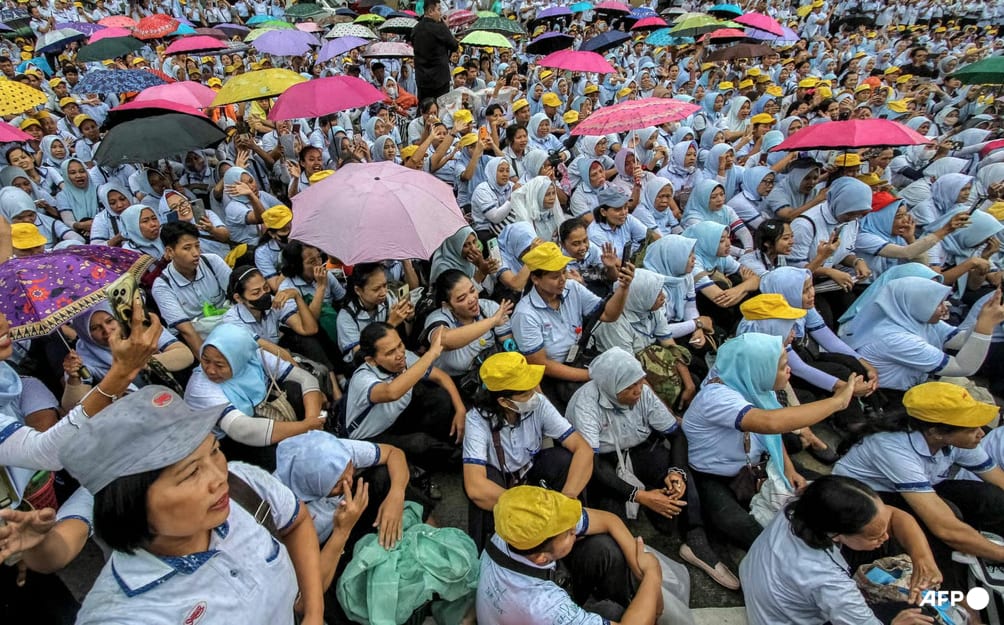 Former Sritex workers gather as they listen to a farewell speech in Sukoharjo, Central Java. (Photo: AFP)
Amid economic uncertainty, companies that can adapt to changing demand and adjust their business models stand a better chance of surviving and growing, while a conservative mindset and reliance on old ways risk holding back scalability, experts said.
Digitalisation is increasingly seen as a potential performance booster, but analysts have cautioned that efforts should go beyond surface-level changes and deliver tangible gains by cutting costs, speeding up processes and improving service quality.
“Digitalisation needs to be connected end to end, from ordering through to delivery, to deliver real efficiency. Partial digitalisation, by contrast, often amounts to little more than window-dressing,” Rizal Taifukurahman, head of macroeconomics and finance at the Institute for Development of Economics and Finance (INDEF) told CNA.
These issues and more will be discussed at the CNA Summit 2026 in Jakarta on Thursday (Feb 5).
Now in its seventh edition, the leadership forum brings together senior decision-makers and thought leaders to share perspectives and leadership choices that define smart growth in a new era of investment and innovation.
Launched in 2020, the CNA Summit has previously explored themes ranging from the digital economy and mental wellness to green recovery and leadership trade-offs.
The Jakarta event marks the first time the summit is being held outside Singapore. It will be broadcast to a global audience on CNA’s YouTube channel.
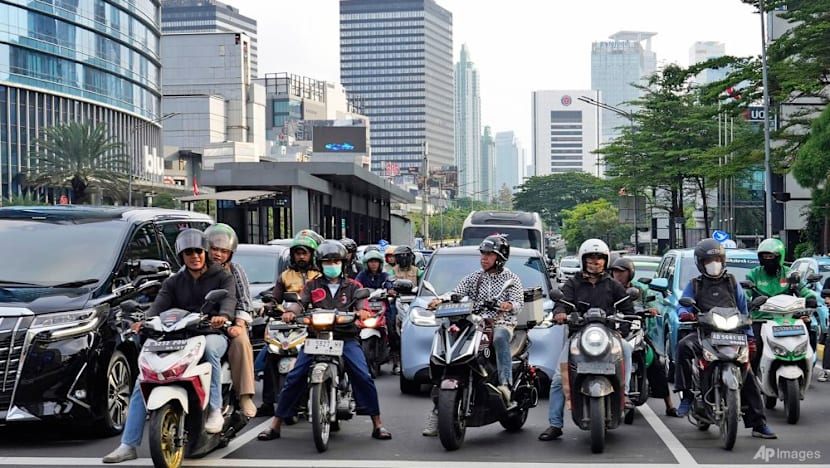 Motorists in Jakarta's main business district. (AP Photo/Tatan Syuflana)
CONSUMERS ARE CHANGING, COMPANIES SHOULD TOO
In recent years, rising price sensitivity has stood out as a defining shift in consumer behaviour, said Bhima Yudhistira, executive director of the Centre of Economics and Law Studies (CELIOS), a research institution.
NielsenIQ’s Mid-Year Consumer Outlook: Guide to 2025 shows Indonesian consumers becoming more selective and cautious in their spending amid price pressures, with 41 per cent saying they are more careful with spending and only 13 per cent feeling financially secure.
A 2025 PwC Voice of the Consumer survey found about 50 per cent of Indonesian consumers buying less and switching to cheaper alternatives as living costs rise, a figure higher than the 44 per cent recorded at the global level and 42 per cent in the Asia-Pacific region.
Bhima said one of the most common challenges for companies is failing to recognise these shifting patterns and adapt accordingly, partly due to the lack of capable market research teams and slow decision-making.
“Lower- and middle-income consumers are becoming increasingly price-sensitive, so companies that manage to survive are those that stay agile and adjust through downsizing,” he said.
Such downsizing typically includes streamlining product lines, offering smaller and more affordable portions, and cutting inefficient fixed costs, enabling companies to preserve cash flow and focus on segments where demand remains.
Among higher-income consumers, Bhima noted a trend of them increasingly choosing to park their money in banks rather than spend it. One response, he said, is for companies to move up the value chain by offering hyper-premium products.
“This is already happening in FMCG (fast-moving consumer goods), with companies launching new premium products in the market,” Bhima said.
Examples include Indofood’s Indomie Japanese Ramen series and Kapal Api’s higher-end Signature coffee range, which are more premium than their traditionally low-priced offerings.
Digital innovation is seen as another way to remain competitive – a crucial tool for lowering costs, raising efficiency and tracking changes in consumer behaviour.
“Everyone is talking about artificial intelligence (AI), but in many cases what users really need is greater production efficiency, more accurate market insights and stronger human capital,” Bhima said.
Rizal of INDEF said meaningful digital innovation is not about superficial or “cosmetic” changes, but removing unnecessary costs and inefficiencies.
He said the biggest impact comes when technological investment is targeted at the most expensive parts of operations, such as digital payments, electronic billing and banking integration. This can lower administrative costs, speed up cash flow and reduce errors in record-keeping.
Meanwhile, Rani Septya, a digital economy researcher at CELIOS, said many digitalisation efforts fail at the implementation stage, when companies simply transfer old procedures into new systems without fixing inefficient workflows.
“What often happens is that legacy (standard operating procedures) and layered approval processes are kept intact, merely moving from paper or email to apps. As a result, processing times do not improve and workloads actually increase,” she said.
Rani added that these failures are more closely linked to managerial decisions than to technological constraints, noting that digitalisation often falls short of its objectives because management avoids making tough and, sometimes, unpopular decisions.
 A technician performs maintenance on power lines in Jakarta, Indonesia. Digital innovation should remove unnecessary costs and inefficiencies, experts say. (AP Photo/Tatan Syuflana)
GROWING PAINS AND HOW THE GOVERNMENT CAN HELP
Economists said these managerial decision-making patterns reflect broader internal challenges, notably a weak push to innovate and scale up.
Jahen Fachrul Rezki, a researcher at the Institute for Economic and Social Research, University of Indonesia (LPEM UI), said this mindset stems from the way some Indonesian business owners view growth as a burden, due to the added regulations and obligations that come with scaling up.
“The bigger a company becomes, the less support it tends to receive from the government,” he told CNA.
For example, once companies exceed the micro, small and medium enterprises (MSME) threshold — such as the annual revenue ceiling of 4.8 billion rupiah (US$285,986) for special tax treatment — they no longer qualify for preferential tax regimes and subsidised financing, and must comply with general tax, labour and environmental regulations that apply to larger businesses.
Beyond resistance among business owners towards growth, Jahen said some of them also believe Indonesia’s large domestic market is sufficient, weakening the drive to explore new markets.
Companies that are reluctant to grow tend to hold back on capacity expansion and hiring, limiting job creation. This weighs on Indonesia’s broader economic growth, which was an estimated 5.2 per cent in 2025, and is projected to be around the same this year.
To foster a stronger growth mindset among businesses, Siwage of ISEAS-Yusof Ishak Institute said the Indonesian government needs to continue providing fiscal and non-fiscal support, alongside infrastructure, to underpin innovation.
“Incentive programmes — whether training initiatives or innovation competitions — should be stepped up with greater private-sector involvement. The government also needs to ease licensing for both foreign and domestic investment, particularly in the creative and digital industries,” Siwage said.
 An animator at work in Bandung, Indonesia. (Photo: CNA/Wisnu Agung Prasetyo)
RISKS AND OPPORTUNITIES FROM TARIFFS
Indonesian businesses are also grappling with increasingly complex external pressures stemming from geopolitical tensions and global trade policies, including tariffs imposed by United States President Donald Trump.
A tariff of 32 per cent on Indonesian goods imported by the US was slated to take effect in August 2025, but negotiations led to the rate being lowered to 19 per cent.
“External factors always matter for businesses, including swings in export tariffs to the US due to trade tensions. Any change in US policy will affect unit costs and, ultimately, prices at the consumer level,” Bhima said.
Jahen of the University of Indonesia said trade wars and geopolitics affect businesses in three key areas: Trade activity, technology transfer and capital mobility.
“These are critical factors for business development,” he said.
He added that geopolitical frictions have a direct impact on supply chains, with global uncertainty making raw materials and product components harder to source or more expensive, driving up costs. With demand weakening, companies often have little room to raise prices, putting pressure on their profit margins.
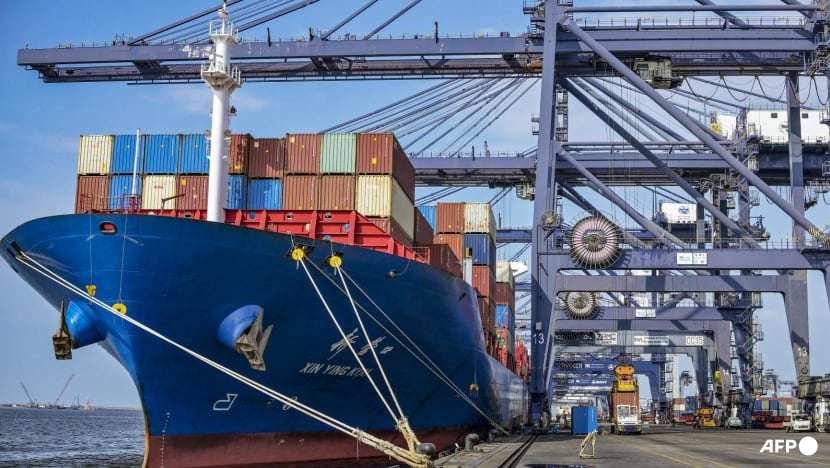 A cargo ship at the Jakarta International Container Terminal in Tanjung Priok Port. (Photo: AFP/Bay Ismoyo)
Industry simulations and analysis by Indonesia’s Ministry of Trade in April 2025 showed that tariff policies imposed by the US have weighed heavily on several of Indonesia’s key export sectors, including textiles and garments.
“Indonesia’s main export products to the United States include electronics, textiles and textile products, footwear, palm oil, rubber, furniture, shrimp and other marine fishery products,” Coordinating Minister for Economic Affairs Airlangga Hartarto said in April last year.
“The imposition of these reciprocal tariffs will have a significant impact on the competitiveness of Indonesia’s exports to the United States,” he added.
However, Deni Friawan, a senior researcher at the economics department of the Centre for Strategic and International Studies (CSIS), said Trump’s tariffs are not uniformly negative for businesses.
The tariffs are a double-edged sword, he said.
“On the opportunity side, they can open up new markets or prompt a repositioning or reconfiguration of supply chains, as some countries look for non-partisan, or neutral, partners,” Deni said.
Indonesian companies need to take a more anticipatory approach to global uncertainty by strengthening strategic planning, particularly through diversifying markets and supply sources to avoid over-reliance on a single country, especially China, he said.
Diversification can be pursued through nearshoring and friend-shoring, by shifting parts of supply chains to geographically closer countries or to partners seen as more geopolitically stable to reduce risk.
“Beyond that, companies also need to set up dedicated units or teams to monitor geopolitical risks and develop scenarios and contingency plans,” he said.
Efforts to open up new markets are also being pushed by President Prabowo Subianto.
Indonesia has concluded talks on the Indonesia-European Union Comprehensive Economic Partnership Agreement (CEPA) and, in September, signed the Indonesia-Canada CEPA as part of efforts to strengthen global market penetration.
To boost exports by MSMEs, the Ministry of Trade is leveraging its network of 46 Indonesian trade representatives across 33 countries to connect exporters with potential buyers through pitching sessions and business matching.
Between January and August last year, the ministry facilitated 462 business-matching activities with total transactions valued at US$90.9 million, with about 70 per cent of participating MSMEs exporting for the first time, largely through online channels.
Analysts noted that while these government efforts create opportunities, their impact will hinge on how prepared and strategic companies are.
Deni said companies must demonstrate both resilience and the ability to create sustainable value to maintain long-term partnerships with investors and business partners.
“Companies need to show a clear and transparent risk management framework, sensible market diversification and expansion strategies, as well as strong financial performance and governance, to demonstrate long-term operational resilience,” he said.
This article is a translation of reports published by CNA Indonesia. Catch the CNA Summit 2026 "live" on YouTube at 10.30am Singapore time (9.30am local time) on Feb 5, 2026.