 2 months ago
64
2 months ago
64
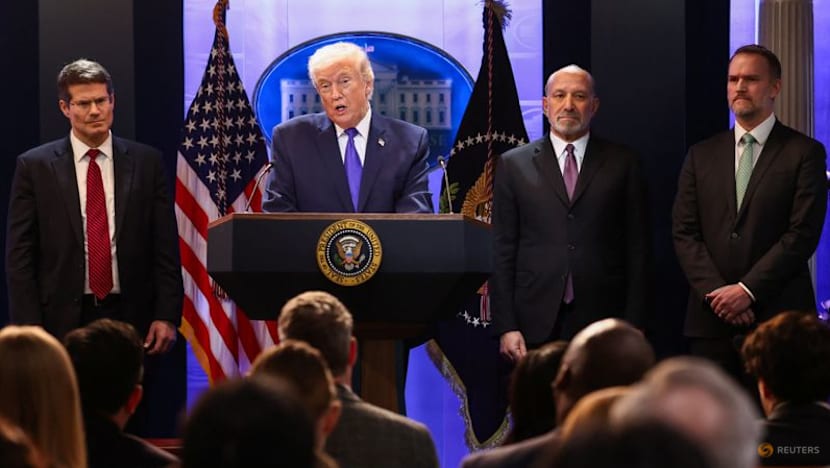
US President Donald Trump, flanked by Secretary of Commerce Howard Lutnick, Trade Representative Jamieson Greer and Solicitor General D. John Sauer, speaks during a press briefing at the White House, following the Supreme Court's ruling that Trump had exceeded his authority when he imposed tariffs, in Washington, DC, Feb 20, 2026. (Photo: Reuters/Kevin Lamarque)
New: You can now listen to articles.

This audio is generated by an AI tool.

The United States Supreme Court’s decision to strike down President Donald Trump’s sweeping “Liberation Day” tariffs has dealt him a rare legal setback, but analysts warn it has done little to calm global uncertainty.
This comes as the White House has pivoted to alternative tools to keep its aggressive trade agenda alive.
In a 6-3 ruling last Friday (Feb 20), the country’s highest court found that Trump’s use of the International Economic Emergency Powers Act (IEEPA) to impose reciprocal tariffs was unconstitutional.
Angela Mancini, head of global risk analysis for Asia Pacific at consultancy Control Risks, called it a “landmark ruling”, noting the court has largely sided with Trump since he returned to office 13 months ago.
She added that the decision underscores limits on presidential executive authority.
“It’s quite a big hammer that’s been taken away,” Mancini told CNA938, referring to Trump’s use of tariffs not just as economic instruments but as diplomatic leverage – from pressuring European allies over Greenland to targeting Latin American countries over migration.
“There are (other) trade mechanisms he can use, but none of them are as easy (or can be wielded) so quickly and unilaterally, as they all have guardrails and different kinds of parameters.”
TRUMP'S TEMPORARY FIX
Indeed, while the ruling bars Trump from using IEEPA to impose sweeping country-based tariffs, it does not strip him of other trade powers.
A day after the court’s decision, Trump doubled down by raising the global duty on imports into the US to 15 per cent under Section 122 of the 1974 Trade Act.
However, the measure is temporary and expires after 150 days. After that, Congress has to step in.
Heng Koon How, head of markets strategy at UOB, said securing approval from Congress may prove challenging. Some Republican lawmakers have openly opposed tariffs on close allies such as Canada, raising doubts about whether Trump can muster majority support in both houses.
This means the tariff landscape is likely to remain volatile, clouding the outlook for both the US economy and global trade.
“For the next 150 days, there will be much more uncertainty as to how tariffs are stacked up, how they apply, if the existing trade deals still apply, etc.,” Heng told CNA’s Asia First programme.
Beyond Section 122, Trump still has other legal avenues.
These include Section 301 of the same Act, which targets unfair trade practices, and Section 232 of the Trade Expansion Act of 1962, which addresses national security concerns. The latter is already in place for industry-specific tariffs on steel, aluminium, lumber and automobiles.
The Supreme Court’s decision has also thrown into question a series of trade deals struck in recent months. While Trump has indicated some agreements would stand, details remain unclear.
Some trade partners are concerned they may have to pay the 15 per cent global rate on top of rates they have already negotiated with Washington.
“(Trump) can always impose higher rates above the 15 per cent … because of other sections of the law,” said Edmund Sim, a partner at Appleton Luff International Lawyers in Washington DC.
“So, it's a consideration for every country (if) they want to … on a diplomatic level disturb the status quo. It would be difficult for countries, for example, those at last week’s Board of Peace meeting, to revisit agreements they already have with the US.”
WILL THERE BE REFUNDS?
IEEPA tariffs are estimated to have brought in more than US$175 billion so far. Legally, those funds may have to be returned, but the process is far from straightforward, said experts.
While the Supreme Court invalidated the tariffs, it did not provide guidance on how refunds should be handled. Trump has said any repayments could be tied up in litigation for years.
Heng said: “There will be a very long-term process of legal loops to clear before the refunds will be given, with some estimates years away.”
Mancini noted that US Customs and Border Protection has tracked tariffs by product code, meaning refunds could technically be processed efficiently. However, she expects resistance from the White House.
“The Trump administration is probably going to make this a complicated process wherein they're going to appeal and push back,” she said.
“It will require a lot of lawsuits and paperwork, and many US small business owners probably won't have the time, energy or money to be able to do that.”
HIGH-STAKES DIPLOMACY
Trump’s setback comes just weeks before a scheduled visit to China in March, where he is set to meet President Xi Jinping in what analysts describe as a high-stakes encounter.
“The US administration has been pushing for this meeting. Trump wants to have the deal of the century with China,” noted Mancini.
She added that the ruling may weaken Trump’s hand heading into the talks.
“He's now had a check on his power. The Chinese will see and note that,” she said.
“It's a really big blow and underscores the rule of law in the US, as opposed to having the presidential executive authority (and making) decisions unilaterally.”
Analysts note that layers of tariffs on Chinese exports were imposed under different legal provisions, such as Section 301, which remain intact. That means significant duties on Chinese goods are still in place despite the court’s ruling.
BUFFER FROM ASIA’S STRENGTH
Despite the turbulence, economists say Asian economies may be somewhat cushioned.
Heng noted that many Asian nations began the year on a strong footing, supported by robust exports and growth in artificial intelligence- and semiconductor-related sectors.
“That will buffer against a little bit of this uncertainty,” he said.
Jeremy Tan, CEO of Tiger Fund Management, added that the court ruling may even ease the burden for some Asian trading partners, particularly those previously facing tariffs above 15 per cent, at least for the next five months.
Still, analysts agree that clarity remains elusive.
“We’re not going to have certainty for a very long time. Most countries globally are (treating it as) a case of watch-and-wait,” Mancini said.
“Trump is the tariff king. If he can’t use the mechanisms he’s been using before, he will find other ways that are legal.”
That prolonged uncertainty is already reverberating through markets, and continued geopolitical risks are likely to drive demand for safe-haven assets, said Tan.
“We have seen a structural change in the prices of precious metals and hard assets. Gold has rallied (to record highs), and we continue to see demand for hedging,” he noted.
Central banks are also increasing purchases of hard assets as part of a broader diversification away from the US dollar, he added.
“We continue to see the de-dollarisation trend continue,” he said. “As the US may not be able to collect as much tariffs (this year), fiscal deficits could worsen, and that will continue to put a drag on the US dollar.”