 3 months ago
117
3 months ago
117
SINGAPORE: It may be Shanti Pereira’s seventh Southeast Asian (SEA) Games, but Singapore’s sprint queen shows no sign of slowing down.
After being dogged by injury in 2024, she bounced back with two silvers at the Asian Championships in May. However, the 29-year-old missed out on a semi-final spot at the World Championships in September.
She is now pushing through with about 10 training sessions a week and has set her sights on gold in all three of her SEA Games events to close out the season.
"It has been a really long season,” she told CNA.
“(My) focus will always and forever be health and recovery – so just making sure that I'm okay, my body is okay, and I'm healthy and ready to be at the start line.”
Pereira is also among several Team Singapore athletes using performance analytics and biomechanics to boost their competitive advantage this year.
Singapore is sending its largest overseas athletics team yet, looking to top its haul of 10 medals from the last edition in 2023.
A record-breaking 39 track and field athletes – 26 men and 13 women – will compete at the Games across events like pole vault, triple jump, long jump and discus throw.
SMALL THINGS THAT PLAY A BIG PART
For Pereira, who is Southeast Asia’s fastest woman ever in both the 100m and 200m, data analytics allows her to work on fine margins – of utmost importance in sprint events.
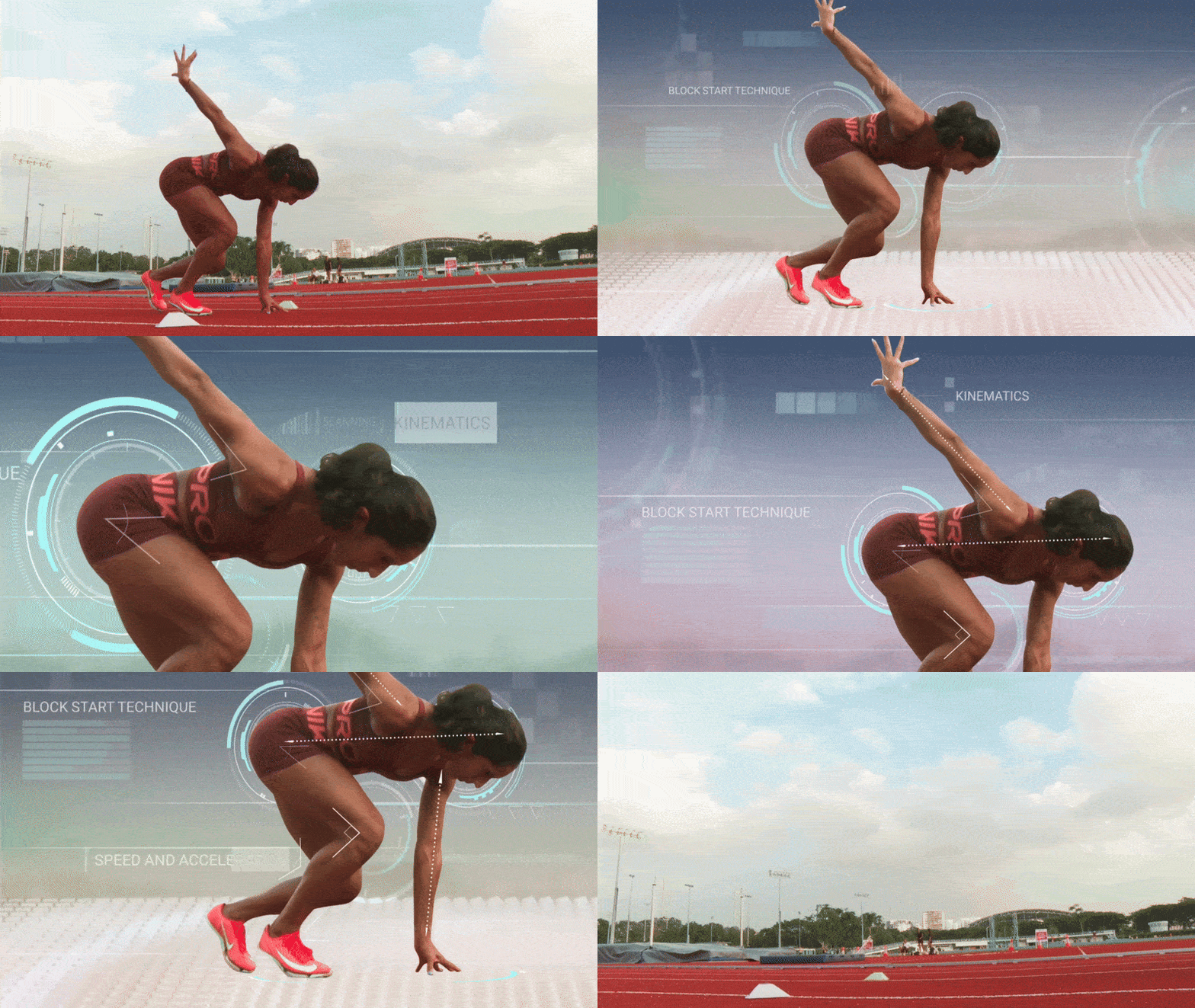
It starts with ensuring she gets the fastest possible launch from the starting blocks.
Her running technique – or kinematics – is also closely analysed, from arm swings to stride length and frequency.
Her speed is tracked as well, with every split time recorded and measured.
Biomechanics focuses on how athletes move, such as the technical execution of individual skills.
Meanwhile, performance analysis involves identifying and analysing critical patterns or events in relation to tactics or strategies used in competition or tracking.
All this work is driven by the High Performance Sport Institute (HPSI), which was launched by Sport Singapore in April. It supports Team Singapore athletes by providing high-performance systems and services to help them reach their full potential.
Its sport science team works directly with athletes to enhance performance through cutting-edge science, performance testing and monitoring, applied research, and education. Key areas include biomechanics and performance analysis, sports nutrition, and psychology.
Pereira told CNA that her coach Luis Cunha has always been a “data man”.
“It’s just really small, small things – the 1 per cent stuff that will eventually contribute (to my performance), like arm swings, my arm placement, foot placement,” she added.
Cunha said he tracks the basics and anything that can affect Pereira’s sprint performance.
“I was able to identify what is important and measure that, because (these) days, you can measure pretty much everything,” he added.
Pereira also noted that this year’s Games, which will take place in Thailand from Dec 9 to 20, is the first edition since 2019 to be held in December.
“It does differ from the usual seasons that I have, where it's usually during the summer period. So (in) training, they have to change quite a bit,” she said.
Being on her best foot is especially important with the strong competition she will be facing at the SEA Games, where she will contest the 100m, 200m, and 4x100m relay. The sprint queen is aiming to defend her 100m and 200m titles.
She said that her competitors are “working just as hard” as them.
“(There are) really strong people from Vietnam, from Thailand, from Malaysia, all over the Philippines as well. I think all we can do is just focus on our training and what we can control, and just be prepared for the day,” she added.
JUMPING AHEAD
Analytics are also giving national triple jump record holder Tia Rozario, who is making her SEA Games debut, an added edge.
The 25-year-old is competing in both the triple and long jump.
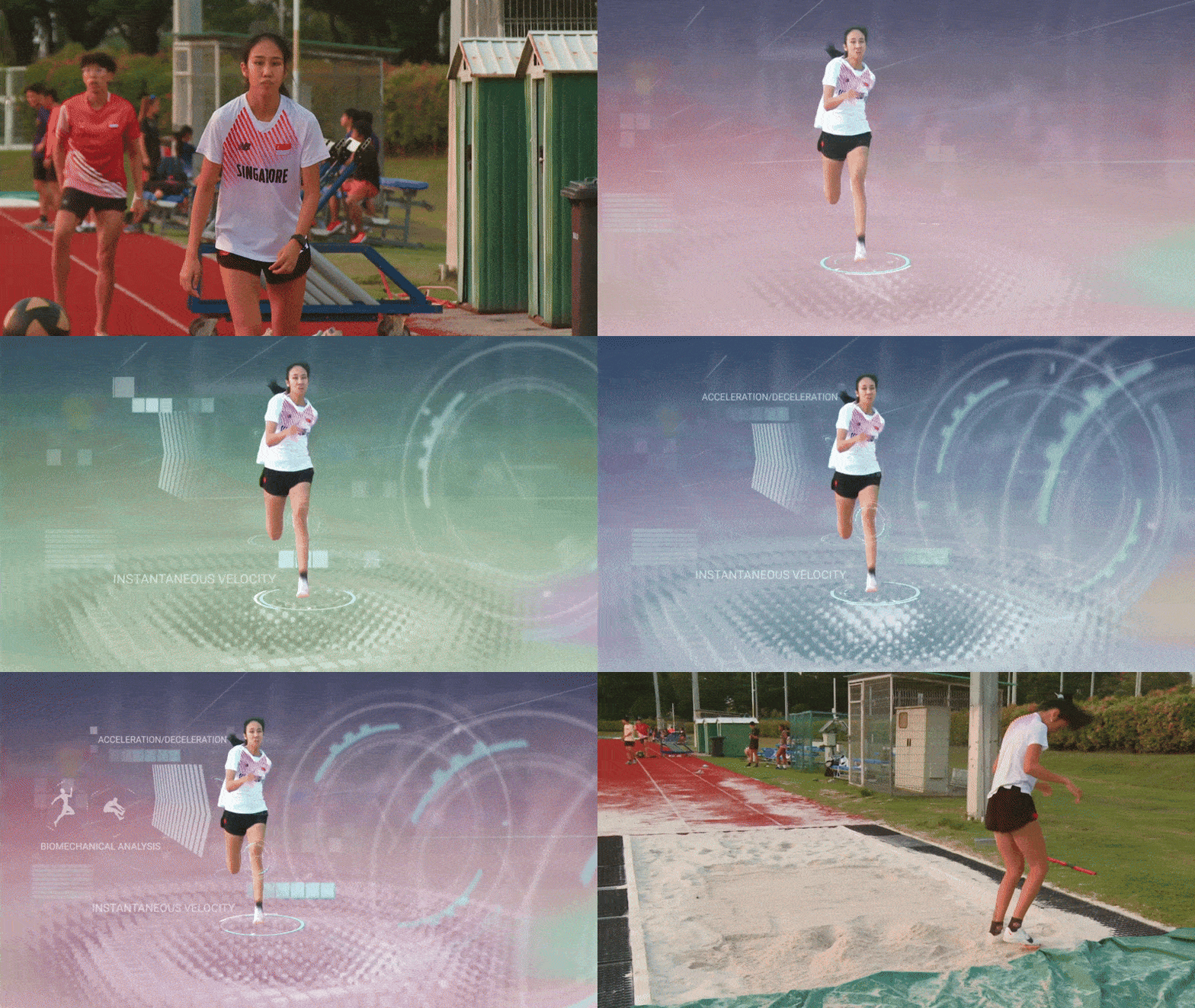
Data helps Rozario to track her run-up velocity between different points.
On top of that, it shows her acceleration or deceleration before take-off – a key factor for a longer jump.
Even her body movements in the air are analysed to improve her technique.
“Having just that additional perspective … gives you that little bit of information that can help you gain the extra centimetre that you might need to get the gold medal,” Rozario told CNA.
Bastian Dohling, deputy general manager at the Singapore Athletic Association, said the collaboration with the HPSI has helped athletes to progress and reach higher standards this year.
“We have much more support when it comes to sports science experts (and) performance analytics or biomechanics,” he added.
“Especially on the relay team side – our relay coaches have been working very closely with our team at HPSI, and we have seen huge improvements in training. Hopefully, that translates into performance gains at major competitions as well.”
PROGRESS IS KEY
Rozario is among 23 Singapore track and field athletes making their SEA Games debut, coming off a standout season with record-breaking performances.
At the Thailand Open Track & Field Championships in June, she came just 2cm shy of the long jump national record after jumping 6.16m, which earned her the silver medal.
No Singaporean has ever medalled in the women’s triple jump, while the last woman to bag a long jump medal at the SEA Games was Foo Hwei Fen who scored a bronze in 1989.
Rozario said going into the Games on the back of a strong season is “definitely a confidence booster”.
“My coach and I started this year with the SEA Games in mind, and so every competition leading up to it has been a building block. We've been learning each round, and I think it's been super helpful in helping me to finetune what I need to perform my best,” she added.
Dohling said while they do not expect all first-time SEA Games competitors to bag medals, they are expected to “progress and to get even better”.
“Of course, we want them to progress towards the Asian Games and Commonwealth Games next year as well,” he added.
“I want especially our younger athletes, to learn to deal with that pressure that comes with a major competition, and to come back stronger and to go into the next competition. So it's really progression – that’s the big theme.”