 1 month ago
64
1 month ago
64
SINGAPORE: Some gold dealers in Singapore are seeing a rise in counterfeit items in the market, as elevated prices continue to drive demand.
Since gold prices surged in January, one dealer said he has filed 50 per cent more police reports compared to the same period last year, after encountering suspicious sellers attempting to offload counterfeit items.
The dealer said he sees up to five fake items a week – ranging from buyers seeking to verify their online purchases to individuals attempting to resell questionable gold.
The increase comes as more buyers turn to alternative channels to get their hands on the precious metal.
Gold prices have been rallying since early 2025, with strong momentum carrying into this year, driven by geopolitical tensions, central bank buying and safe-haven demand.
In January, gold broke through the US$5,100 mark for the first time. Although it has since fallen, it is hovering above US$4,000, remaining elevated.
This has fuelled demand, particularly in secondary markets such as online platforms and social media resale channels.
ONLINE DEMAND RISE
E-commerce platform Carousell said searches for gold items rose 17 per cent year-on-year in February.
Mr Kwek Seow Bin, owner of Singapore-based startup Metal & Picks, who runs a Telegram channel for private buyers, said social media platforms are gaining popularity due to limited stock at physical stores.
“When supply is tight, (dealers like us) don’t have enough ready stocks to meet consumers’ demands,” he told CNA.
“When people purchase physical gold, they want to get their stock immediately. So, if they can't get it (from bullion stores), they will try secondary markets.”
Dealers say many counterfeit items are entering the market through these channels, often originating from overseas.
ALL THAT GLITTERS IS NOT GOLD
Industry players note that while some pieces may look authentic, appearances can be deceiving.
Despite bearing hallmarks of genuine gold – including certificates and serial numbers – some items are in fact made of copper or nickel.
Such fakes are becoming increasingly difficult to detect, especially for lay buyers. Online, it is often even harder to tell the difference.
Counterfeit goods range from crude fakes – such as bars that feel too light or flimsy, or those with identical serial numbers – to high-quality replicas.
Mr Brian Lan Zhongping, managing director of GoldSilver Central, said not all online sellers are upfront about the authenticity of their products. Some even use packaging and marketing material resembling those of well-known jewellers.
“They price it slightly below the (market) price so many people think this might be a good deal. It comes with a box and even with a certificate. And because (customers) think it’s the reputable jeweller, they will buy it,” he said.
“Even some wholesalers who are new to this trade were duped.”
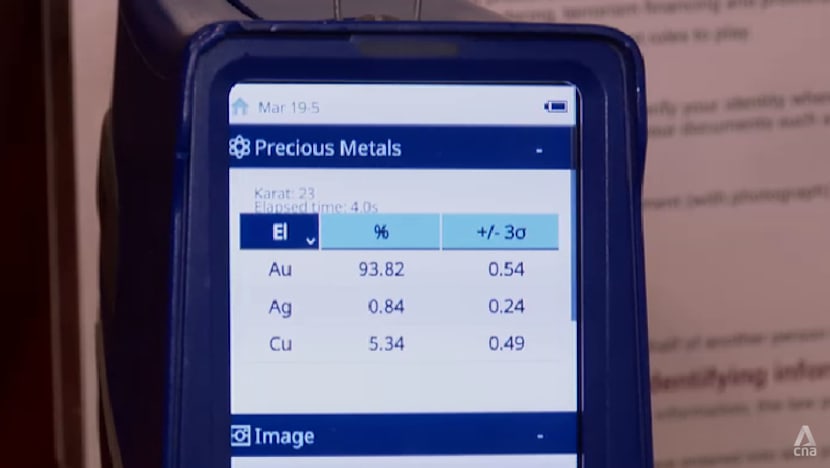 A analyzer is used to measure the chemical composition of a gold bar, which has a 93.82 per cent purity, in a shop.
FOOL’S GOLD
Another dealer, Mr Billy Chiam, said the gold rush has led to as much as a 40 per cent increase in fake items being brought into his store for resale.
He said these often arrive in bulk, and may include so-called “sand gold” designed to mimic the look and weight of genuine gold. He believes some customers could be attempting to slip in counterfeits among real gold.
Mr Chiam noted that even testing machines may not immediately detect such fakes, especially when materials like tungsten – which has a density similar to gold – are used.
"It could have a thick layer of gold on top of it, then some other material can hide inside. So, you have to cut it and test the core to ensure that the content is really gold,” said the founder and director of Gold Price Singapore.
BUYERS BEWARE
Dealers warn that private buyers remain especially vulnerable, as they often lack the equipment needed to verify authenticity. They say one of the biggest red flags is a price that seems too good to be true.
“Gold is very expensive and very easy to sell. So, it becomes very attractive for scammers,” said Mr Kwek.
“If you are new to precious metal, try to go to trusted, reputable dealers who have the right machineries and (proper) authentication … so you know you are buying a real pure gold bar, and not a fake one.”
Industry players expect such cases to rise further if gold prices continue climbing, and are urging buyers to remain vigilant and stick to reputable sources.