 3 months ago
114
3 months ago
114
The island of Islay off the western coast of Scotland is as far removed from Asian urban life as you can imagine. Islay is almost exactly the same size as Singapore – but with a total population of 3,500.
This makes Islay a destination to truly switch off, slow down and breathe deeply, whether it's the bracing, salty sea air or the heady, peaty aromas of a single malt whisky.
There’s certainly no shortage of the latter on this speck of land, a 25-minute flight or five-hour drive and ferry crossing from Glasgow. The names roll off the tongue, from Laphroaig to Lagavulin, Bowmore to Ardbeg.
But none can come close to Ardbeg when it comes to experiences and hospitality, thanks to the newly opened Ardbeg House in Islay’s second largest town, Port Ellen.
This surrealist’s dreamscape of quirky, upcycled, locally-driven design, all curated by Russell Sage Studio, makes for one of Scotland’s most unique and remarkable places to stay. Even before you’ve had a drop.
The first sign that this is whisky country comes at the tiny airport itself, as I spot a brook of crystal-clear water – running directly alongside the car park. Bilingual road signs in Scottish Gaelic and English read like a whisky lover’s almanac, while an occasional white building is the only sign of modernity against the greenish-red hills and brooding dark grey clouds on the horizon.
THE HOTEL
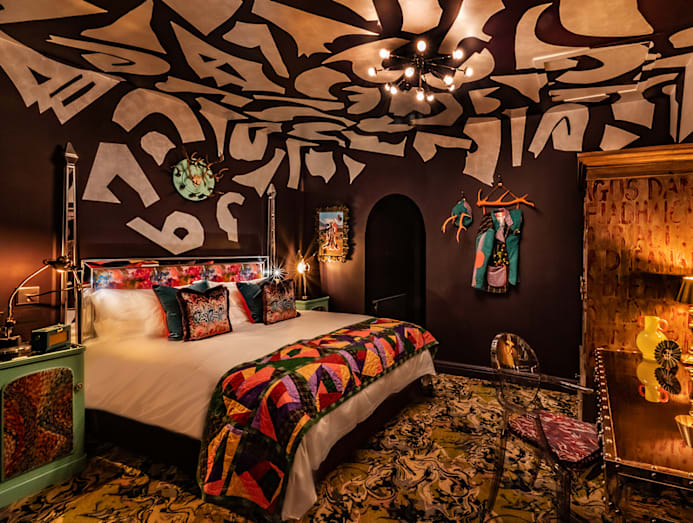 The Untamed Room is one of 12 uniquely designed rooms at Ardbeg House. (Photo: Ardbeg House)
The 12 rooms at Ardbeg House all tell their own story and feature creative art from the hands of the local community. If that risks sounding twee, it’s not. This ancient Scottish isle, just a few miles across the water from Ireland, has been home to myths and legends for millennia before the first whisky was ever bottled.
The works by 40 local people, including tapestries, sculptures and collages, in their own way, tell modern tales of lore.
So, if minimalism and Philippe Starck style interiors are your bag, this is categorically not the place for you. But if whimsy, delight – and most of all fun – are your keywords, then Ardbeg House will be paradise found.
 The Islay Bar. (Photo: Sim Canetty Clark)
Ardbeg House is owned by the Glenmorangie Company, who also own the equally creative Glenmorangie House. The group itself is part of the global luxury goods group LVMH, meaning that the bar serves an unmatched lineup of 56 different Ardbeg single malts, but also serious drams from Glenmorangie. As the bar also proudly plays a role as a local pub, other Islay gems feature in a wall of bottles which stretches halfway across the bar.
Unexpected chairs include original tractor seats which have been upcycled into bar stools – although you wouldn’t want to spend all night on one without a cushion. Elsewhere, sculptures are inspired by kelp and an extraordinary octopus crowns the private dining room, while depictions of Shorty the Jack Russell, Ardbeg’s mascot, also abound.
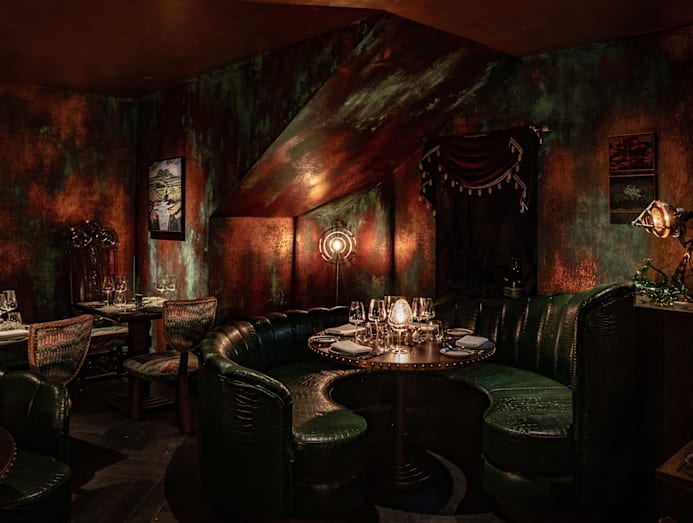 The hotel's Signature Restaurant. (Photo: Sim Canetty Clarke)
In the dining room and communal areas, fire extinguishers and trombones have morphed into lamps, while outside on the terrace sits a vast barbecue smoker and a shiny green hot rod tractor. But of course. Russell Sage explains with considerable understatement: "We’re allowed to slightly slip into fantasy".
Every bedroom is unique and features bespoke carpets, wallpaper, furniture and more, while even every loo seat is hand painted. Miniature bottles of Ardbeg are also hidden in your room, yours to find – and keep.
FOR PEAT'S SAKE
With 10 distilleries for a population of 3,500, the whisky industry and associated hospitality landscape is everything on Islay, employing more than 2,000 people.
To get a feel for the terroir, we start with a peat cutting masterclass in a windswept field. Peat is compacted organic material, dead plants which form at the rate of 1mm per year. So, if you dig down through a metre of peat, you’re back in the year 1025.
A beautiful ash-handled peat spade topped with a cow horn is the tool of choice as the perfectly named Doug shows us how to dig down through the centuries.
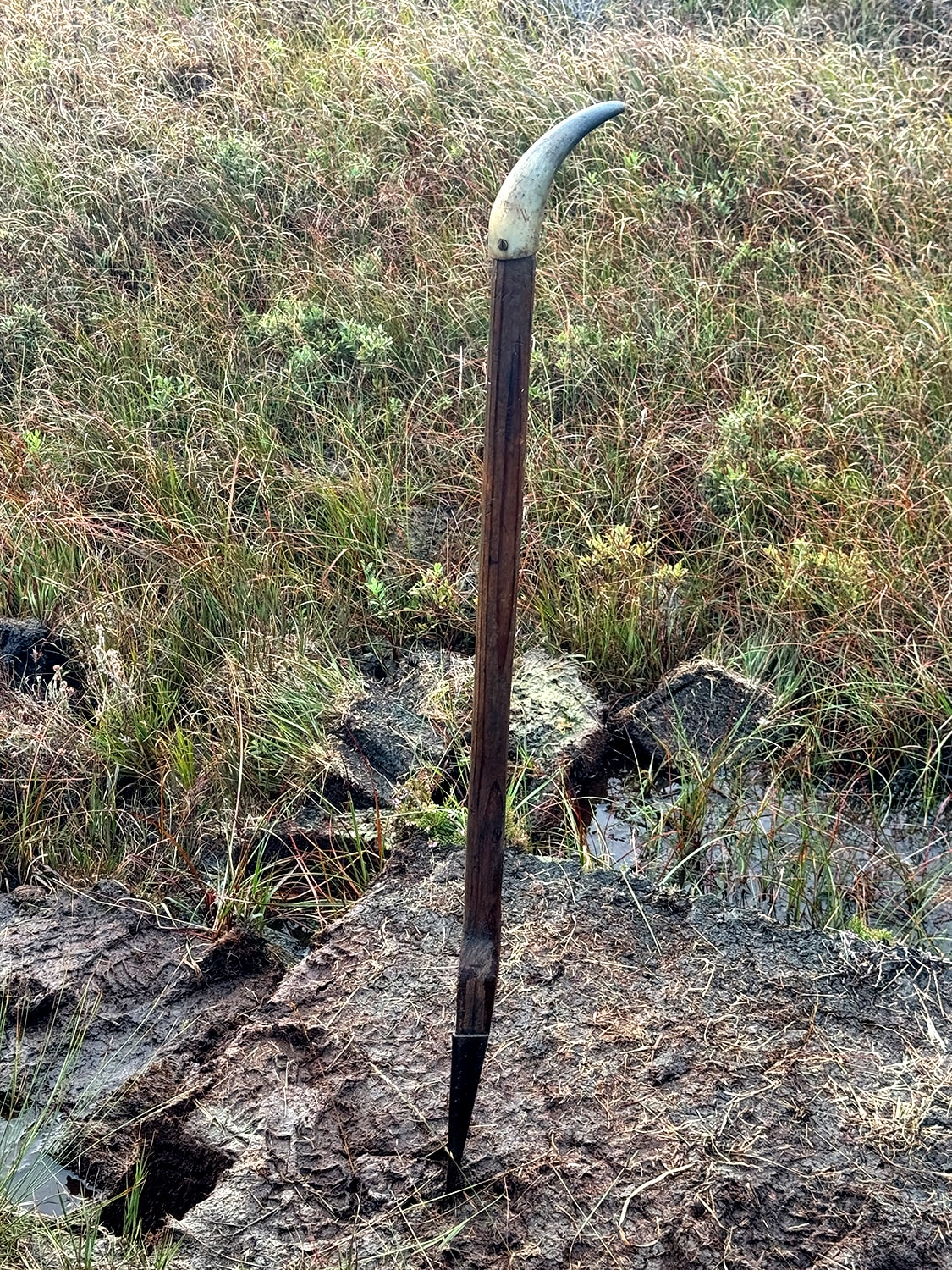 A ash-handled peat spade topped with a cow horn. (Photo: Chris Dwyer)
I have a go next, channelling my deep Irish DNA and manage to extract a slab measuring about a foot and a half. My mind is blown when Doug explains that, once dried out, my peat will burn for all of eight minutes. It’s not exactly the ROI I was expecting – but also explains why peat cutting was such a crucial job until just a couple of decades ago. Even today, a handful of houses on Islay are still heated by burning peat.
THE DISTILLERY
Every stay at Ardbeg House includes a tour, tasting and transfers to the historic distillery just a few minutes’ drive along the coast.
Ardbeg has genuine cult status with whisky aficionados, but their history has not always run smoothly since 1815. In the 1980s, the distillery was mothballed, producing no whisky until 1989. But when Glenmorangie Group bought Ardbeg in 1997, they immediately invested in buildings, machinery and production to bring it back to life with a vengeance.
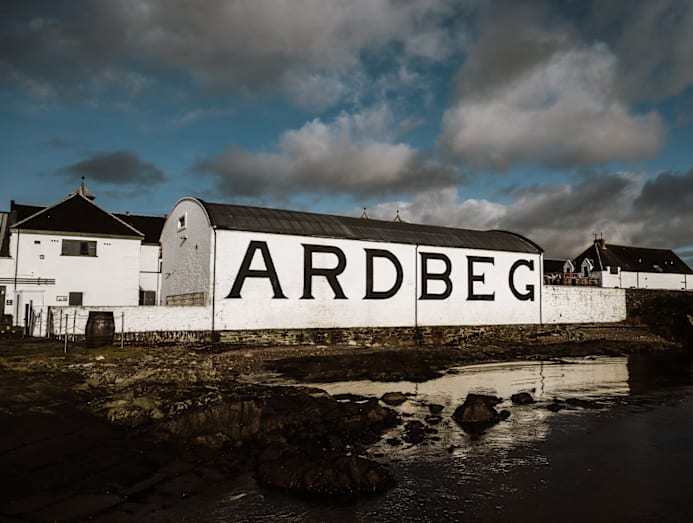 Every stay at Ardbeg House includes a tour of the distillery. (Photo: Ardbeg)
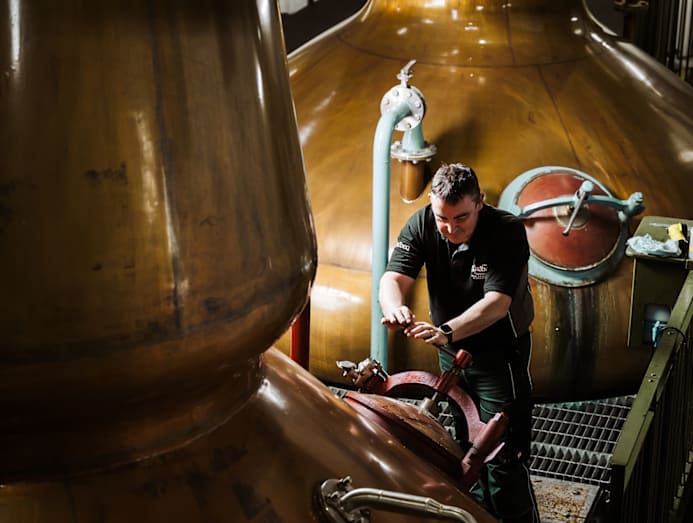 (Photo: Ardbeg)
The kilns sit a few miles away down winding roads and are where the peat works its mysterious magic in the malting process, ensuring that Ardbeg is the smokiest single malt available, at 50 parts per million of phenolic malt.
Back at the distillery, the malt is then crushed by a beast of a machine dating to 1921, a Bobby malt mill, into a product called mash. Water is piped down from Loch Airigh Nam Beist three miles away, heated to 63.5°C, then mixed with the mash to ensure maximum sugar extraction. It’s cooled and yeast is added to begin fermentation in washbacks made of Oregon pine.
Distillation comes next, a boiling and condensing process where alcohol vapours evaporate in a two-step process that brings balance and complexity. Finally, maturation in ex Bourbon oak casks, sherry butts and even French oak barrels.
SCOTTISH CEVICHE
Ardbeg drinks beautifully on its own but also pair with pristine produce, especially when it comes from the shores of Islay.
One of the experiences that Ardbeg House offers is a boat trip along the craggy coast to the distillery, passing castles, catching glimpses of red deer frolicking in the woods, and watching large white seals lolling on rocks, eyeballing us as we chug past.
On board, Captain Gus, a short, stocky Islayman, hauls in some of the maritime bounty from under the waves in a lobster pot. Although the cynic in me wonders how it contains such a pristine selection of seafood, it’s still an unbridled joy to watch as he carefully pries open an enormous shell, cuts the flesh from the foot and then passes it around to let us taste the sweetest scallop of all time.
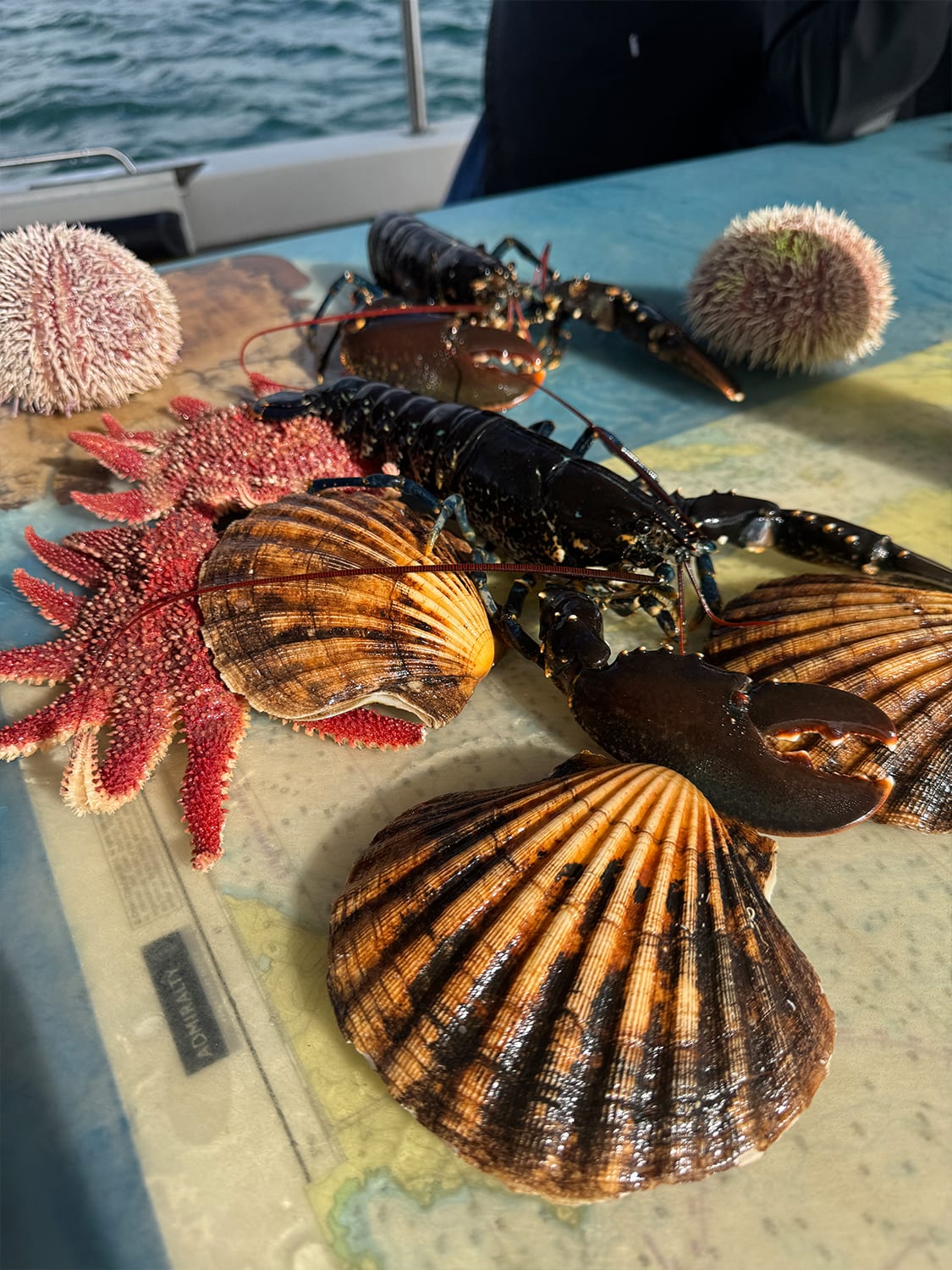 Seafood bounty from a boat trip along the coast to the distillery. (Photo: Chris Dwyer)
There are also bright red starfish and two huge urchins, each about the size of a tennis ball, which remind us that not all uni tastes the same. The Scottish version has a fetching red-and-white exterior, while the flesh is grey rather than orange, with a grittier texture and a more saline taste than its more famous Hokkaido cousin.
He keeps the black lobsters as part of his weekly catch, but cuts up another scallop and this time generously swamps it in 10-year-old Ardbeg for a stunning celebration of local terroir.
An unusual pairing – but what can only be called a Scottish ceviche.