 3 months ago
103
3 months ago
103
When Sacha Leong was 12, his parents decided to build their own house in Singapore. While most children that age were absorbed by video games or football, young Sacha found himself utterly captivated by something else entirely: the architect’s meetings.
“I used to love going with them and looking at the plans and models, sitting in and learning how a home was designed,” he recalled. Beguiled by this exposure, he organised a design competition among his schoolmates to create the front gate. “I thought it might actually get built but then realised how bad all the proposals were, including mine!”
That early brush with the gap between ambition and execution proved formative. Today, as co-founder of London-based studio, Nice Projects alongside Australian designer Simone McEwan, Leong has spent the intervening years closing that gap – creating restaurants, bars, and hospitality spaces across two continents that marry rigorous spatial thinking with an almost maniacal attention to tactility and craft.
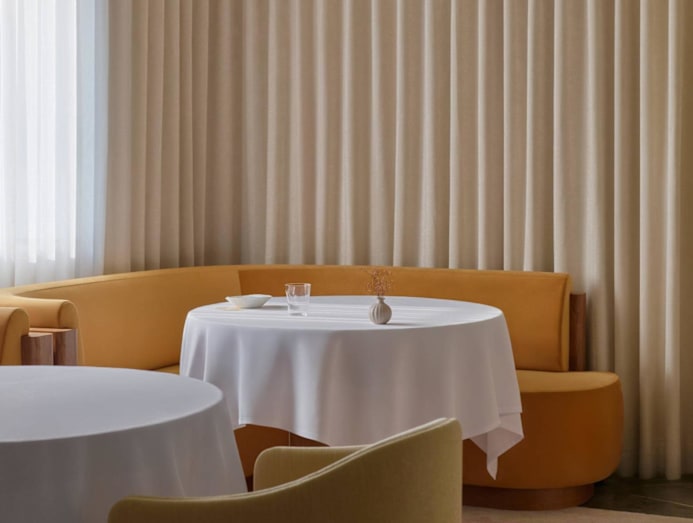 The revamped Odette features a warmer palette with buttery hues. (Photo: Odette)
In December 2025, Leong comes full circle. He returns to reimagine Odette – the three-Michelin-starred restaurant he designed in 2015 for chef Julien Royer, one of Asia's most exciting culinary talents. On any metric, it’s a rare opportunity: the chance to revisit your own work with the benefit of maturity and distance.
“I have great fondness for Odette as it was the first restaurant I designed in Singapore,” Leong said. “I’m so proud of what Julien has turned it into. From the staff he has trained to the guests who have become friends, it feels like a family. I’ve learnt how important that is to making something of quality with longevity.”
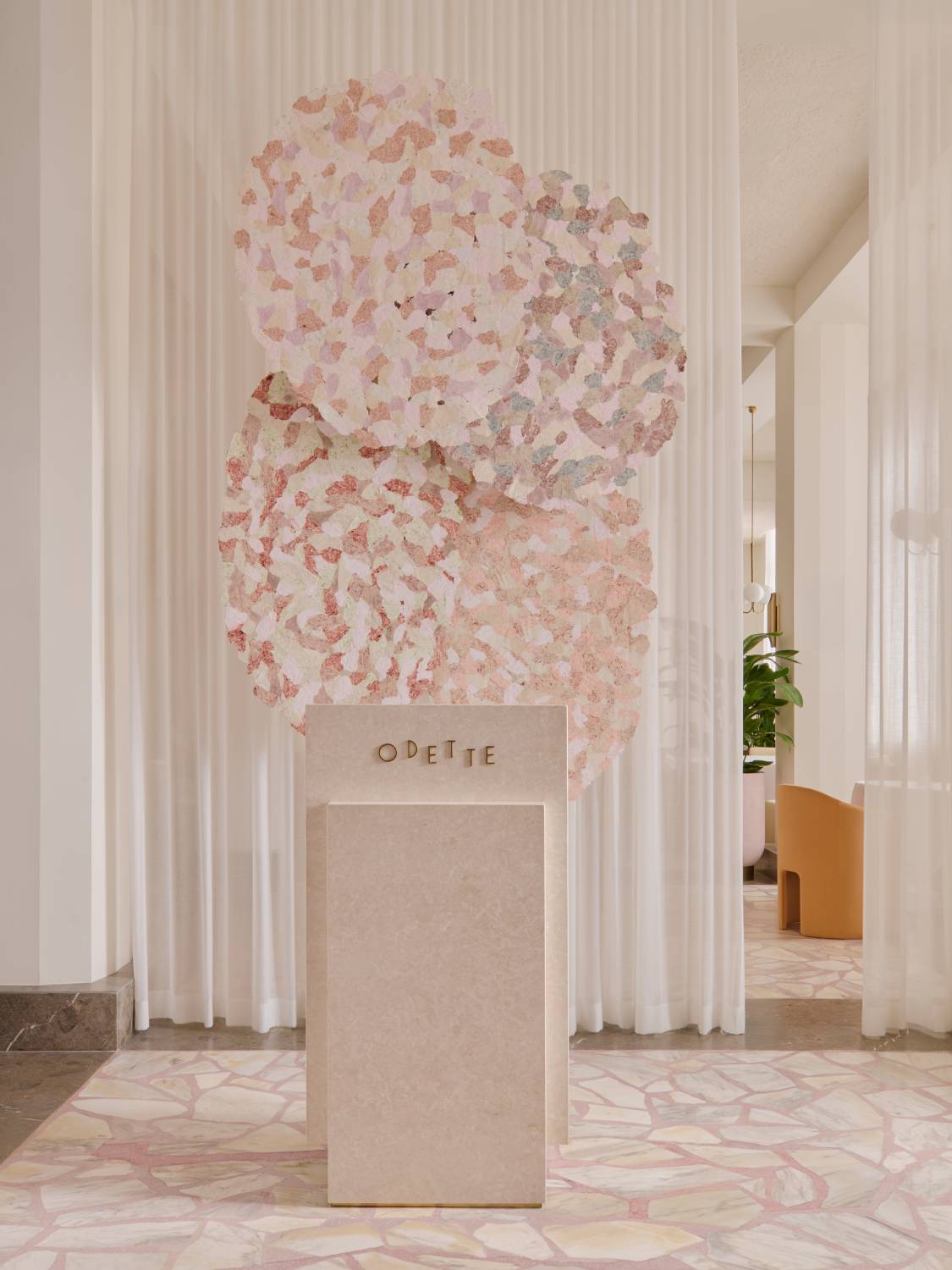 Winter, Spring, Summer or Fall, a new aerial artwork by Dawn Ng, hangs at the reception area. (Photo: Odette)
When Odette opened at the National Gallery 10 years ago, Singapore’s fine dining landscape skewed dark, heavy, and overwhelmingly masculine. Leong – then a Design Project Leader at Universal Design Studio – conceived something different. Working with Singaporean artist Dawn Ng, whose ethereal aerial installation of suspended paper sculptures became the restaurant’s signature, he deployed a pastel palette of pinks and creams that felt radical in its restraint, whilst mirroring Royer’s culinary philosophy: ingredients at their purest, presented with elegance and restraint.
The new Odette retains that foundational DNA while speaking in a richer, more assured voice. “It’s an evolution,” Leong explained, pointing to a space deeply familiar in its bones, yet utterly transformed in its skin – much like Royer’s cuisine, which has similarly deepened in sophistication over the years. The pastels have given way to a sophisticated palette anchored in warm timber marquetry that celebrates the 90-year history of the former Supreme Court building. The curved screens remain, though now reinterpreted through intricate patterns that reference French art deco. Mohair velvet banquettes, cast mirrored glass panels, and brass pendants by Michael Anastassiades heighten the sense of tactility and craft. Dawn Ng returns with a new installation at the entrance, her sculpture now drawn from seasonal botanical and culinary palettes.
“We have chosen a more contemporary look,” noted Leong, who worked with local craftspeople to create bespoke marquetry. “The new version features a richer, more tactile palette that emphasises craftsmanship and plays with the different tones and textures of timber.”
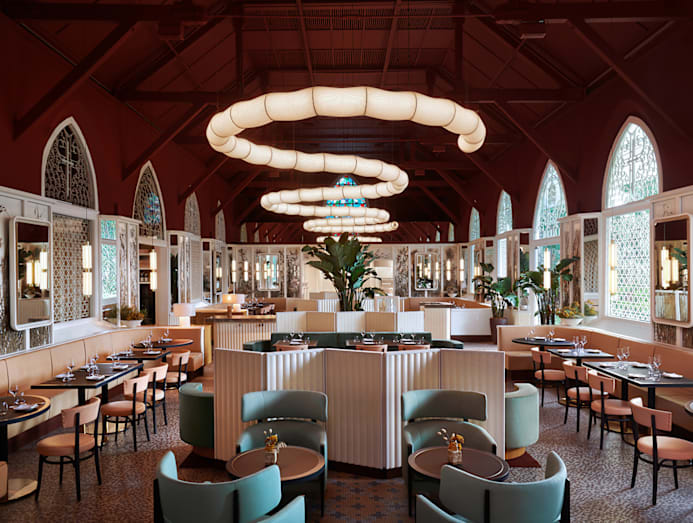 Claudine. (Photo: Hosanna Swee)
The journey from that first Odette to this new iteration traces Leong’s own creative evolution. Born to a lawyer father and a mother who moved from teaching to selling Chinese antiques to missionary work in India, his path into design wasn’t preordained. “It wasn’t a traditionally creative household but I was a creative child, always curious,” Leong said. Singapore in the 1980s and 90s, he recalled, felt like things were beginning to happen but it just wasn’t fast or open enough for him. Pre-Internet, he spent hours in school libraries and at Borders bookshop, devouring international magazines – Art in America, The Face, i-D – that opened portals to elsewhere. He became obsessed with I.M. Pei, the Chinese architect who had designed Singapore landmarks like The Gateway, and the OCBC headquarters.
At 17, Leong left for Carnegie Mellon. “What America gave me was access to so much more information and creative thinking,” he reflected. After summers interning at small interdisciplinary studios in London, he pursued his master’s at The Bartlett, drawn by what he perceived as the UK’s more imaginative, individual approach to architectural education. His final thesis was a large-scale art installation – a hint of things to come.
Joining Universal Design Studio meant working alongside Edward Barber and Jay Osgerby, two of British design's most respected figures. “It was great seeing the detail and rigour in Ed and Jay’s design process,” Leong said. The Ace Hotel in Shoreditch proved transformative. “It really ignited my love for hospitality. I learnt so much about how to think differently about how spaces could be run.” The project taught him the value of collaboration, not least commissioning East London furniture designers and trusting his own “sometimes weird, very specific taste”.
That sensibility – thoughtful, collaborative, quietly assured – defines Nice Projects, which Leong and McEwan founded in 2020. Their partnership with Singapore’s Lo & Behold Group has been particularly fruitful, yielding Odette, Claudine (housed in a restored 1930s chapel), Fico (inspired by Puglian masserias), Somma (a reimagined secondary school library), Le Bon Funk, and The Coconut Club. “They’re brilliant clients who are very thoughtful about what they want to do and recognise what is special about Singapore,” Leong said. “We have shared values and a design sensibility that we’ve developed over numerous projects.”
Of course, working across cultures requires vigilance against pastiche. For Fico, Nice Projects collaborated with makers from Puglia; for Odem, a Korean makgeolli bar, they specified Korean lighting manufacturers and worked with Seoul-based designers on custom chairs. “It’s about understanding what qualities make those spaces special and capturing that in a Singaporean context,” Leong explained.
His own creative influences range widely: Gio Ponti, Charlotte Perriand, Kishio Suga, Max Lamb, Per Kirkeby. Cities matter too – Milan, Stockholm, Paris, places “so layered with richness and appreciation for beauty over such a long period of time.” His ideal spaces reveal similar depth: Villa Necchi in Milan “for the sheer beauty and details”, Dover Street Market London “for never-ending inspiration”, Les Roches Rouges in southern France “for its effortless chicness”. If he could have designed any historical space, it would have been Villa Noailles, Robert Mallet-Stevens’ Modernist masterpiece in Hyeres where avant-garde artists gathered and “everyone just looked like they were having so much fun”.
That last detail is telling. For all his architectural rigour and emphasis on longevity – he speaks passionately about creating spaces that “age beautifully” rather than chasing trends – Leong hasn't lost sight of pleasure, of the joy that drew him to those architect's meetings when he was a child.
In a way, the new Odette embodies that same balance: serious craft tempered by delight, refinement leavened with warmth, built for permanence yet designed to surprise. The work reveals someone who has learnt how spaces breathe and evolve – lessons that can only come with time. That 12-year-old organising gate design competitions would surely approve.