 3 months ago
125
3 months ago
125
SINGAPORE: Singapore and South Korea on Monday (Mar 2) launched an artificial intelligence alliance, with Seoul pledging to establish a US$300 million (S$382 million) global fund here by 2030 to support joint AI development.
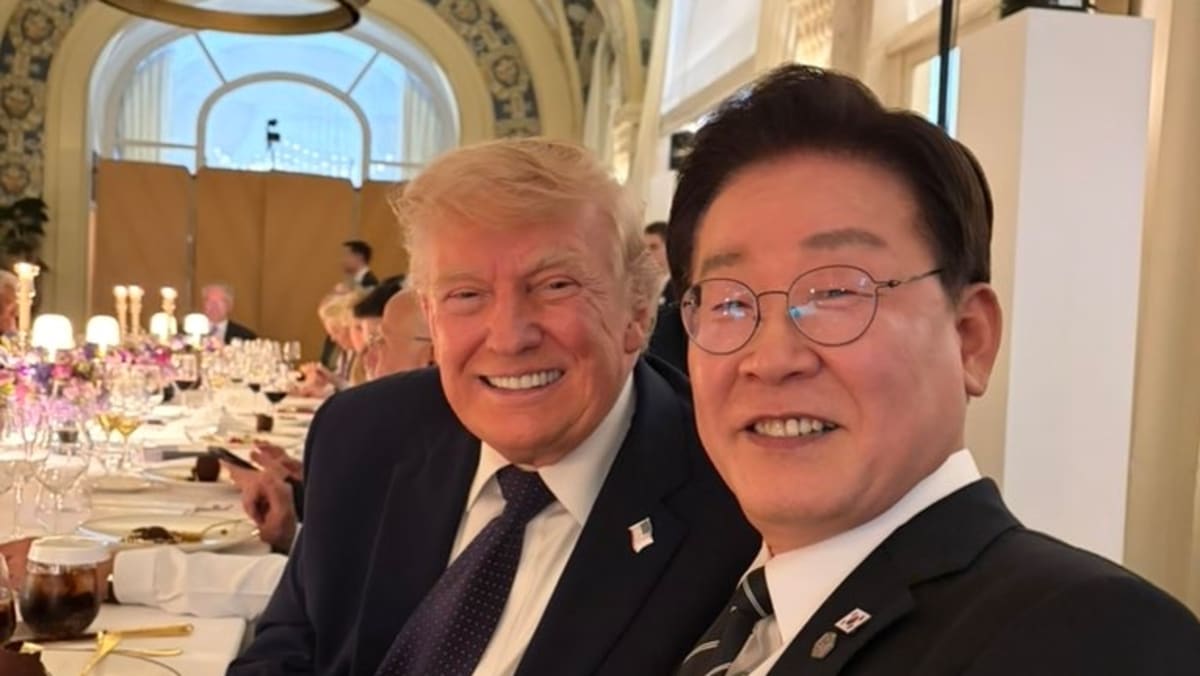
Visiting South Korean President Lee Jae Myung announced the Korea-Singapore AI alliance at the Korea-Singapore AI Connect Summit held at Shangri-La as part of his three-day visit to Singapore.
The summit was convened to bring together diverse perspectives from future AI leaders of both countries to jointly take the lead in the global AI market, the office of the Secretary to the President for Foreign Press Affairs, South Korea, said in a press release.
In his opening remarks, Mr Lee said both nations share the common experience of "having overcome the constraints of limited territory and natural resources through the strength of our people and technology" and achieving prosperity through "unceasing innovation".
"Now is the time to apply the spirit of innovation within our DNA to the AI industry, thereby opening new horizons for the digital economy together," he added.
The South Korean president described the new AI alliance as the starting point of an open innovation ecosystem where companies, universities and startups collaborate to share knowledge and resources.
He urged both sides to ensure that the shared growth of South Korea and Singapore extends beyond Asia, to usher in what he called a "great new 'age of AI exploration'" and assume leadership in setting the course for the global AI industry.
Mr Lee also introduced a Korea-Singapore AI Cooperation Framework on Monday.
Under the framework, South Korea will establish a US$300 million global fund in Singapore by 2030, to ensure that capital, technology, talent and industry are "seamlessly" interconnected and that substantive cooperation can be achieved.
"Through joint research that transcends national boundaries, we will enable researchers from both countries to devote themselves to developing AI technologies aimed at addressing humanity’s most challenging issues," he added.
Seven memorandums of understanding (MOUs) on joint AI research and business cooperation in future industries, such as autonomous driving and public safety, were also adopted.
These MOUs are expected to enable Korean AI companies to leverage Singapore's infrastructure to expand business opportunities throughout Southeast Asia, said the South Korean public relations office in its press release.
Earlier in the day, Mr Lee met Singapore Prime Minister Lawrence Wong, and the two leaders announced plans to upgrade the free trade agreement between both countries.
Several other MOUs in areas such as civil nuclear energy and intellectual property were also exchanged.
About 150 people, including AI entrepreneurs, venture capitalists and researchers, participated in the Korea-Singapore AI Connect Summit.
Singapore Foreign Affairs Minister Vivian Balakrishnan was also in attendance, along with officials from government institutions and industry stakeholders such as the Home Team Science and Technology Agency (HTX) and SGTech.
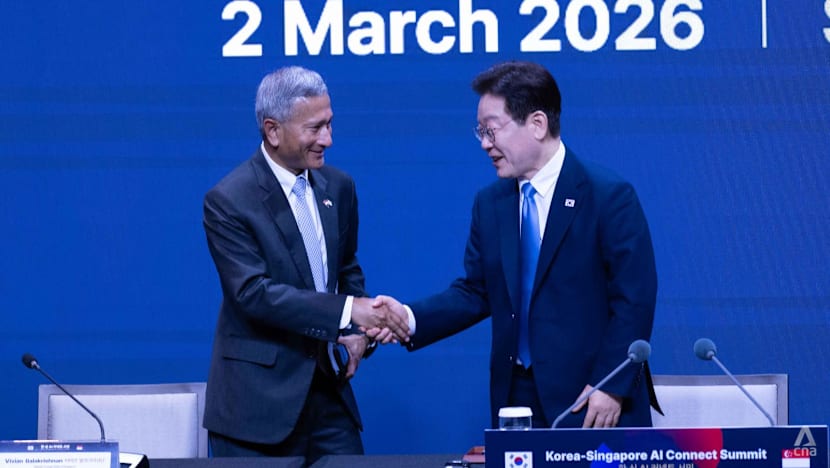 Singapore Foreign Affairs Minister Vivian Balakrishnan and South Korean President Lee Jae Myung at the Korea-Singapore AI Connect Summit on Mar 2, 2026. (Photo: CNA/Lim Li Ting)
Speaking at the event, Dr Balakrishnan said that Singapore sees itself as a trusted hub where companies can develop, test and deploy impactful AI solutions.
The minister also welcomed Korean companies looking to expand their footprint in Southeast Asia to take the first step in Singapore.
Dr Balakrishnan suggested three areas in which both countries can play a meaningful role: develop trusted supply chains; help in formulating open global standards for AI; and the interoperability of AI systems.
He also highlighted the setting up of Singapore's new National AI council, which will be chaired by Prime Minister Wong, to coordinate and drive the country's AI strategy.
The Singapore government will also invest over S$1 billion between 2025 and 2030 under the National AI Research and Development Plan, which will focus on both fundamental and applied AI research and AI talent.
Dr Balakrishnan called the AI summit a "meaningful step in the right direction" and told Mr Lee that the two countries will work as strategic partners "to push the boundaries of what is possible" and harness AI for the good of all people.
In closing the event, Mr Lee said: "I am confident that if Korea's outstanding AI technology is backed by Singapore's status as a global hub, this will create a significant turning point, broadening the horizons of the Asian AI ecosystem."
"Today’s meeting should not be a one-time exchange. Rather, Korea and Singapore should chart a shared future of growth through sustainable solidarity," he added.
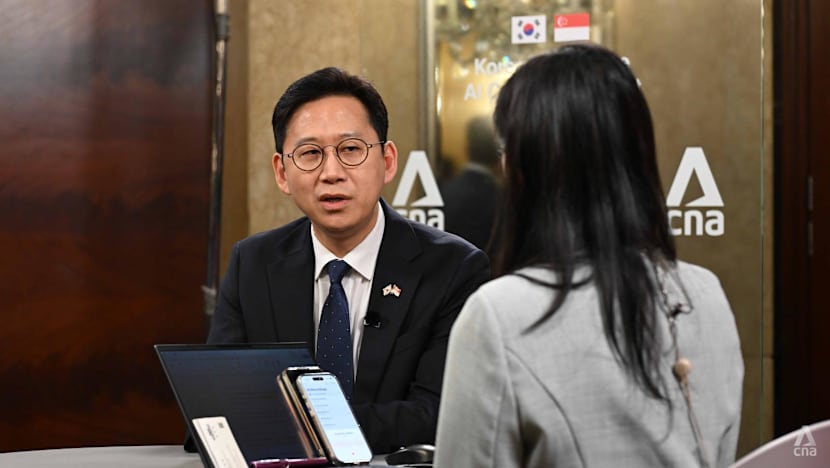 South Korean Deputy Prime Minister and Minister of Science and ICT Bae Kyung-hoon speaking to CNA on Mar 2, 2026. (Photo: CNA/Lim Li Ting)
Separately, in an interview with CNA alongside the launch of the AI alliance, South Korean Deputy Prime Minister and Minister of Science and ICT Bae Kyung-hoon said Singapore serves as a gateway to ASEAN markets, while South Korea, for its part, has recently advanced its global position in terms of AI competitiveness.
"Singapore has demonstrated strong capabilities in applying AI to smart factories and has notable strengths in cybersecurity, while South Korea has had significant advantages in manufacturing-based AI transformation," he added.
The latter has also secured capabilities in foundational AI models, following the United States and China, Mr Bae told CNA.
"If Korea and Singapore combine our strengths, we can achieve AI capabilities comparable to those of the United States and China."