 3 months ago
106
3 months ago
106
BEIJING: Chinese autonomous driving firm Pony.ai says the groundwork for large-scale robotaxi deployment is largely in place, as it pushes to expand services in China and overseas.
CEO James Peng said the company has upgraded the artificial intelligence system behind its vehicles and is working to lower production costs as it moves towards wider commercial rollout.
“I think all the important factors are already in place. Now, we are sort of in the evolution process. It’s just launching more,” Peng said.
AI UPGRADES DRIVE FUTURE GROWTH
At the centre of Pony.ai’s push is an upgrade to its core AI system, known as PonyWorld.
The company said it uses more real-world driving data to better model traffic dynamics and road-user behaviour.
This helps its vehicles respond more effectively in complex driving scenarios.
This process, known as “reinforcement learning”, has been a key feature of the system since its launch three years ago, Peng told CNA on the sidelines of the Auto China show in Beijing on April 24.
But the latest version marks a shift towards more autonomous decision-making, he added.
“We (have) evolved from reinforcement learning into self-learning,” Peng said. “The vehicles actually can judge how good the driving is by themselves.”
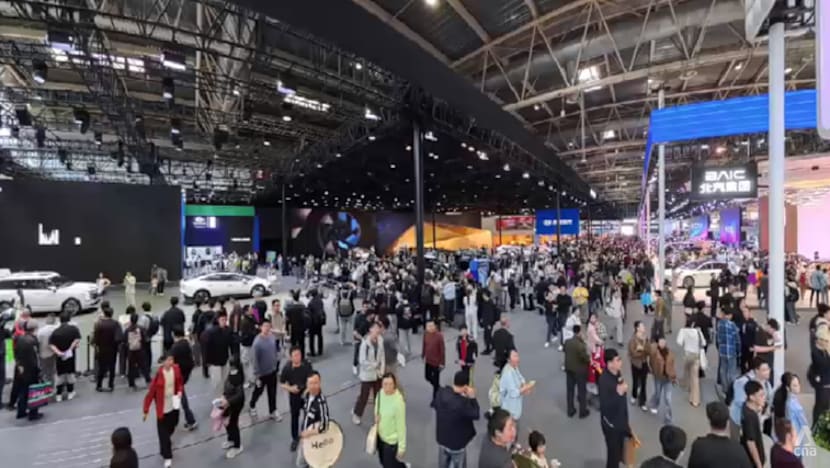 Crowds at the Auto China show in Beijing.
SCALING UP ROBOTAXIS
Autonomous driving is commonly classified across six levels, from Level 0, from no automation, to Level 5, with full automation. China also uses this six-level framework under its national standard for vehicle driving automation.
At Level 4 – the level targeted by most robotaxi firms – vehicles can operate fully driverless within specific areas or conditions, without needing human intervention.
Asked how close Pony.ai is to large-scale Level 4 deployment, Peng said the company has most of the key elements in place.
What remains includes producing enough vehicles, securing regulatory approvals, building storage facilities and growing a user base, he added.
“I don’t think there’s one single block for large-scale deployment, it just takes time,” he said.
Pony.ai is also working to bring down the cost of its vehicles, a key step towards mass adoption. Its seventh-generation robotaxis could cost below US$34,000 by 2027.
China has already emerged as a major testing ground for autonomous driving, with more than 50 cities rolling out policies for its use.
Fully driverless robotaxis are already on the roads in designated zones across four cities – Beijing, Chongqing, Wuhan and Shenzhen.
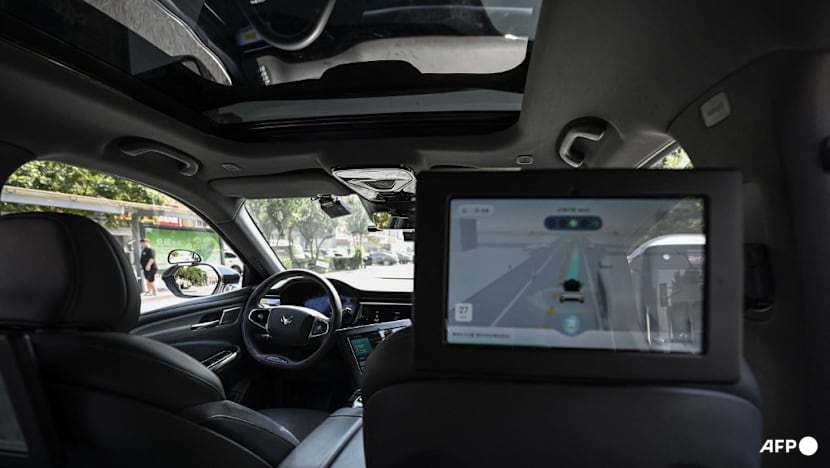 A driverless robotaxi developed by Baidu Apollo driving along a street in Beijing in 2023. (Photo: AFP/Jade Gao)
Beyond China, Pony.ai is also stepping up efforts overseas, targeting markets such as the Middle East and Europe.
In March, ride-hailing giant Uber announced a partnership with Pony.ai and Croatian startup Verne to launch what is set to be Europe’s first commercial robotaxi service in Zagreb.
The company has also partnered Estonian ride-hailing firm Bolt to test and deploy fully driverless vehicles in Europe, with initial rollouts targeted for 2026.
“There are a lot of European cities (that have) come to talk to us about launching L4 services,” Peng added.
“I think in the coming years, we’ll see there’s going to be exponential growth.”
FOCUS ON TECH AT AUTO CHINA
Interest in intelligent vehicles was also evident at the biennial Auto China show, which ended on Sunday.
With more than 890,000 visitors and over 1,400 vehicles on display, manufacturers sought to capitalise on the interest.
Across the show floor, automakers showcased features ranging from AI-powered in-car assistants to automated parking and driver-support systems.
Observers say the focus reflects growing competition in China’s auto market, where smart features are no longer a bonus, but an expectation.
“Many Chinese consumers care more about whether their car has better smart features compared to their friends' cars, rather than how it drives,” said 32-year-old automotive content creator Huang Yichao, who produces videos advising buyers on car choices.
Manufacturers also showcased more models developed jointly with foreign partners, combining traditional engineering with software and systems tailored to Chinese users.
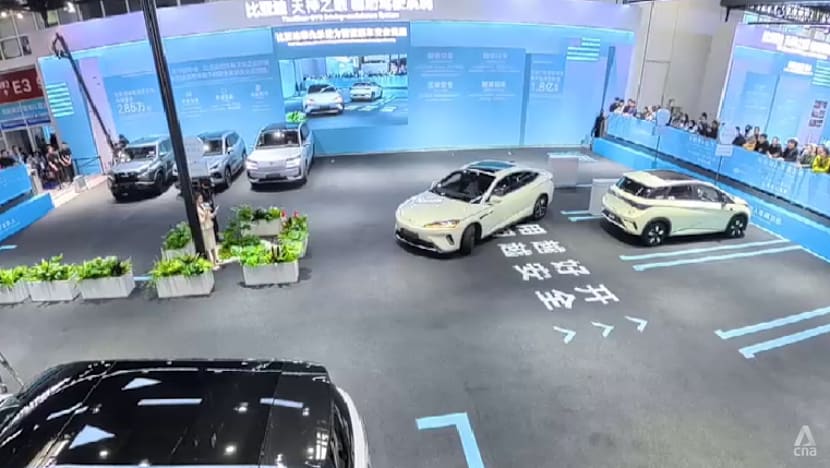 Vehicles demonstrate automated parking features at the Auto China show in Beijing.
STILL ROOM FOR GROWTH IN CHINA
China’s passenger vehicle sales fell by 17.4 per cent year-on-year in the first quarter of 2026, amid reduced government subsidies and softer demand, with carmakers slashing prices in response.
But price wars are unsustainable, said Yale Zhang, managing director at Automotive Foresight. He noted that manufacturers are increasingly focusing on technology, with such features particularly appealing to younger consumers in China.
Zhang added that while demand has softened in the short term, the domestic market is expected to remain resilient, as many households still do not own cars.
Industry estimates put China’s car ownership below that of mature markets such as South Korea and Japan, suggesting room for further growth.
Electric vehicle adoption is strong in major cities, but rural areas still present opportunities for expansion, he added.
Zhang said improving charging infrastructure and access to low-cost power could help drive the next phase of growth. However, intensifying competition means weaker players may be forced out or acquired as the industry consolidates.
OIL PRICES AND EV ADOPTION
Rising oil prices, driven by tensions in the Middle East, are also shaping market dynamics.
Pony.ai’s Peng noted short-term disruptions, particularly to vehicle exports to the Gulf.
But over time, he expects the situation to accelerate the shift towards electric and autonomous vehicles.
“It’s changed consumers’ behaviour and perception that there could be a disruption to oil and gas,” he said. “So I think EV adoption in the mid- to long run … could be even higher.”
Despite the export disruptions, Peng noted that discussions with local partners and governments point to growing support for autonomous driving.
BUILDING TRUST IN AUTONOMOUS DRIVING
Safety remains a key concern, especially as incidents involving self-driving vehicles occasionally make headlines.
Pony.ai itself has faced scrutiny in the past, including after one of its robotaxis caught fire in Beijing last year. No injuries were reported.
Peng said building trust would depend on several factors, even as the industry continues to face safety scrutiny.
He maintained that the company’s technology is safe and stressed the importance of working with regulators and improving public understanding.
As more robotaxis hit the roads, visibility itself could help win over sceptics, he said.
“Gradually, as we are launching more and more vehicles … people can actually see it, and seeing is believing.”