 1 month ago
57
1 month ago
57
In the aquarist lab of the Singapore Oceanarium, I watched Ms Vivian Cavan transfer hundreds of baby sea jellies from one vessel to another with a pipette.
It was a painstaking process – each baby is barely larger than a grain of rice and needs to be handled with the utmost care and attention.
Watching Ms Cavan, 38, do this delicate work, I couldn't help but feel slightly stressed. But I seemed to be the only one.
"This doesn't even feel like work to me," she said without missing a beat, sounding every bit as relaxed as she appeared.
Just minutes before, in the quiet of the oceanarium before the crowds arrived, the lead animal care specialist had been making her morning rounds. Her energy had been completely different then, efficient and exacting as she moved briskly between habitats, sharp eyes roving over each one to ensure nothing was out of the ordinary.
Ducking into the lab and joining her team in the routine cleaning of the habitats, she relaxed almost immediately.
For her, entering the lab seemed to be akin to coming home for any other person. Earlier that morning, she had candidly admitted having nerves about media interviews; now, those nerves seemed to dissipate instantly.
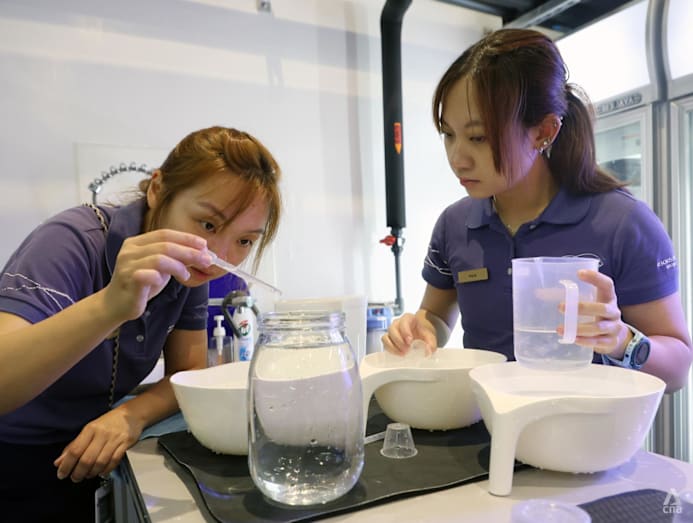 Ms Vivian Cavan (left) and her team member Ms Vera Ngin transferring ephyrae of sea jellies from a bowl to a mason jar of clean water, at the aquarist lab in the Singapore Oceanarium on Feb 25, 2026. (Photo: CNA/Ooi Boon Keong)
Ms Cavan is a self-professed workaholic. Sea jellies are always on her mind, so much so that she can sometimes even come across as "insensitive" to others, she confessed with a laugh.
Once during a morning briefing, she noticed a young team member with swollen eyes and immediately pointed out that she might have difficulty handling the tiny baby sea jellies, also known as ephyrae.
That team member nodded and said nothing. Only later did Ms Cavan learn, from other colleagues, that the woman had been crying all night over a breakup.
Nine years into the job, Ms Cavan's fascination with sea jellies has led her to build a life that she readily admits revolves around the creatures. Her family and friends have come to expect it.
"They think I'm obsessed. They know that if they want to get me something, just buy sea jelly merchandise."
She has amassed a sizeable collection of sea jelly-themed keepsakes from around the world – books, soft toys, figurines and so on – but keeps them carefully stored away, rarely bringing them out for fear of damage.
On the name "sea jellies", the oceanarium is quick to insist they should not be called "jellyfish" even though this is a widely-used term. Unlike fish, sea jellies have no gills, fins and backbones, it said.
Given Ms Cavan's passion and confidence, it was a surprise to discover that not only had she never expected to end up working in an oceanarium, prior to being employed as one, she had not even known what an aquarist was. For the record, an aquarist manages aquariums, and is involved in the care of aquatic creatures.
FROM RETAIL TO REEF
Ms Cavan got her first taste of a working life earlier than most. In 2005, upon completing her O-Level examinations, she began part-time position at a pet store.
"I've always loved animals and would volunteer regularly at shelters. But it'd be with mammals like dogs, cats, and rabbits," she said.
What was meant to be a temporary role stretched to nearly seven years, as she continued working there while attending polytechnic in pursuit of a marketing diploma.
Over time, her responsibilities at the store grew and grew. She initially started out part-time while in poly, before converting to a full-time role after graduation. Within a few years, she helped the business expand from a single store into a chain of around 40 to 50 outlets.
Within a few months of graduating polytechnic, most of Ms Cavan's peers were still looking for or just starting their first full-time jobs. She was already overseeing multiple outlets, opening new branches and managing day-to-day operations for the business – a stable career path with a stable income.
Around the six-year mark, a spontaneous decision to join her cousins on a trip to an island in the Philippines changed her life's trajectory permanently.
For her cousins, the main objective of the trip was scuba diving. Ms Cavan was a complete stranger to the activity, but tried it for the first time with her cousins' encouragement.
She ended up loving it so much that she decided that very same day that she would go on to obtain her open water certification.
"The thrill of jumping in, the mystery and adventure of it all – it changed my life," she said.
"I realised I needed to go out there and figure out what I really wanted to do."
After nearly seven years at the pet store chain, Ms Cavan began to question whether it was a path she wanted to continue on, and if she was willing to dive into the unknown.
"It was a huge jump because you're going from a very good income at the age of 23 to no income at all," she said. "But I just wanted to do something that didn't require me to chase a KPI."
A year later, in 2011, she quit the store and set off on a year-long backpacking trip across several places including Taiwan, Vietnam and Thailand. Her solo adventure eventually led her to Boracay, in the Philippines, where she ended up staying for more than two years.
There, she got acquainted with the owner of a dive shop, a Frenchman who offered her free dives in exchange for helping to translate for Chinese customers – a deal she readily agreed to.
For those two years, she enjoyed the relaxed pace of Boracay. Early mornings were spent preparing gear, afternoons on suntanning and diving, and evenings attending to inquiries back at the shop – a stark contrast to the go-getting life she had left behind in Singapore.
"I could feel true happiness radiating from my belly," recalled Ms Cavan. "That simple life made me realise what fulfilment felt like."
But even then, she knew life in paradise could not last forever. "After a while, it just felt like time to go back to reality," she said.
So she returned to Singapore in 2014. Soon after her return, a friend working at Resorts World Sentosa told her about a job fair offering roles at the Singapore Oceanarium, known back then as the SEA Aquarium.
By then, her time in the Philippines had sparked a deeper interest in marine life. Seeing entire reef systems up close, and later seeing the damage left behind by Typhoon Haiyan in 2013, left a lasting impression.
So when the aquarist opportunity arose a year later, she decided to give it a shot – despite having only a diving certification and zero knowledge of fishkeeping, theoretical or practical.
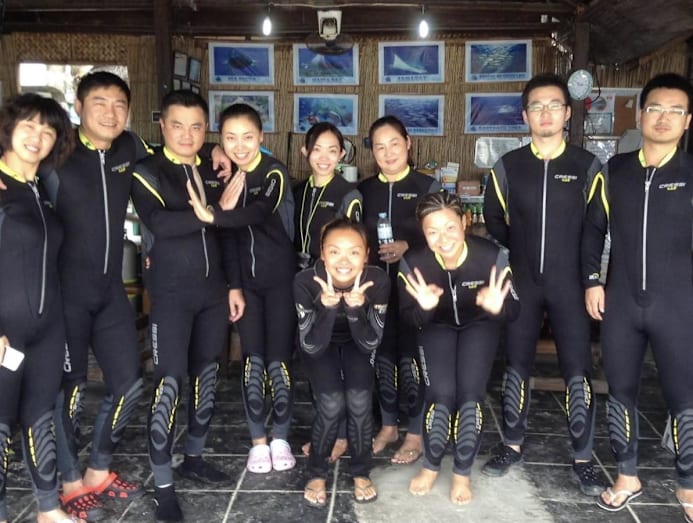 (Front row, middle) Ms Vivian Cavan with a group of tourists she guided in Boracay in 2013, where she spent over two years working at a dive shop. (Photo: Vivian Cavan)
More importantly, she felt drawn to the broader purpose of the role, which went beyond displaying and caring for fish to include education, conservation and the coordination of multiple departments.
"I wasn't sure I would get the job," she said. "But I had the willingness to learn, and I think that's why I was hired."
She added: "I don't mind being dirty, fishy, wet or carrying heavy things. But I mind feeling stuck."
STARTING FROM ZERO
Ms Cavan was first placed in the coral and fish team, and then moved to the sea jellies team a few months later – a surprise even to herself.
"I didn't even realise there was a sea jellies team," she admitted with a laugh.
The early days, she added, were "embarrassing".
Being entirely unfamiliar with sea jellies at the start, the learning curve turned out to be steeper than anything she had faced before.
Despite thousands of dives, she had never before encountered a wild sea jelly. When she was first asked to join the team, her initial concern was whether she would be stung – a concern soon put to rest by the assurance of protective gear.
Her brief stint in the coral and fish team quickly proved to be only of limited value. Working with the sea jellies was hardly comparable – they don't react or interact much with external stimuli, unlike more responsive animals.
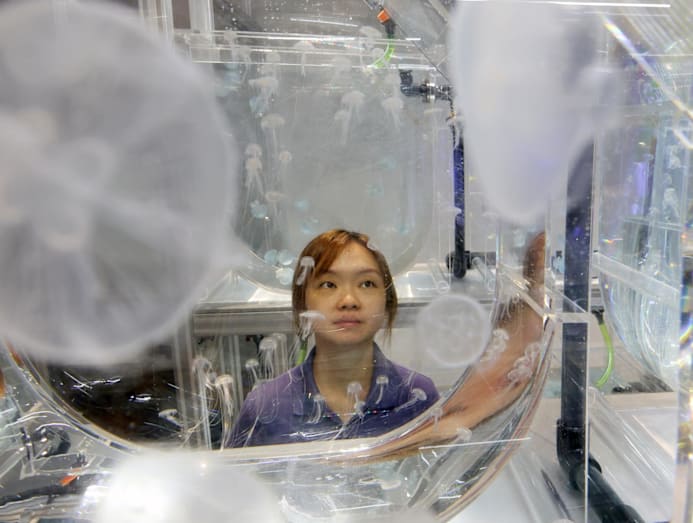 Ms Vivian Cavan, an lead animal care specialist at the Singapore Oceanarium, looking at a habitat of moon jellies at the aquarist lab on Feb 25, 2026. (Photo: CNA/Ooi Boon Keong)
She also quickly found out that much of sea jelly work, unlike with fish, takes place out of the water. A lot of it can be dry and technical, carried out with pipettes, clickers and careful measurements.
The team still has to enter the water habitats for cleaning and maintenance, but even such menial tasks are more laborious and painstaking than in other habitats.
Each jelly is made up of about 90 per cent water, and is thus easily damaged.
They drift through the water passively and do not move out of the way in the same manner as sea dragons or seahorses, which she had worked with previously. Each one had to be scooped carefully into a container before cleaning and then returned to the habitat equally carefully.
She also had to adjust to working in confined habitats using surface-supplied diving, where breathing air is supplied from the surface. This means she had to learn to dive without fins, accessories she had always relied heavily upon for control while in the water.
In the process of learning, she often found herself struggling to maintain her balance during routine tasks. Once, she recalled a senior staff member reminding her not to "look like a clown" in front of visitors watching on the other side of the glass.
"Because I had no experience, I was like a sponge – willing to pick up anything," she said.
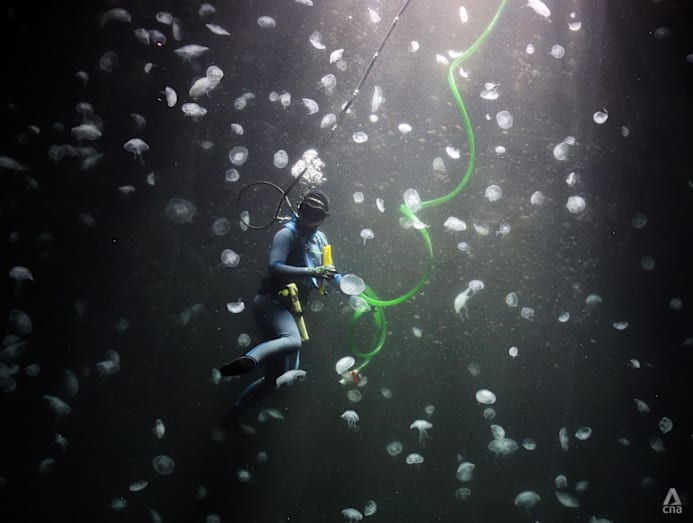 Ms Vivian Cavan, a lead animal care specialist at the Singapore Oceanarium, dived into the moon jellies’ habitat to clean it on Mar 3, 2026. (Photo: CNA/Ooi Boon Keong)
With only a basic understanding of aquatic husbandry, such as harvesting food and maintaining habitats, Ms Cavan embarked on a journey of intense self-study. Whenever she was out of the tank, she pored over scientific papers, looked up research references and applied what she learnt on paper through trial and error.
"When we saw improvements – such as successfully breeding certain sea jellies, closing their life cycles, and refining flow habitats and husbandry practices – it proved that with enough reading, experimentation and persistence, I could make things better for the animals," she said.
Progress came slowly – built through small adjustments, repeated trials and long hours of observation.
A collaboration with a researcher on St John's Island, off southern mainland Singapore, later broadened her exposure, and she began steadily building a network of aquarists and researchers around the world which she maintains to this day.
JELLY HEARTS
Working in the oceanarium may seem like a dream job for any avid fan of fish – but Ms Cavan is adamant that it requires more than just a love for aquatic life.
"It takes patience, teamwork and perseverance," she said. "You can love marine animals, but that doesn't mean you can do this job."
Over time, she found herself developing a deeper love not just for the animals themselves, but also the process of understanding and caring for them.
She wanted to know that her work had value – that she was contributing in a meaningful way.
Working with live animals also meant Ms Cavan had to rethink her fundamental notions of success and failure.
Compared to her prior experience with the rapidly expanding pet store chain, she now had to recalibrate her expectations in an environment where experiments and efforts do not always succeed, and progress could be slow.
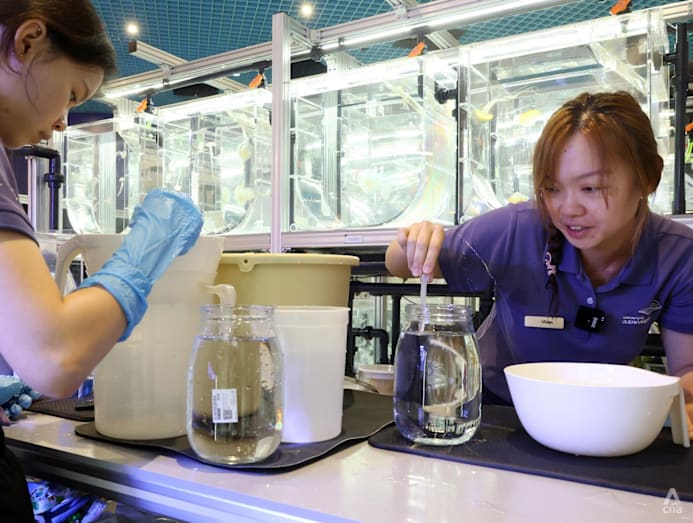 Ms Vivian Cavan (right), a lead animal care specialist at the Singapore Oceanarium, transferring ephyrae of sea jellies from a bowl and to a mason jar of clean water on Mar 3, 2026. Water change for sea jellies’ ephyrae is part of the sea jellies animal care team’s daily routine. (Photo: CNA/Ooi Boon Keong)
In the early days, the team relied on external vendors for sea jellies, some of which could be displayed for only around a year before they start shrinking, pushing them to strive towards becoming self-sustaining through breeding.
But when it comes to the breeding of sea jellies, results are never guaranteed.
Firstly, the process requires careful timing. Secondly, once it's triggered, there is little for Ms Cavan and her team to do but monitor their gelatinous charges – sometimes for days, sometimes for weeks on end.
"That might be the most challenging part of my job – the emotional toll of waiting," she said.
Even after nearly a decade, Ms Cavan said, the anxiety never goes away. During breeding periods, the team checks each and every day for signs of new life. But instead of the hundreds they hope for, they can sometimes get only a handful.
"The whole team waits together, like a family outside a labour ward," she said. "I'll ask for updates even when I'm at home."
You can love marine animals, but that doesn't mean you can do this job.
Over the years, the sea jellies team has grown from three to seven members, and from four habitats to eight.
As their capabilities grew, so did their ambitions, and with support from management, the team eventually redesigned their former office into what is now the aquarist lab – a controlled back-of-house space tailored to their needs, allowing them to scale up production while maintaining biosecurity.
DRIVEN BY PURPOSE
When I asked Ms Cavan what her life is like outside of work, she seemed almost amused by the question.
"I don't really understand work-life balance," she said. "This work is part of my life."
A mother of two girls, aged 12 and 4, she is deliberate about the example she sets and sees her commitment to her work not as a trade-off, but as something her children can learn from.
Ms Cavan's husband – whom she met at work – takes a different tack. While she's chasing down sea jelly updates even when she's outside the lab, he prefers to keep clear boundaries outside of working hours.
In the early years of starting a family, they relied on support from her mother and childcare centres, later engaging a helper to manage daily routines.
"I don't think you should stop pursuing what you love just because you become a wife or a mother," said Ms Cavan.
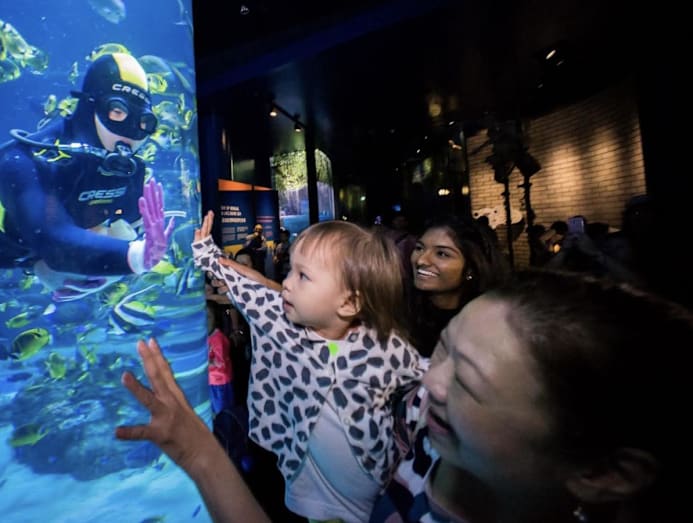 Ms Vivian Cavan diving in 2016 to surprise her daughter, held by her mother, at the Singapore Oceanarium, formerly known as the SEA Aquarium. (Photo: Vivian Cavan)
In the same vein, just as her family members support her commitment to her work, Ms Cavan believes in supporting their interests.
Her eldest child, for instance, is passionate about dance. Ms Cavan and her husband show their support by sending her to classes and putting in regular attendances at her performances.
When it comes to learning, Ms Cavan makes sure to walk the talk for her kids. Last year, she completed a specialist diploma and later took up a Japanese language course.
The role of motherhood carries over to work, and not just with her beloved sea jellies. Within her team, she is affectionately known by her human charges as "jelly mother".
"They call me 'mother' when everything is normal," she said, laughing. "But when they do something wrong or want to take leave, suddenly I become 'Vivian'."
"I want them to enjoy the work, so it doesn't feel like work," she said. "Not just working for money, but doing something meaningful."
Beyond day-to-day duties, she also encourages the team to take on self-initiated projects, such as identifying and cultivating new species that enter the oceanarium system.
This includes collecting and isolating tiny organisms that attach to rocks or pass through intake lines, then placing them in controlled environments to observe their growth and reproduction.
These projects, she said, give younger team members a sense of hope and achievement, while keeping the work dynamic and engaging.
"It wasn't easy when I started, but that helped shape who I am today," she said, adding that a smoother path might have led her to train others differently.
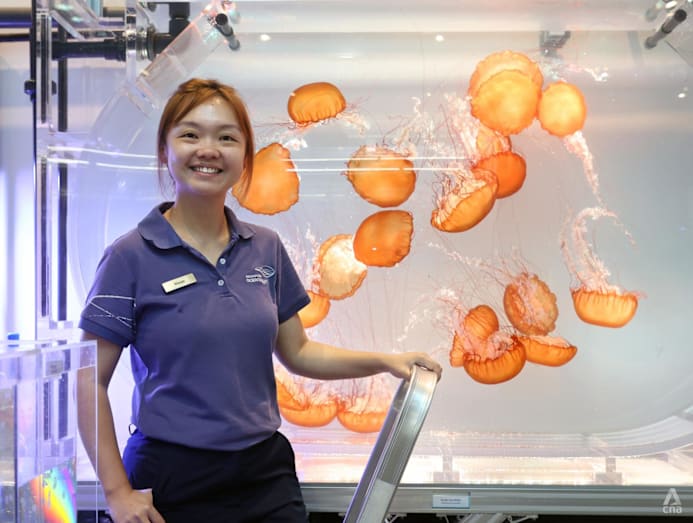 Ms Vivian Cavan, a lead animal care specialist at the Singapore Oceanarium, in front of a habitat of Pacific sea nettle at the aquarist lab on Feb 25, 2026. (Photo: CNA/Ooi Boon Keong)
Because she had to figure things out on her own, she now strives to strike a careful balance with her team between guiding them and encouraging them to take ownership of their work. Rather than directing every step, she focuses on encouraging them to solve problems themselves and see their work as something more than just a job.
Part of her passion, she added, also stems from a sense of responsibility to deepen understanding of sea jellies in Southeast Asia, where much remains unknown.
She is particularly interested in finding out what species exist in local waters and learning how to care for and breed them, with the aim of sharing insights that can help researchers better understand their presence in the region.
"There's no limit to how much I can learn about sea jellies. My goals keep piling up and expanding – it's like being thirsty, nothing quenches it."
That drive, she said, is what keeps her going, and she credits much of it to her team – many of whom have stayed on for years.
"When there's a species that's very hard to breed, I become very focused on it until I overcome the challenge," she said.
The way Ms Cavan sees it, the work is never finished. Each breakthrough is only ever temporary.
"Once I do, it's on to the next," she said. "There is always more to discover about sea jellies."
By the end of our conversation, it seemed crystal clear to me that Ms Cavan would never again return to the corporate career she pursued so relentlessly as a young adult.
I asked her to think back to that Vivian Cavan of 15 years ago, the one who spent years removed from reality in Boracay. What would she say to that younger version of herself now?
"Don't worry," she said simply. "You will love the version of yourself in the future who's happy and doing what you enjoy."