 1 month ago
65
1 month ago
65
JAKARTA: Indonesia President Prabowo Subianto has hit back at criticism of his overseas trips, as he dismissed claims that these were purportedly for “sightseeing” or ceremonial visits.
In what is believed to be the first time he has spoken out on his frequent visits abroad, he added that they are part of a broader economic diplomacy strategy aimed at protecting jobs and advancing Indonesia’s national interests.
Speaking in a video posted on his official YouTube channel titled “Prabowo Menjawab 2” on Sunday (Mar 22), the president said that each overseas trip has a specific purpose tied to the livelihoods of millions of Indonesian workers.
“People think I like to travel but I travel to take care of my people as well,” he was quoted as saying by local news outlet Detik.
He added that his overseas engagements are aimed at opening market access and strengthening Indonesia’s bargaining position and industrial cooperation - all of which have a direct impact on employment.
Since assuming office, the 74-year-old retired general has pursued an intense diplomatic schedule, attending at least nine international summits and making more than 40 official visits to more than 20 countries, spanning major powers and smaller strategic partners alike.
He has visited several countries more than once, including Malaysia, which he visited at least five times, news outlet Kompas reported.
The numbers far exceed that of his predecessor Joko “Jokowi” Widodo’s 16 state visits, or former president Susilo Bambang Yudhoyono’s 10 overseas trips, in their first full years in office.
Prabowo added that in many cases, the direct presence of a head of state is a decisive factor in economic negotiations, particularly those related to trade and investment.
“In the end, I have to be there,” he said.
He added that negotiations often reach a deadlock at the technical level and in such situations, strategic decisions can only be made through direct communication between national leaders.
“Sometimes in negotiations, they always say they need to report to their top leader. There are important matters that must be discussed directly between the heads of state,” he said.
Prabowo cited Indonesia’s success in gaining access to the European Union (EU) and Canadian markets through economic cooperation schemes, which have allowed several key Indonesian exports such as textiles and footwear to enjoy zero tariffs after previously facing trade barriers.
Without direct intervention at the head-of-state level, he said, Indonesia’s domestic manufacturing sector could have come under serious pressure.
“Our shoes and textiles were once under threat, but now we have secured alternatives. If I had not gone directly to meet the King of Belgium, the King of the Netherlands, or EU leaders, we might not have broken through,” he said.
The high frequency of visits reflects a changing global landscape that increasingly prioritises economic strength, which is key in determining a country’s standing, he added.
“If our economy is strong, we cannot be pushed around,” he said.
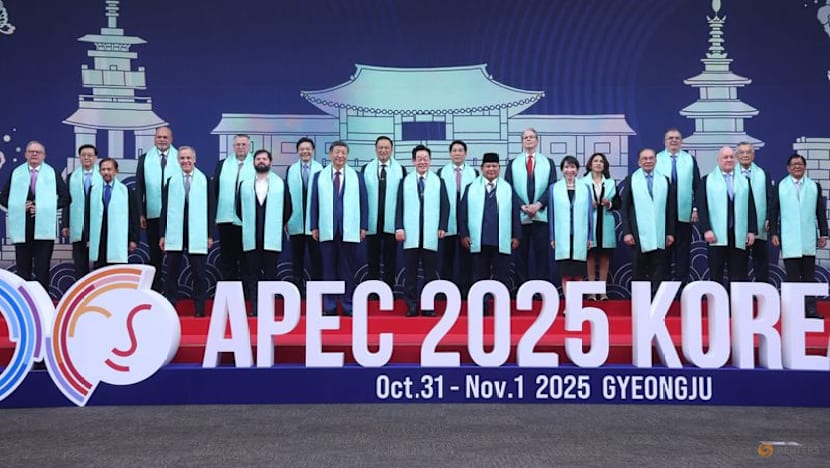 Indonesian President Prabowo Subianto poses with fellow leaders at the APEC summit in Gyeongju, South Korea, on Nov 1, 2025. (File Photo: Yonhap via Reuters)
He also highlighted Indonesia’s strategic position as a resource-rich country that attracts global powers.
Ties with international organisations such as the Association of Southeast Asian Nations (ASEAN), the G20, and the Organisation of Islamic Cooperation (OIC) must continue to be strengthened to maintain stability and safeguard national interests, he said.
He also added that attending international invitations is part of diplomatic norms.
“If we are invited and we don’t attend, it’s not good. That’s why every Indonesian president ends up being very busy.”
Observers had told CNA previously that Prabowo’s intense diplomatic schedule can be seen as positioning Indonesia as a middle power ready to engage directly with the major powers.
The experts added that in today’s increasingly fragmented world – marked by US protectionism, geopolitical and economic rivalry between Washington and Beijing and prolonged conflicts in Europe and the Middle East – Indonesia may have the opportunity to position itself as a bridge-builder, mediator and agenda-setter.