 3 months ago
175
3 months ago
175
Beijing has confirmed one national killed in Tehran and evacuated more than 3,000 citizens from Iran, as those stranded across the Middle East describe explosions, airspace closures and mounting uncertainty.
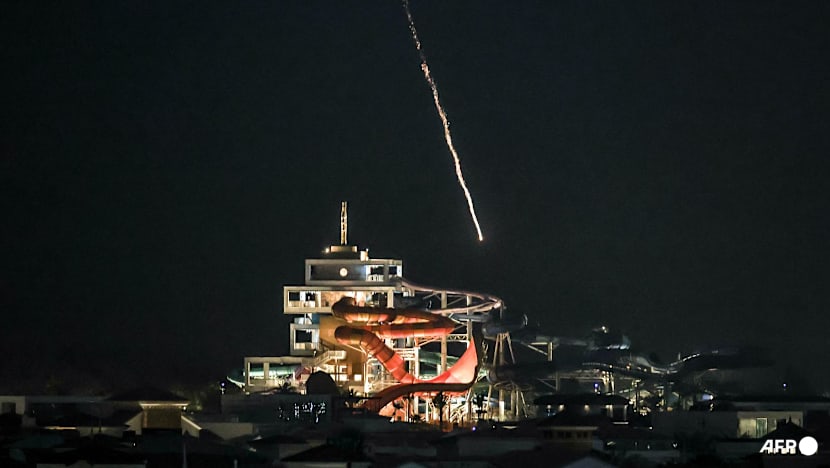
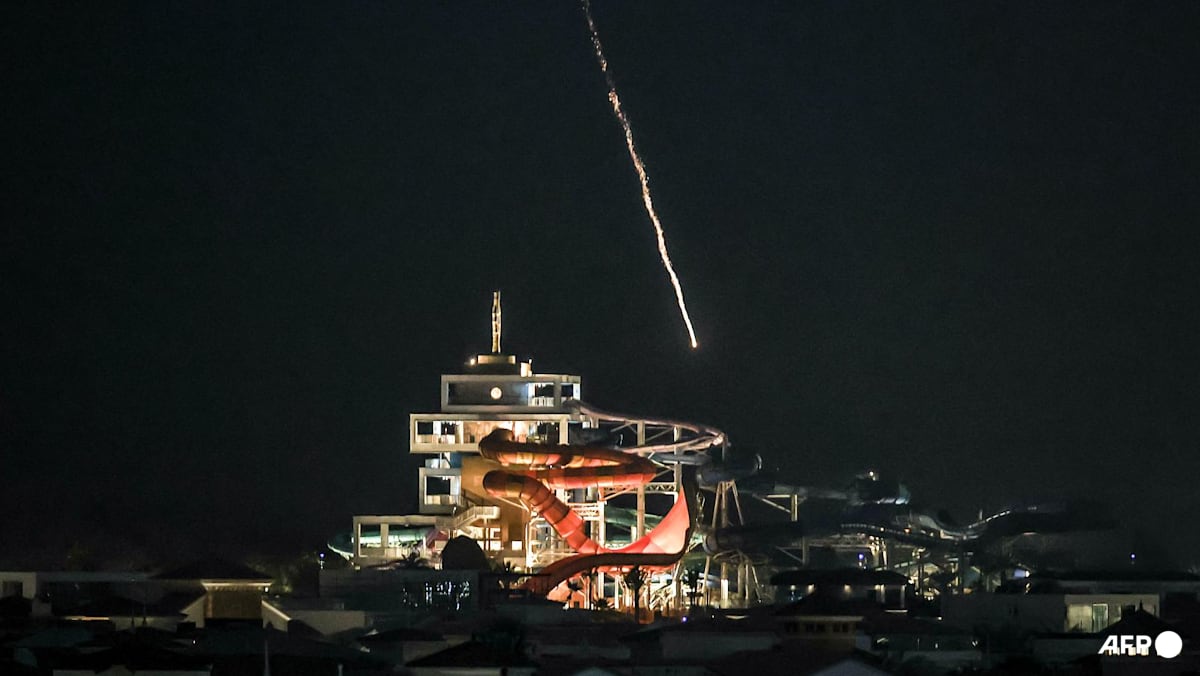
An intercepted projectile falls into the sea near Dubai's Palm Jumeirah archipelago on Mar 1, 2026. (Photo: AFP/Fadel Senna)
New: You can now listen to articles.

This audio is generated by an AI tool.
BEIJING: Missile blasts lighting up the night sky. Shockwaves rattling windows. Flights cancelled without warning.
Chinese citizens stranded across parts of the Middle East have described frightening scenes amid the conflict involving military strikes by the United States and Israel and subsequent Iranian retaliation.
Amid the violence, China’s Ministry of Foreign Affairs said on Monday (Mar 2) that a Chinese citizen has been killed in Tehran, without providing additional details about the deceased’s gender or age.
More than 3,000 Chinese nationals have since been evacuated from Iran.
Speaking at a routine media conference, Chinese foreign affairs spokeswoman Mao Ning said that the Chinese Embassy as well as consulates across Iran are assisting citizens to evacuate the country as soon as possible.
Mao added that Chinese embassies and consulates in other neighbouring countries have since dispatched teams to border crossings to provide assistance.
“In light of the current situation in Iran, we once again solemnly remind Chinese citizens in Iran to strengthen personal precautions, evacuate safely as soon as possible.”
The first batch of Chinese citizens were evacuated by land to southern Azerbaijan, according to Chinese state media reports.
Buses have also been arranged by Chinese embassy officials in Azerbaijan to ferry citizens from the border to the capital Baku.
Officials also shared several border crossing evacuation routes to nearby countries like Turkmenistan, Armenia, Iraq and Türkiye.
“The situation is changing rapidly and (we) will continue to monitor border conditions and provide updates,” the Chinese embassy said in a statement shared on the WeChat app.
Chinese citizens in Israel, on the other hand, have been advised to evacuate to safe areas within Israel, said China’s National Immigration Administration in a statement on WeChat.
They were warned to stay away from “military units, sensitive institutions and major transportation hubs like airports and train stations” and also avoid travelling to cities like Tel Aviv, Haifa and Jerusalem.
EXPLOSIONS AND SHOCKWAVES
Chinese travellers shared harrowing encounters on the ground.
A Chinese tourist in Dubai, surnamed Chen, said explosions from intercepted missiles overhead caused shockwaves so strong that he could feel buildings vibrating slightly.
Chen, who is in Dubai with his wife and child, initially planned to head home to China by Kuwait.
“(The) boarding had just completed then, and just as we’re about to take off, the captain suddenly announced that the entire airspace was closed due to a ‘terrorist attack’ and other reasons,” Chen told the state-owned newspaper Beijing News.
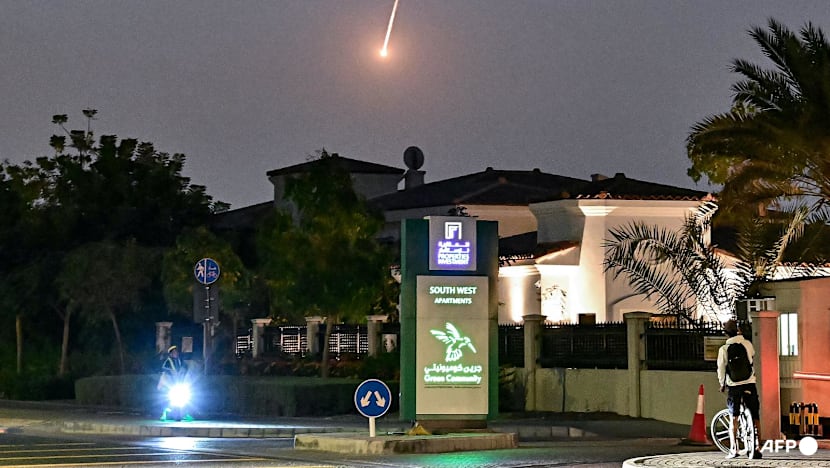 A cyclist watches as a projectile falls over Dubai on Feb 28, 2026. (Photo: AFP)
Because of the sudden change, Chen sought temporary refuge at a friend’s home in Dubai.
He had heard at least 10 explosions overhead, like “massive fireworks going off”.
“We don’t know where the missiles are aiming for,” he said. “It does feel like everything is on edge at the moment. If a car drives past loudly, or planes fly past, it does get very nerve-wracking.”
The family is taking refuge indoors for the time being.
“We’re trying to find a way to return home,” he said. “Safety is more important than anything else.”
Writing on Xiaohongshu, a Chinese user in Dubai with the handle Mu Rou, shared that she also heard loud explosions that caused the windows of her home to shake.
“The sound of artillery fire was muffled so it was probably a bit of a distance away,” she said, adding that she had also received two missile strike warning alerts on her phone.
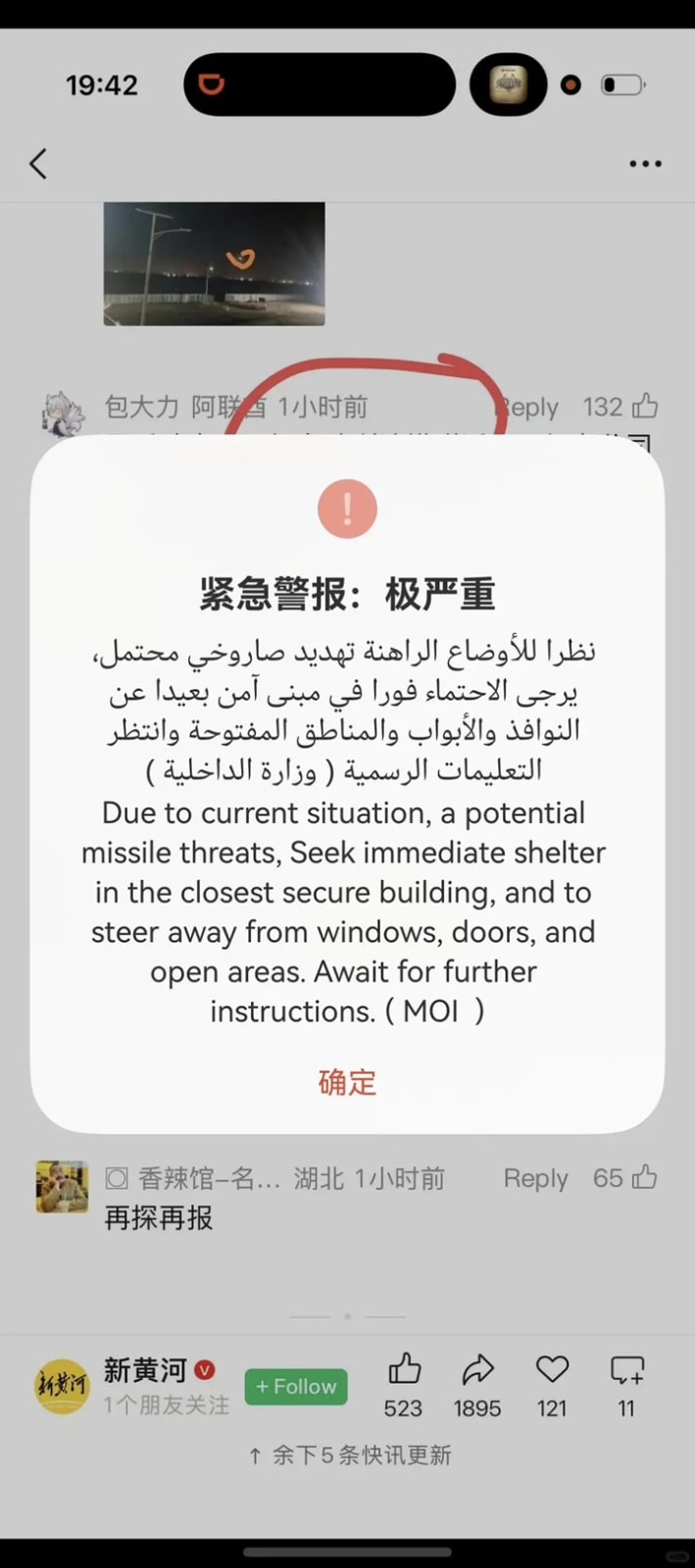 A screengrab of a missile strike alert from the United Arab Emirates' interior ministry. (Image: Xiaohongshu/Mu Rou)
Li Mao, a Chinese entertainer, was also among Chinese tourists currently stranded in Dubai.
Posting on short-video platform Douyin, Li shared that he still could not return to China due to flights being cancelled.
“I haven’t slept for the whole night,” he said in a video, which drew concerns from followers.
In a video he posted on Monday, Li said that he would attempt to cross the border to Oman to catch a flight back to China.
The ongoing conflict has affected multiple locations in Dubai, including its international airport and hotels, he said - adding that he just “wants to go home”.
Hong Kong immigration authorities said they had received nearly 200 inquiries from residents stranded in Middle East countries.
All currently remain in safe locations and officials are coordinating with relevant government agencies and embassies across Qatar, the United Arab Emirates (UAE), Saudi Arabia, Bahrain and Jordan, Hong Kong’s Immigration Department told the South China Morning Post on Sunday.
“The Immigration Department will continue to maintain contact with Hong Kong residents who made inquiries, providing appropriate advice and feasible assistance regarding their itineraries and flight information,” it added.
Martin Yeung Wan-fung, a Hong Kong solicitor, remains stranded in Dubai after his flight to Hong Kong had been grounded.
Yeung was in Dubai for personal matters - arriving on Friday and reported hearing constant “explosion sounds”, also seeing “flashes of fire” in the sky.
“It was quite terrifying - something we rarely encounter in Hong Kong,” Yeung said, adding that he saw “missiles explode right above you”.
“Even though it’s at a distance, you know that they (armies) are actually attacking you.”
TRAVEL WARNINGS RAISED
Taiwan also revised travel warnings.
Travel alerts for Bahrain, Kuwait, the UAE, Saudi Arabia and Qatar were raised from yellow to orange - the second highest level, said Taiwan’s Ministry of Foreign Affairs in a statement on Monday.
Taiwanese have also been warned to avoid unnecessary travel to those destinations.
Travel alerts for Israel and Iran remain at red, the highest level.
No official requests have been made for government assistance for evacuation, the ministry said, adding that it has been in contact with about 3,000 Taiwanese - and all remain safe, according to local media reports.
Given that Iran’s retaliation has been focused on US military sites in the region rather than on civilians, Taiwan’s foreign affairs ministry said officials have no immediate plans to evacuate Taiwanese in Middle East countries.