 1 month ago
60
1 month ago
60
While Singapore is not facing a shortage of medical supplies, disruptions to oil flows in the Middle East are tightening the supply of naphtha, a key feedstock for many everyday plastic items.

Naphtha is a key ingredient used to make plastics in medical and everyday products. (Photo: iStock)
New: You can now listen to articles.

This audio is generated by an AI tool.


SINGAPORE: A key raw material used to make everyday plastic products – including medical supplies such as syringes and catheters – is facing supply uncertainty as tensions in the Middle East disrupt global oil flows.
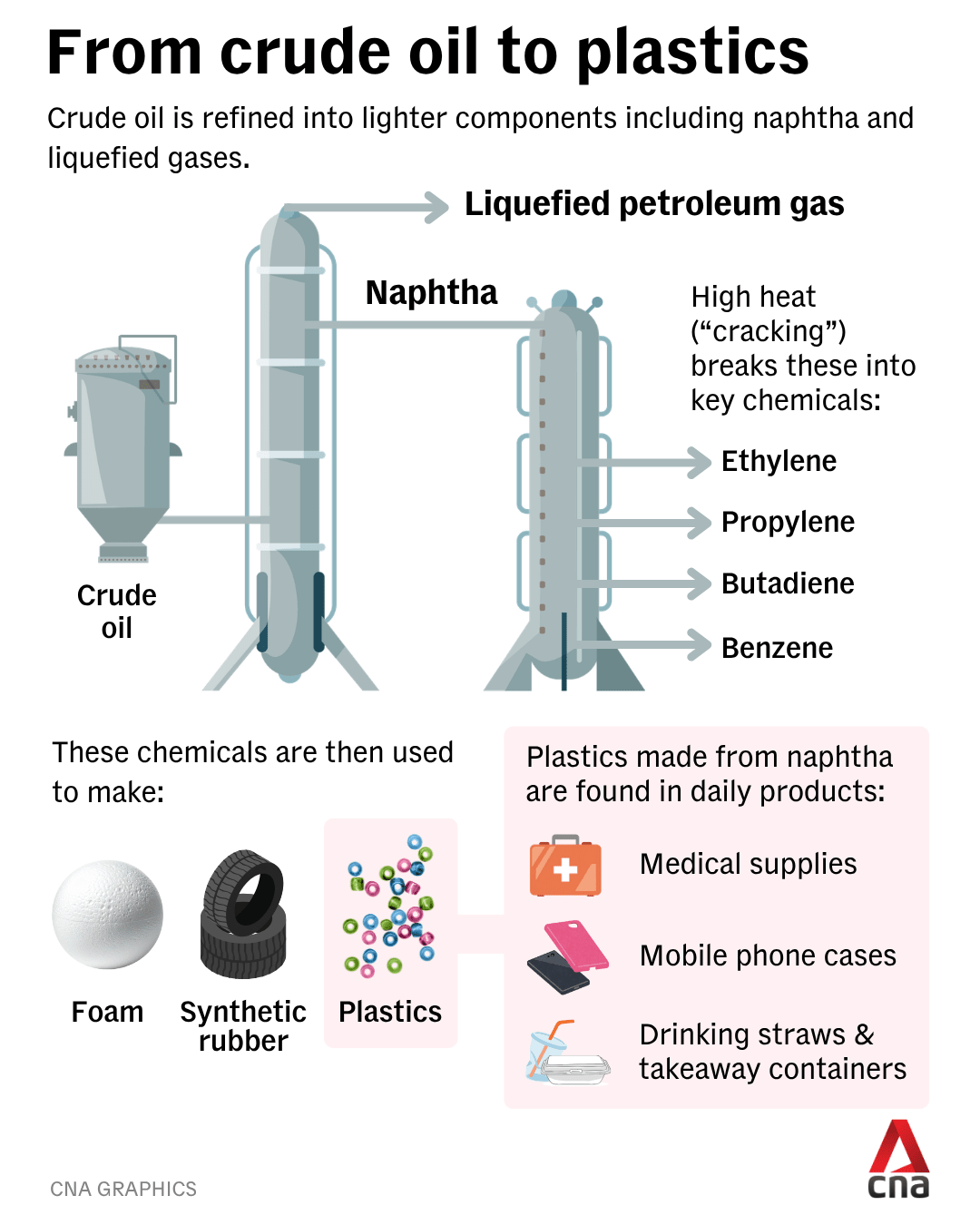
Naphtha, a petrochemical derived from crude oil, is widely used to produce plastics found in items ranging from personal protective equipment to food packaging.
Suppliers say prices of such products are already rising, with some warning that increases could reach as much as 50 per cent.
However, Singapore authorities say there is no immediate shortage.
WHAT IS NAPHTHA AND WHY IT MATTERS
Naphtha is a vital building block in modern manufacturing.
It is a petrochemical liquid mixture produced during crude oil refining, and a key feedstock for plastics and other materials.
These materials are then supplied to downstream industries to manufacture a wide range of products – including plastics such as polyethylene and polypropylene – which are used across multiple industries.
IMPACT OF MIDDLE EAST CONFLICT
However, the ongoing conflict in Iran has threatened naphtha supplies, as much of the crude oil used by refineries in Singapore comes from the Middle East.
Shipments pass through the Strait of Hormuz – a critical waterway that handles about a fifth of global oil trade. Iranian attacks targeting oil tankers have disrupted traffic through the strait, putting supply chains under strain.
“When the Strait of Hormuz faces disruption, it chokes the naphtha and natural gas flow, which is the lifeblood for the petrochemical sector,” said Mr Melvin Tan, vice president of the Singapore Manufacturing Federation (SMF).
He added that manufacturers are facing a “triple threat” of rising energy, logistics and raw material costs as fuel prices drive up electricity and transport expenses, while a tighter supply of feedstock like naphtha pushes up production costs.
Associate Professor Goh Puay Guan from the National University of Singapore Business School said the impact of oil supply disruptions could extend beyond manufacturing and plastics.
Oil by-products are also needed to produce fertilisers, which are critical for food production, he noted.
He pointed to the Russia-Ukraine war, where disruptions to energy and fertiliser supplies contributed to higher fertiliser and food costs, and warned that the impact could be greater if the Middle East supply is affected, given the region’s larger share of global oil exports.
FIRMS BRACING FOR RISING PRICES
Local distributors of medical equipment said some manufacturers have already raised prices due to higher raw material costs.
At Medpro Medical Supplies, demand has risen and customers are buying more items as backup stock. It has also increased inventory levels for certain products in anticipation of stronger demand.
Freight costs are also expected to rise, compounding the pressure.
“If we continue ordering the same quantity as before, the cost could increase by about 50 per cent,” Medpro said, adding that bulk purchases may help cushion the increase.
The company added that further price increases are expected, with rising material and shipping costs likely to prompt more manufacturers to adjust prices.
Singapore’s Ministry of Health said there is no shortage of medical supplies, adding that public healthcare institutions maintain adequate stockpiles and have diversified sourcing strategies to ensure supply resilience.
Other retailers are also monitoring the situation.
“Prices and stock for pharmaceutical products are currently stable. We are monitoring the situation closely and working with our trusted suppliers to maintain supply,” said a spokesperson for pharmacy chain Guardian.
INDUSTRY RESPONSE
To cope with the uncertainty, manufacturers are exploring alternative supply sources and shifting strategies.
Mr Tan of the SMF said some firms are already seeing early signs of strain, with feedback indicating potentially longer lead times for certain chemical inputs and components, although this remains anecdotal.
In response, companies are moving away from “just-in-time” supply chains towards a “just-in-case” approach, building buffer stocks and securing secondary suppliers to guard against potential disruptions.
He added that firms are also exploring regional options such as the Johor-Singapore Special Economic Zone and Batam to diversify their supply chains.
Such moves could help reduce reliance on a single supply source, though they are longer-term solutions and do not address immediate challenges, he noted.
At the same time, companies are looking to manage rising energy costs by investing in renewable energy and improving efficiency.
Mr Tan noted growing interest in solutions such as rooftop solar and energy storage systems, which can help reduce exposure to volatile fuel prices.
While alternatives to naphtha exist, experts say they are not yet available at scale.
For now, industries remain heavily dependent on petroleum-based feedstocks.
Experts say this means any prolonged disruption in oil supply could continue to push up costs across multiple sectors, with effects likely to ripple beyond manufacturing into everyday goods.