 3 months ago
103
3 months ago
103
SINGAPORE: Malaysian Fauzan Azmi was at lunch with his colleagues near the Dubai Marina on Saturday (Feb 28) afternoon when two loud nearby explosions ripped through the air.
“At first we thought it was just a random thing, then a few minutes later someone in our group said it was a missile that was intercepted,” the corporate governance specialist told CNA via a video call on Monday. “So that was the first sign of escalation.”
Later around midnight, Fauzan, 31, who arrived in Dubai on Feb 25 on a business trip, said he received iPhone alerts notifying him to head indoors after the nearby Fairmont Hotel in Palm Jumeirah was reportedly set ablaze after a projectile struck outside its entrance, injuring four people.
“At the hotel area, you could see people running and the management trying to get everyone to the basement. With about 300 people in the lobby trying to check-in, the sirens happening, loud bangs, it wasn’t a smooth process,” he said, describing the scene when he returned to his own hotel, the Grand Hyatt.
“Basically everyone tried to evacuate and get near a sheltered place. They told us that we could come up to our rooms but not stay near the windows. This was about 1.30am,” Fauzan said.
The Grand Hyatt has provided complimentary food and water, Fauzan added.
“I think the worst part is the uncertainty. All hotel rooms are fully booked, people can’t find a place to stay. People who left to the airport and checked out had to come back and find their rooms already occupied.”
“There's a feeling that we're like sitting ducks right now,” he added, lamenting that the Malaysian consulate general in Dubai is closed during the “hardest time ever” and he was told to contact the mission via email and telephone.
 Malaysian Fauzan Azmi is among thousands of Southeast Asian nationals reportedly stranded in Dubai after Iran's airstrikes in the region. (Photo: Fauzan Azmi)
Another Malaysian, Chen Shiau Haln, told CNA via text message she was en route on an Emirates flight with her husband to Edinburgh from Kuala Lumpur on Saturday. Her flight was due to transit in Dubai when the pilot remained airborne for an extended period amid airspace closure by the United Arab Emirates (UAE).
The 35-year-old bioinformatician, who is pregnant and set to start a new job on Monday in Edinburgh where she currently lives, is dismayed, knowing she is likely not be able to leave the UAE anytime soon after a delayed descent into Dubai.
“We thought that perhaps we might still be able to fly out of the UAE, since the airspace was reported to be only partially closed. It was only around 4.30pm that we found out all flights up to 3.00am had been cancelled,” she said.
Chen said that it was “chaotic” at the transfer desk as passengers scrambled to get information and rebook their flights, while Emirates provided her and her husband with complimentary meals at selected airport food outlets and hotel accommodation vouchers.
Since being stranded in Dubai on Saturday, Chen and her husband have heard loud bangs in the area.
“The loudest one that we’ve heard happened just over an hour ago. It has been quite unnerving, and it feels like we’re on constant high alert. We struggled to sleep on our first night here, and we have our emergency grab bags packed ready to go as and when possible,” she told CNA on Monday afternoon.
The couple are staying in a hotel while monitoring the latest news.
“This is not how I imagined my first week with the new company, but I’ve been trying to stay calm and do what I can, such as offering to make a head start on training materials that I know will be useful in my new job,” she said.
Chen and Fauzan are among thousands of Southeast Asian citizens reportedly stranded in Dubai and other Gulf states amid flight disruptions due to the ongoing Israel-Iran conflict as governments scramble for options on how to evacuate their citizens back home.
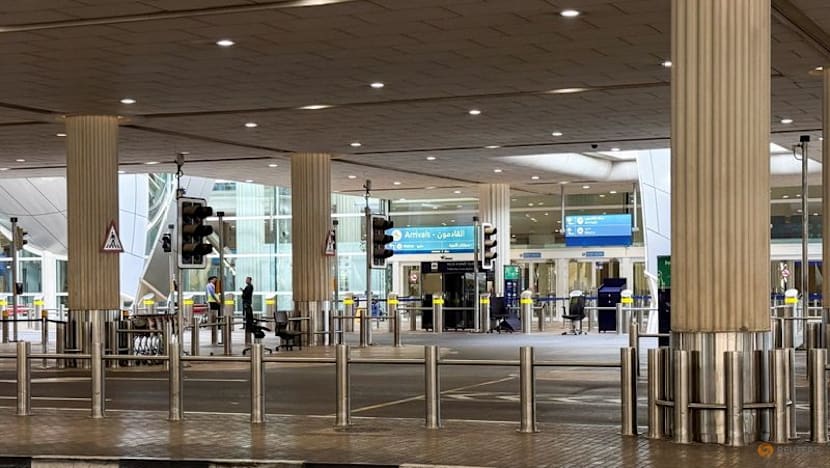 An empty arrivals area at the Dubai International Airport, following the United States and Israel strikes on Iran, in Dubai, United Arab Emirates, on Mar 2, 2026. Picture taken using a mobile phone. (Photo: REUTERS/Raghed Waked)
Iran’s retaliatory attacks across several Gulf Arab states targeting airbases with United States assets have led to explosions echoing across the area since Saturday.
Explosions were heard across Dubai in the UAE, Bahrain’s capital Manama and Qatar’s capital Doha.
Fauzan was set to return to Kuala Lumpur on Mar 4 but noted that all flights had been suspended in light of the airstrikes.
While some of his colleagues tried to take the bus to Oman then to Egypt, he said the borders at Oman were “very busy” and it would take travellers around 12 hours to pass through, according to the latest update he heard.
Fauzan said he would try to take the bus to Oman if the situation does not improve.
Meanwhile, Chen said that while she had registered with the Malaysian embassy in the UAE, she has not received updates from the embassy or consulate, other than their travel advisories.
“I think it would be most helpful for us to know if and what is being done to support Malaysians abroad, if anything is in the works at all, or even regular communication to know that we’re not forgotten. The silence and uncertainty have not been reassuring,” she added.
Malaysia’s parliament on Monday observed a moment of silence over the deaths of Iran’s Supreme Leader Ayatollah Ali Khamenei and his people, while Prime Minister Anwar Ibrahim expressed condolences and condemned Israel’s US-backed attack on Iran.
He also said that the foreign ministry is monitoring the safety of 29,112 Malaysians in several affected countries but evacuations cannot be carried out as much of the Middle East’s airspace is closed except for flights operating from Saudi Arabia, as reported by local news agency Bernama on Monday.
“As the government, we are responsible for safeguarding and ensuring the safety of Malaysians so that their presence there (in affected countries) is secure,” Anwar said when tabling a motion condemning Israel’s attacks.
“Most of our citizens in Middle Eastern countries are mainly residing in Qatar, the UAE (United Arab Emirates), Saudi Arabia and Jordan,” he added.
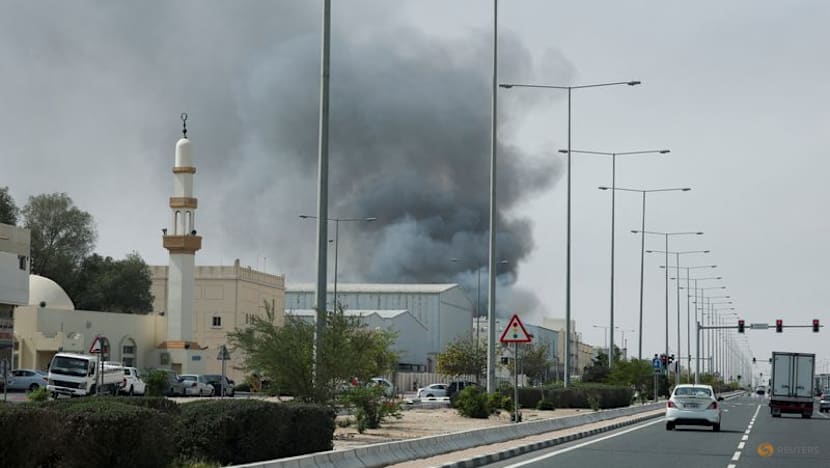 Smoke rises after reported Iranian missile attacks, following United States and Israel strikes on Iran, as seen from Doha, Qatar, on Mar 1, 2026. (Photo: REUTERS/Mohammed Salem)
MALAYSIAN FOREIGN MINISTRY WORKING WITH EMBASSIES TO PROVIDE SUPPORT
Malaysia’s foreign ministry said on Monday that it is coordinating with airlines and its diplomatic missions in Saudi Arabia to support its stranded citizens.
“At this time, Malaysians are strongly advised to defer all non-essential travel to Iran, Iraq, Jordan, Kuwait, Qatar, Bahrain and the United Arab Emirates,” the ministry said a statement.
Across the Middle East in the UAE, Bahrain, Oman, Qatar, Kuwait, Jordan, Syria, and Cyprus, security conditions remain generally stable, the ministry added.
No Malaysians have been injured, and diplomatic missions continue providing consular support, particularly for temporary accommodation and travel coordination, the ministry said.
It also urged Malaysians in several Middle Eastern countries to stay vigilant, avoid military areas and comply with local authorities.
Its embassies in the region have similarly urged Malaysians to stay calm and avoid areas near military facilities or falling debris.
The Malaysian embassy in Abu Dhabi said on Monday that it will be closed to the public amid the ongoing "regional security situation" but that consular services remain available online.
Earlier on Thursday, foreign minister Mohamad Hasan said that 13 Malaysians, including students, opted to stay in Iran voluntarily despite being offered assistance to return home following heightened US-Iran tensions.
ALL 329 INDONESIANS SAFE IN IRAN: AMBASSADOR
The Indonesian government confirmed on Saturday that all 329 Indonesians living in Iran are safe after the attacks, reported local news outlet Jakarta Globe.
“As of 2.30pm local time, we have contacted all Indonesian communities across Iran. They have reported that none of them … feel threatened,” Indonesian ambassador to Iran Rolliansyah “Roy” Soemirat said in an audio recording.
Roy told the Jakarta Globe that the 329 Indonesians comprise those who have registered and are officially recorded in the embassy, and that the embassy would continue to engage in “two-way communications” with all Indonesians across the country.
The Indonesian government has not made any plans to evacuate its citizens from Iran, added Roy on Monday, as reported by local news outlet Republika.
He said that the evacuation plans must be carried out under an order from the Indonesian government.
Separately, Indonesia’s President Prabowo Subianto said on Sunday that he is willing to travel to Tehran “to conduct mediation”.
SUPPORT FOR MALAYSIAN, INDONESIAN PILGRIMS
Some 55 Malaysian umrah pilgrims set to travel to Mecca, Saudi Arabia, were reportedly stranded in Jeddah after their return flight scheduled for Saturday morning was cancelled, according to Bernama.
Malaysia’s pilgrims fund board Lembaga Tabung Haji (TH) said on Sunday that it is monitoring the situation and will provide further updates at an appropriate time.
“In line with TH’s responsibility towards prospective national pilgrims, TH’s subsequent actions will be based on advice received from partner airlines, Saudi authorities and Wisma Putra (Malaysia’s foreign ministry),” said its managing director and chief executive Mustakim Mohamad in a statement.
Meanwhile, nearly 60,000 Indonesian pilgrims were recorded by the Hajj Ministry performing umrah, a “minor” pilgrimage to Mecca during Ramadan, according to local media.
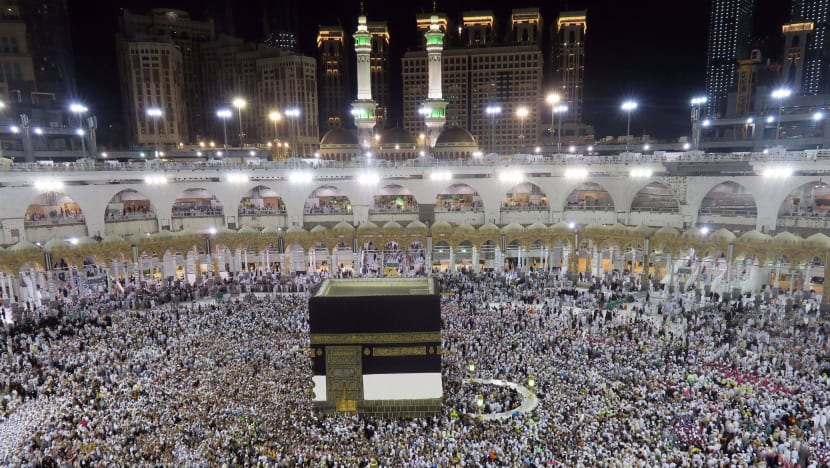 Muslim pilgrims circle the Kaaba at the Grand Mosque in Mecca. Photo: Reuters.
Puji Raharjo, director general for hajj and umrah management at the ministry, said on Saturday that the government - through the ministry, overseas representatives and relevant authorities - is closely monitoring developments and coordinating efforts to ensure pilgrims remain safe and properly served.
Puji stressed that the state is present to protect and assist pilgrims in accordance with regulations and that families should not be swayed by unverified information online.
“We urge all umrah pilgrims not to panic. Remain calm and continue coordinating with your respective licensed umrah travel operators to obtain official and up-to-date information,” Puji said, as quoted by local media.
THAILAND PLANS EVACUATION PLAN FROM TURKEY
Meanwhile, Thailand’s labour ministry said on Monday that around 80,000 Thai workers in the Middle East are safe with no reported injuries or deaths, as it prepares to roll out a detailed evacuation plan to repatriate its citizens.
Foreign minister Sihasak Phuangketkeow outlined a land-to-air evacuation plan from Turkey as over 1,000 Thai nationals in the UAE hoped to return home, reported local media.
The ministry plans to facilitate their transit via Muscat, Oman, which it said would take two hours.
"We are coordinating with Iranian authorities to ensure safe passage on humanitarian grounds," Sihasak stated. "The journey is arduous, and we require firm security guarantees for our citizens.”
He also warned that the conflict has evolved beyond a limited strike on nuclear facilities and is likely to become a “prolonged” engagement, according to The Nation.
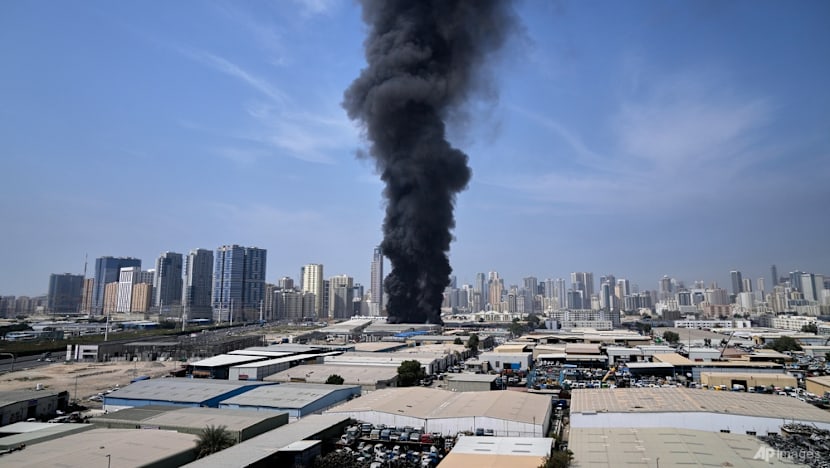 A black plume of smoke rises from a warehouse at the industrial area of Sharjah City in the United Arab Emirates following reports of Iranian strikes in Dubai, United Arab Emirates, on Sunday, Mar 1, 2026. (Photo: AP/Altaf Qadri)
Thailand’s prime minister Anutin Charnvirakul told reporters in Bangkok on Sunday that its plan to evacuate its citizens will be carried out through military or charter flights with coordination from the Royal Thai Air Force, prioritising those in Iran.
About 110,000 Thais were living in the Middle East region, including around 65,000 in Israel and about 250 in Iran, said Thai foreign ministry spokesperson Panidone Pachimsawat on Sunday.
He added that about 29 Thai nationals in Iran and 20 in Israel have registered their wish to return to Thailand with the government.
Only about 10 per cent of Thais in Iran said they wanted to be evacuated with most opting to stay there despite the war, Sihasak said on Monday.
The government was ready to airlift them from Iran if Thais wanting to leave reached 100 or more, the minister added. Otherwise, they would return on commercial flights, the Bangkok Post reported.
Vietnamese ambassador to Iran Nguyen Luong Ngoc told news agency Tuoi Tre on Sunday that “swift measures” have been taken to protect its 38 citizens in Iran, including evacuating embassy staff and their families to a safer location.
All Vietnamese nationals are safe and calm since the airstrikes, reported Tuoi Tre.
A spokesperson from the Vietnamese foreign affairs ministry Pham Thu Hang said on Saturday that the ministry and domestic agencies have ordered Vietnam’s representative missions in Iran and Israel to maintain close coordination with domestic authorities.
Vietnamese embassies in Qatar, the UAE, Kuwait, and Saudi Arabia issued urgent notices on Saturday, advising Vietnamese citizens to increase vigilance and strengthen safety measures.
Meanwhile, some 823 and 30,347 Filipinos are in Iran and Israel respectively, according to media platform Inquirer.net.
The Philippines has set the crisis alert level in the middle east at level two, or the restriction phase. Under this phase, Filipinos are advised to shelter in place and exercise increased caution when travelling, reported Inquirer.net.
In Dubai, at least 80 overseas Filipino workers expressed intent to be repatriated, said the migrant workers department on Monday.
Secretary of migrant workers Hans Leo Cacdac said the government is preparing for repatriation assistance, but cannot proceed yet as the UAE airspace remains closed.
Cacdac added that mandatory repatriation will happen once the alert level is raised to four. The UAE is also under alert level two. There are 20 Filipino foreign workers who are in shelters in Dubai, he added.
Filipinos working at American military bases in the Gulf that were under Iran's attacks were safely evacuated, said migrant workers department secretary Hans Cacdac on Monday.
"There are Filipinos working within the bases. But we know that military protocol is such that when there is a military engagement, civilians are not involved," he said, as quoted by local news outlet Philstar Global.
Cacdac did not say how many Filipinos are employed at US installations in the region.
The Philippines Armed Forces is also prepared to assist in humanitarian and evacuation operations in the Middle East, the national defence department said on Sunday.
The defence department said it is coordinating with the foreign affairs department, migrant workers department and other relevant agencies on the conflict, reported the Inquirer.
“The Armed Forces of the Philippines stands ready to assist in humanitarian and evacuation operations, if directed,” the ministry’s defence department said in a statement.