 3 months ago
101
3 months ago
101
SINGAPORE: Indian businesses are bracing for turbulence as the escalating conflict between the United States, Israel and Iran threatens to send shockwaves through one of India’s most vital economic corridors.
The first tremors are already visible. Crude oil prices are climbing amid fears that fighting could disrupt shipping through the Strait of Hormuz, the narrow gateway between the Persian Gulf and the Gulf of Oman that carries a significant share of the world’s oil and gas.
For companies across sectors, from biscuits and confectionery to billion-dollar infrastructure projects, that waterway has suddenly become a pressure point.
India is the Gulf Cooperation Council’s second-largest trading partner after China, with bilateral trade worth US$158 billion in 2024 - about 10 per cent of the bloc’s total trade.
Energy-intensive and export-driven sectors such as textiles, leather, gems and jewellery, marine products and garments are particularly vulnerable to higher transport and input costs.
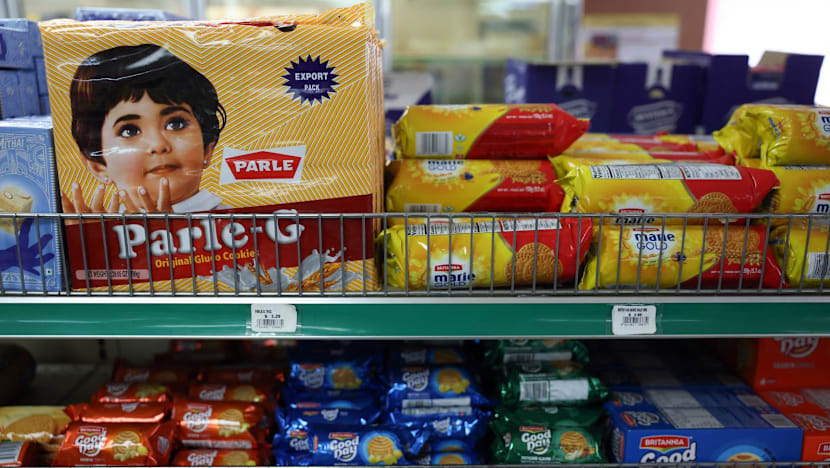 Parle-G cookies displayed for sale at a grocery store. (Photo: AFP/Patrick T. Fallon)
Mumbai-based multinational conglomerate Parle Products, whose Parle-G biscuits have become a staple in Gulf supermarkets, expects packaging costs linked to crude oil derivatives to rise.
Freight charges on exports to the Middle East are also likely to increase, Parle Products’ vice-president Mayank Shah says.
Any escalation would push up expenses and could eventually burden consumers, he told the Press Trust of India.
“The expectation is that it should not prolong, and that is what we hope,” he said.
While the exact share of Parle-G’s Gulf revenue is unclear, the company does not have manufacturing facilities in the Middle East, leaving exports exposed to higher shipping and energy costs if tensions persist.
For other firms, the exposure runs much deeper.
Infrastructure giant Larsen & Toubro (L&T) employs more than 58,000 people in the Middle East, from which it derives nearly 40 per cent of its total business, according to stock market analytics platform Trendlyne.
The company said it is closely monitoring developments in the Middle East and that its employees and assets remain safe.
Its share price has fallen more than 12.5 per cent since last Friday (Feb 27), local media reported - a sign of investor unease.
OIL: THE CRITICAL PRESSURE POINT
Energy remains the biggest concern, observers say.
In 2025, nearly half of India’s crude oil and LNG imports - and more than 85 per cent of its liquefied petroleum gas - passed through the Strait of Hormuz, according to Ajay Srivastava, founder of the Global Trade Research Initiative (GTRI).
“Closure of the Strait of Hormuz would not only drive up global oil prices but also threaten physical supply availability,” he said.
The strait handles about a-fifth of global crude and LNG consumption - and up to 13 million barrels per day of crude exports, roughly a-tenth of global demand, could be affected by any serious disruption.
Roughly 50 to 60 per cent of India’s crude imports, or 2.5 to 2.7 million barrels per day, go through the strait, along with the majority of its LNG supplies.
Higher oil prices would inflate India’s import bill, widen the current account deficit and add to inflationary pressures.
Following joint Israel-US strikes on Iran, global crude benchmarks jumped nearly 10 per cent on fears of supply shocks.
“Oil prices are already rising sharply, and India’s import bill will increase,” said Karthik Nachiappan, a research fellow at the Institute of South Asian Studies.
Rising petrol, diesel and LPG prices would ripple across the economy, lifting transport and manufacturing costs and squeezing household budgets, he added.
TRADE, TECH AND REMITTANCES
Beyond oil, the Gulf has become a crucial market for Indian exports and a growing source of investment.
Shipments to the United Arab Emirates (UAE) rose 25.6 per cent to US$27.4 billion in the 2023-24 financial year, driven largely by non-oil goods. Smartphones alone accounted for US$2.5 billion in exports.
The region has also emerged as an important source of capital for India’s technology sector. Over the past 18 months, Gulf funding has backed IT services, artificial intelligence ventures and data centre projects.
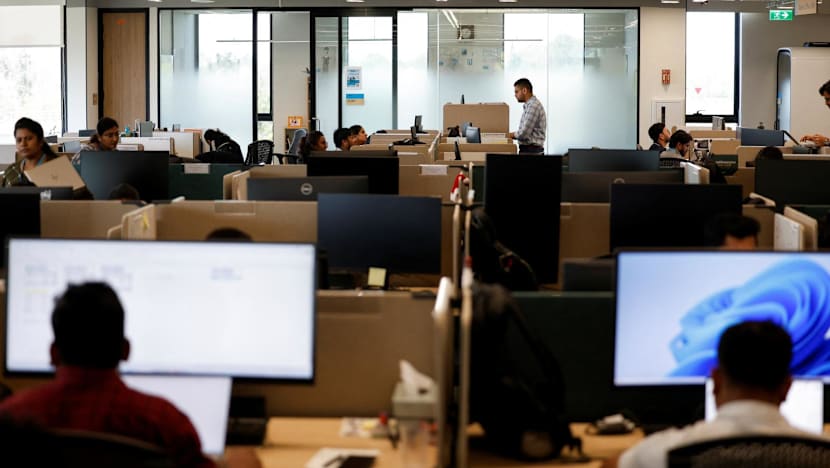 Employees inside an office in Bengaluru on Feb 23, 2026. (Photo: Reuters/Priyanshu Singh)
“Much of the deep capital for tech relies on money from the Middle East. It will be affected, because investors are unlikely to commit during a crisis,” Nachiappan said.
Trade with Iran remains limited due to longstanding US sanctions, but even modest flows - about US$1.2 billion in Indian exports and US$408.6 million in imports in 2025 - could face further complications if shipping lanes are disrupted.
Overseas remittances present another vulnerability.
More than 8.8 million Indians live in the Gulf, including over 3.5 million in the UAE and nearly 2.5 million in Saudi Arabia, sending roughly US$45 billion to India annually.
Any instability affecting jobs or capital flows could dampen consumption in several Indian states, such as Kerala and Odisha, that depend heavily on Gulf incomes, observers say.
“Those people working in the Gulf probably have to save more to deal with potential shocks in their own economies. So that means they have less money to send from overseas to India,” said Nachiappan.
BUSINESS AS USUAL FOR CHINESE FIRMS - FOR NOW
The Middle East has become an increasingly important destination for Chinese companies, driven by expanding trade, investment and infrastructure ties - including projects linked to Beijing’s Belt and Road Initiative (BRI).
Gulf hubs such as Dubai and Riyadh now host growing clusters of Chinese businesses and workers across technology, logistics, energy and services.
As regional tensions escalate, Chinese firms operating there told CNA they are closely monitoring developments, with many reporting limited immediate disruption so far.
Food delivery platform Keeta, the international arm of Chinese tech giant Meituan, said its operations have experienced only minor interruptions, with adjustments made in line with government directives.
“We are in continuous contact with the relevant authorities and are strictly following all government guidance and official directives, including any instructions related to operational suspensions or service adjustments,” the company said in a statement to CNA, adding that services may be temporarily limited in specific areas to ensure safety.
CNA understands that conditions vary across locations. In some areas, operations were briefly suspended following official notifications but resumed within a day as circumstances shifted.
The company did not disclose how many employees it has in the region, though many staff are locally hired.
Employees have been advised to work from home where necessary and avoid high-risk areas.
Some Chinese professionals in the Gulf described a cautious but orderly environment.
“Iris” - a 28-year-old Chinese digital nomad in the Web3 sector who recently arrived in Dubai - said her employer had instructed staff to work remotely and remain indoors as a precaution.
“The company sent us guidelines on what to do and asked us to stay inside. My manager checked in to make sure I was okay,” she said.
Despite reports of explosions elsewhere in the region, she described the situation in Dubai as stable.
“Compared with what you see online, it’s more controlled here. The city is operating as usual, though some services and stores have closed and deliveries are delayed. People seem nervous, but there isn’t widespread panic,” she said.
Zhang, a 25-year-old administrative worker based in Riyadh, said daily life in the Saudi capital remained largely normal, although flights had been suspended.
“There hasn’t been much impact, and I haven’t heard any explosions. Everything is basically normal, except that all flights have been grounded,” said Zhang, who has lived in Saudi Arabia for seven years and works for a private company supporting Chinese businesses.
He added that his employer had not introduced special arrangements and that supermarkets and daily supplies remained unaffected.
While his family in China has been checking in more frequently, he has not considered cutting his stay short.
“For now, I’m just waiting for news about flights resuming,” he said.
Collapse Expand
FINDING NEW LIFELINES
To cushion potential shocks, Indian refiners are expected to diversify crude sourcing towards Russia, the US, Canada, West Africa and Latin America, while drawing on strategic petroleum reserves.
But these alternatives often mean longer shipping routes, higher freight costs and fewer long-term contractual advantages than established Gulf suppliers.
“The unfolding crisis has renewed calls to reset India’s energy strategy,” Srivastava said, noting that India produced nearly 85 per cent of its oil needs in 1985 but now imports almost 85 per cent.
Exporters may also look to Southeast Asia and the Pacific for new markets or lean more heavily on India’s domestic consumption engine.
Yet, supply chains built over decades cannot be easily reconfigured, said Nachiappan.
Strategically, India could also face pressure to expand its role in maritime security to safeguard trade routes in the Indian Ocean, potentially stepping up naval escorts and cooperation with Gulf partners.
On Wednesday, the US and Israel’s war on Iran reached India’s strategic waters with a US submarine sinking an Iranian warship off Sri Lanka.
The Iranian vessel was sailing home from India after participating in a multinational naval exercise and International Fleet Review, and the incident prompted some politicians in India, such as Congress leader Pawan Khera, to question India’s influence in its own neighbourhood.
India’s Ministry of External Affairs refuted a claim in a US-based channel called the One America News Network that the US was using Indian ports to strike Iran, calling it “fake and false”.
India has expressed “deep concern” over the escalating conflict in the Middle East and called for restraint and dialogue.
For now, New Delhi is proceeding cautiously. Existing energy contracts and reserves mean any severe disruption would likely unfold over weeks rather than days, observers say.
But with oil prices volatile, the rupee under pressure and investor sentiment fragile, Indian businesses are preparing for a period of sustained uncertainty in one of their most important overseas markets.