 3 months ago
121
3 months ago
121
SINGAPORE: Consumers in Singapore flagged fake online reviews, ticket scalping and car sharing as key areas of concern in a survey commissioned by the Consumers Association of Singapore (CASE).
CASE on Monday (Dec 8) released the results of the survey, which involved more than 1,500 respondents and was conducted by an independent research consultancy between July and August 2025.
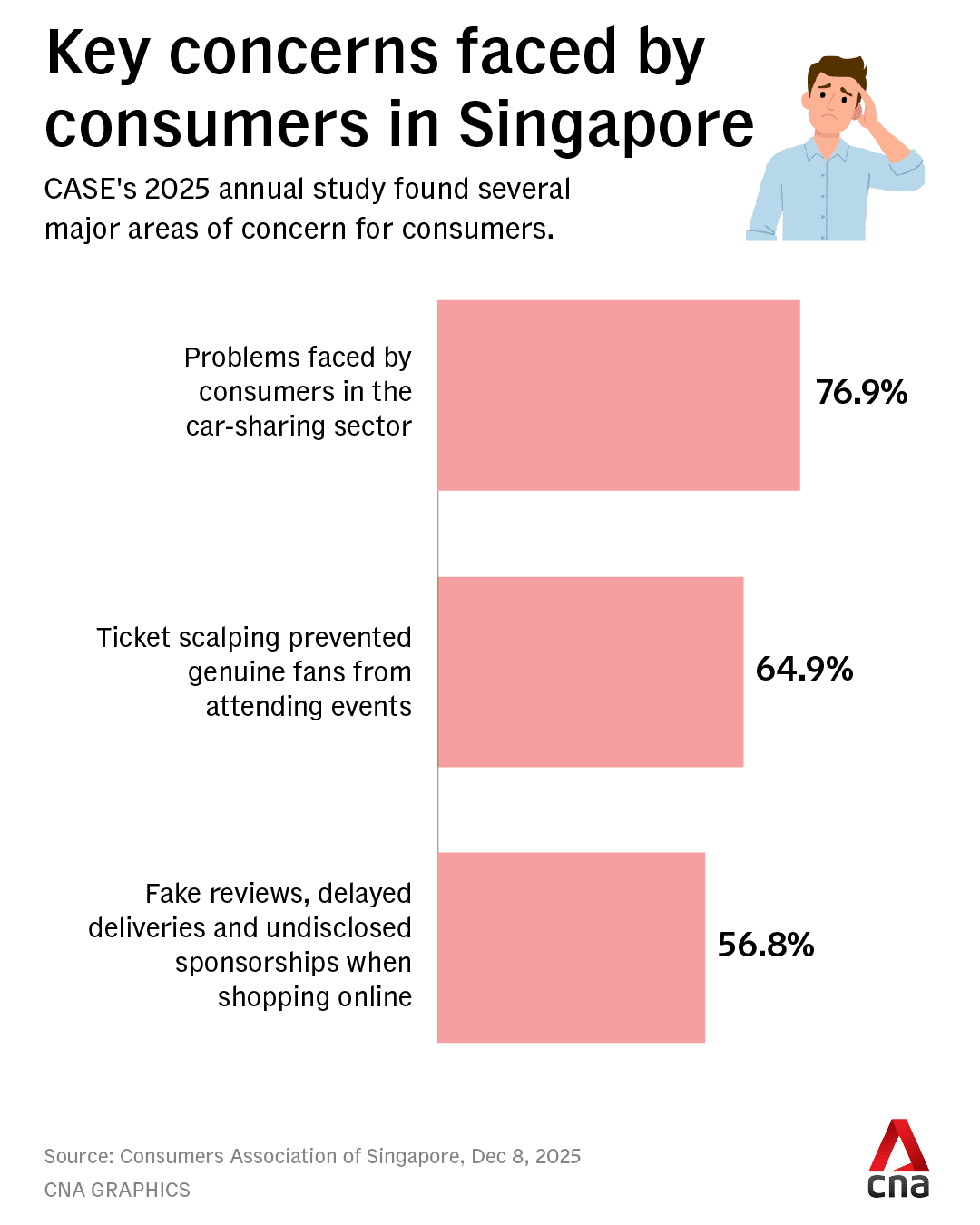
The 2025 findings showed that a major area of concern was the car-sharing sector, with 76.9 per cent of respondents flagging risks in this area as a key worry.
Just under two-thirds or 64.9 per cent of respondents felt that ticket scalping prevented genuine fans from attending events, and 61.4 per cent said scalping creates unnecessary stress.
And a total of 56.8 per cent of respondents, when shopping online, had encountered issues such as fake reviews, delayed deliveries and undisclosed sponsorships.
ONLINE SHOPPING WOES
Of the respondents who encountered issues when shopping online, 26.5 per cent of them said they encountered fake reviews, 18.4 per cent experienced delayed deliveries and 17.9 per cent encountered undisclosed sponsorships by social media influencers.
“Participants expressed scepticism towards practices used by merchants to influence online reviews, such as incentivised ratings, deleting negative reviews and creating fake accounts to boost credibility,” CASE said.
Respondents also indicated frustration with delivery-related issues, including delays, missing items and complex refund processes.
“To help consumers shop with confidence, we are stepping up our efforts to increase CaseTrust accreditation among e-businesses. We will also continue to advocate for mandatory merchant verification and escrow accounts to protect consumers,” CASE president Melvin Yong said.
CaseTrust is the accreditation arm of CASE, which oversees eight accreditation schemes for different industries.
TICKET SCALPING
A third of respondents said that the introduction of official resale channels with price caps to prevent unfair price mark-ups would deter ticket scalping.
Participants in focus group discussions were concerned about fake or duplicated QR codes that may be discovered only at event venues.
They also flagged the issue of bots that sweep up primary ticket sales within seconds and push consumers to resale platforms where tickets are resold at double the original price.
Given Singapore’s position as a go-to regional hub for concerts and events, more needs to be done to tackle the issue of ticket scalping, Mr Yong said.
“The consumer protection review panel is actively engaging ticket service providers to explore establishing authorised ticket sale platforms to provide consumers with greater certainty that tickets resold on proper platforms are legitimate,” added Mr Yong.
“We are also studying suggestions, including phasing out paper tickets and to only have digital tickets with dynamic QR codes, to address ticket scams.”
CAR-SHARING RISKS
Respondents were the most worried about problems in the car-sharing sector, with 76.9 per cent of respondents expressing concern.
Participants in focus group discussions pointed to billing disputes, claims related to damages, the lack of clarity in contracts or damage attribution and incident reporting or investigation delays.
“As car-sharing becomes more common, it is important to ensure that consumers can use these services with confidence,” Mr Yong said.
He added that “CASE is working with car-sharing operators to develop a CaseTrust accreditation scheme for the sector, which will set out clear standards on transparency, safety, and service quality”.
How was the survey conducted?
- The survey involved 1,510 respondents and was conducted by an independent research consultancy between July and August 2025.
- It comprised face-to-face interviews with respondents who were representative of the Singapore population based on housing type, age group, ethnicity and gender.
- Focus group discussions were conducted with 33 participants from Sep 30 to Oct 7, 2025 to supplement the survey.
Collapse Expand
POSITIVE PERCEPTIONS OF CONSUMER RIGHTS
In a slight increase from 66.9 per cent in 2024, CASE found that 67.4 of respondents have a positive perception of consumer rights in 2025.
The proportion of respondents who felt confident that businesses would not cheat or mislead them also rose from 71.8 per cent in 2024 to 72.8 per cent in 2025.
More respondents felt that laws against businesses using undue pressure on customers were adequately enforced, rising from 70.7 per cent in 2024 to 71.4 per cent in 2025.
The perception that laws against misleading practices were adequately enforced also increased to 72.2 per cent in 2025 from 71.3 per cent in 2024.
“These findings suggest that consumers are increasingly assured that their rights are recognised and protected,” CASE said.
More respondents were aware of CASE, the Consumer Protection (Fair Trading) Act and the Lemon Law in 2025 compared to 2024.
“It is encouraging to see that public perception and awareness of consumer rights have improved steadily,” Mr Yong said.
The persistent issues involving e-commerce and ticket scalping highlight the need to review and strengthen existing safeguards, he added.
“The consumer protection review panel is looking into these issues and I look forward to its recommendations in due course. In the meantime, CASE will continue promoting fair trading through CaseTrust, enhancing price transparency through Price Kaki and providing consumers with better access to dispute resolution.”