 3 months ago
126
3 months ago
126
SINGAPORE: Iran was betting that United States President Donald Trump would want a quick strike against it for refusing to bow to his demands to give up its nuclear programme, a show of force that would not entangle the US in the sort of lengthy conflict he had railed against his predecessors for.
It was a miscalculation. On Saturday (Feb 28), the US and Israel launched a massive attack on Iran – which Mr Trump called “Operation Epic Fury” – and outrightly stated that the goal is regime change. Supreme Leader Ayatollah Ali Khamenei was killed on the first day of strikes, confirmed Iran state media.
Even so, it would be premature for the US and Israel to declare victory. Mr Khamenei’s death does not mean the collapse of the regime.
The 86-year-old supreme leader’s succession was long in preparation. Iranian officials accelerated efforts after last year’s Israeli and US attack on Iran in which Israel was able to kill much of Iran’s senior military and security command.
Even so, by opting to challenge Mr Trump’s might-is-right approach, Iran was betting on a reading of post-World War II American history that no longer applies with Mr Trump in office. Iran saw a pattern of US military defeats and withdrawals starting with Vietnam in the 1970s and the 1983 pullback from Beirut following embassy and barracks bombings to, most recently, the 2021 retreat from Afghanistan – which Mr Trump is determined to correct.
MISCALCULATION ON BOTH SIDES
Yet, there’s also may be some miscalculation on Mr Trump’s part. To put a dent in his plans, all Iran’s leaders need to do now is to ensure the regime’s survival.
That is an achievable goal, if Mr Khamenei’s death does not spark renewed anti-government protests and the regime does not fracture – particularly in the Islamic Revolutionary Guard Corps, the backbone of Iran’s military.
Iran is not a one-man regime. It is institutionalised. Much of the regime was killed in the early days of the 1979 revolution, but the regime persisted.
Change in Iran was always likely to come from within the regime. Before the strikes, many analysts expected Mr Khamenei’s successor to come from hardline elements within. But until the new leader is named, it’s hard to say how a successor would differ in terms of policy.
The bar Mr Trump has set for US and Israel victory is much higher. To claim success, they will have to either defeat Iran and force it to surrender or, at the very least, destroy what is left of Iran’s nuclear programme following the destruction of its main facilities during last June’s 12-day war and obliterate the Islamic Republic’s ballistic missile capabilities.
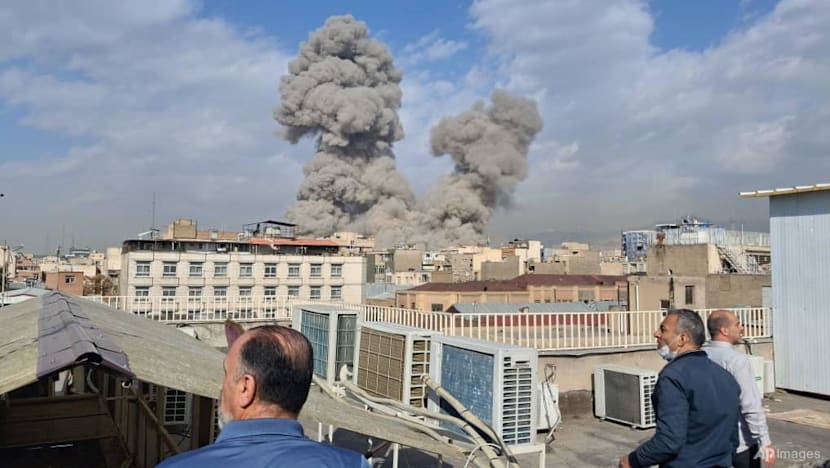 People watch as smoke rises on the skyline after an explosion in Tehran, Iran on Feb 28, 2026. (Photo: AP)
Mr Khamenei’s death reduces the possibility of Mr Trump being forced to put boots on the ground in a mid-term election year, with some 60 per cent of the American public opposed to US intervention in Iran.
But this still sets Iran up to be the only country to engage militarily with the US after Mr Trump made demands that came with the threat of military force.
GULF COUNTRIES UNDER ATTACK
A major concern now is the risk of sparking a higher-intensity regionwide war.
Iran’s firing of missiles at US military facilities in Gulf countries in the first hours of the conflagration significantly raised that risk, even if the missiles were mostly intercepted.
While smaller Gulf states like Qatar, the United Arab Emirates and Bahrain that host US military bases may not strike back at Iran, the question is what the region’s behemoth, Saudi Arabia, will do after having been targeted alongside other Gulf states.
The Iranian strikes came as satellite pictures showed an increase in the number of US warplanes, including refuelling tankers, stationed at the kingdom’s Prince Sultan Air Base. Saudi Arabia has told Iran it would not allow its airspace or territory to be used for military actions against the Islamic Republic.
Saudi Arabia was quick to condemn the Iranian firing of missiles against targets in the vicinity of the capital Riyadh. For now, the Saudi and other Gulf states are likely to adopt a wait-and-see attitude rather than fuel the fire.
However, whether that holds, if Iran or the Iran-backed Houthis in Yemen strike at international shipping in crucial Gulf waterways, remains unknown. Much of Asia’s trade and energy flows go through the Red Sea, where disruptions by Houthi rebels have persisted since late 2023.
The Gulf states are not the only regional nations worried about being dragged into a war they fervently tried to prevent. Türkiye, in particular, would also be concerned about Iranian strikes on US bases.
Türkiye houses US nuclear weapons at Incirlik Air Base under a NATO nuclear weapons sharing agreement. The country has denied claims that its territory and airspace were used for US and Israeli strikes on Iran.
Turkish fears are fuelled by last week’s creation of a coalition of five Iraq-based militant Iranian Kurdish groups, some of which have enjoyed US and/or Israeli support in the past. The coalition plans to exploit a potential power vacuum in Iran to establish Kurdish rule in the Kurdish-populated regions of the country.
TALKS HAVE NOT AMOUNTED TO MUCH
By attacking Iran at a moment when Oman-mediated talks appeared to make progress, Mr Trump has shattered diplomatic norms.
Despite significant differences remaining between the US and Iranian positions after a third round in Geneva on Thursday, the two countries had agreed to hold technical talks on Monday in Vienna, home to nuclear watchdog the International Atomic Energy Agency.
The US-Israeli attack is certain to complicate any future talks.
This is the second time in less than a year that Israel and the US struck Iran as Oman was mediating, and it came less than 24 hours after Oman’s top diplomat described talks as having reached a major breakthrough.
After the strikes but before Mr Khamenei’s death was confirmed, Iran said it was interested in de-escalation if the US wants to talk. But it’s not clear what more talks will do if neither side is willing to budge.
Dr James M Dorsey is an Adjunct Senior Fellow at Nanyang Technological University’s S Rajaratnam School of International Studies, and the author of the syndicated column and podcast, The Turbulent World with James M Dorsey.