 3 months ago
141
3 months ago
141
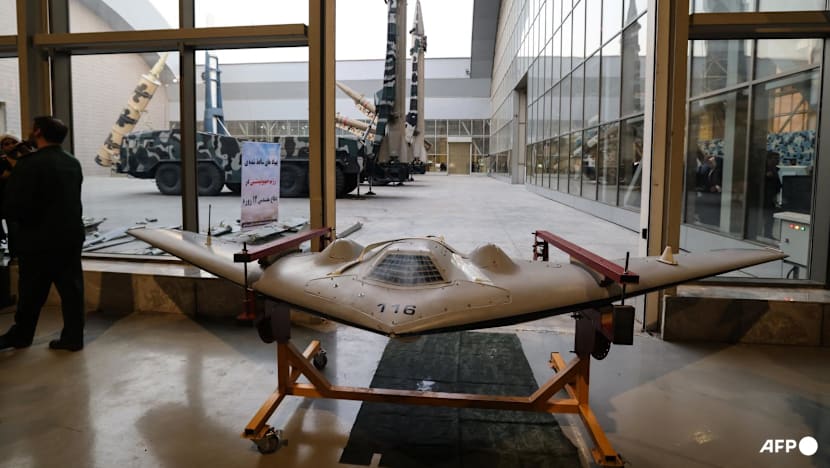
A Shahed-161 drone is displayed in Tehran on Nov 12, 2025. (File photo: AFP/Atta Kenare)
New: You can now listen to articles.

This audio is generated by an AI tool.

Iran's Shahed drones are playing a major role in its war against the United States and Israel.
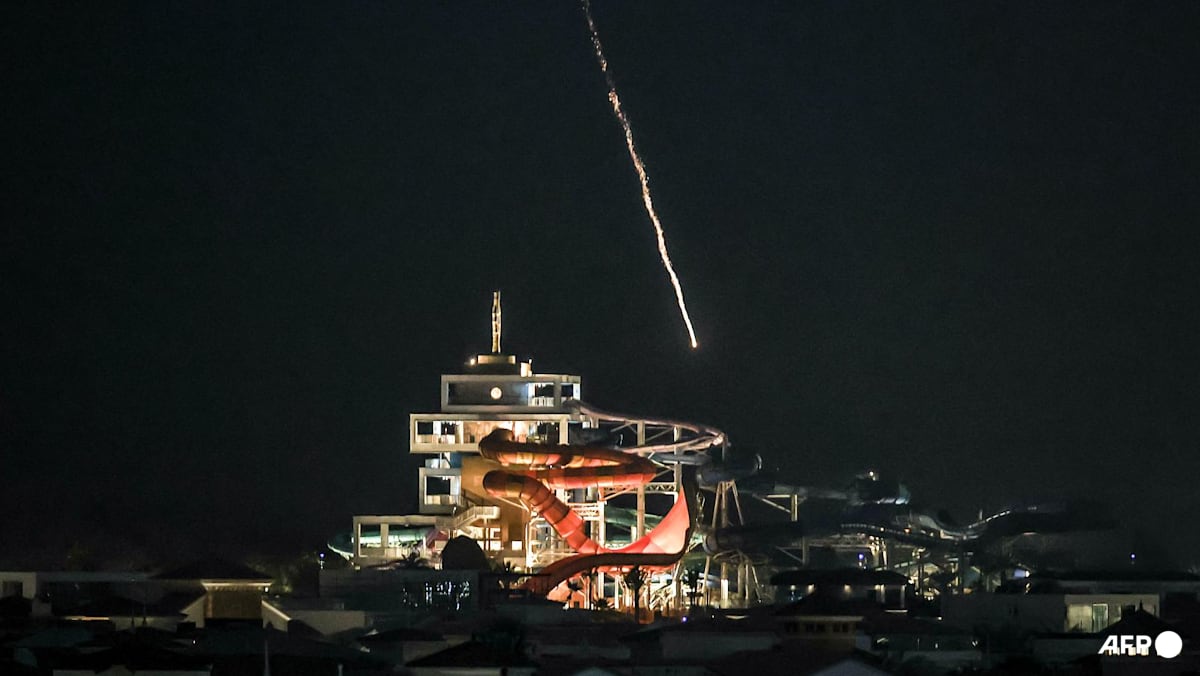
Tehran unleashed hundreds of missiles and drones across the Middle East following US and Israel strikes on Saturday (Feb 28), underscoring just how central these systems have become to its military playbook.
Some of these drones flew as far as the British Royal Air Force base in Akrotiri, Cyprus, striking the runway - a sign of their extended reach.
Already widely used by Russia in the war in Ukraine, Shahed drones are now back in focus amid escalating tensions in the Middle East.
In a notable shift, the US has also begun fielding low-cost one-way attack drones modelled after Iranian designs.
What are Iran’s Shahed drones?
Shahed (meaning witness in Farsi) drones are low-cost, one-way-attack unmanned aerial vehicles developed by Iran.
Often referred to as "kamikaze" or "suicide" drones, they function essentially as guided missiles that fly towards a pre-designated target and explode on impact.
Their key advantage is scale. Produced in large numbers, swarms of Shahed drones can overwhelm air defences by saturating them from multiple directions at once.
While ballistic and cruise missiles fly much faster and pack a bigger punch, they cost millions of dollars each and are available in far smaller quantities.
A Shahed drone, by contrast, is estimated to cost between US$20,000 and US$50,000 - a fraction of the price of a ballistic missile.
The drones have a flight range of at least 2,000km and can travel at speeds of around 180kmh.
Ukrainians have dubbed them “mopeds” for their distinctive buzz.
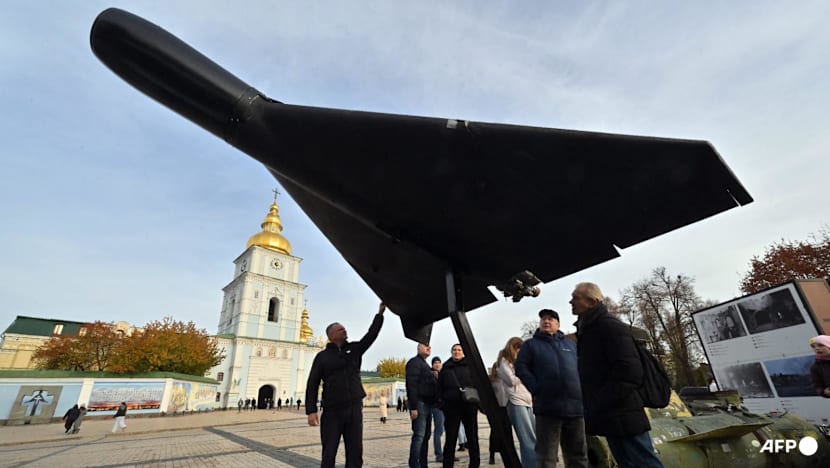 People look at an Iranian-designed Shahed 136 drone of the Russian Army in Kyiv on Nov 2, 2025. (File photo: AFP/Sergei Supinsky)
Why is the US adopting similar drones?
For the first time in combat, the US military said it has deployed low-cost, one-way attack drones against Iranian targets.
The US Central Command (CENTCOM) said the drones, which are expendable but cheaper than traditional missiles, were based on lessons drawn from Iran's own technology.
"These low-cost drones, modelled after Iran's Shahed drones, are now delivering American-made retribution," CENTCOM said in a statement on X.
The drones are inexpensive and are meant to be produced by several manufacturers, the Pentagon has said.
Photos released by the Pentagon suggest that the drones resemble the LUCAS (Low-Cost Unmanned Combat Attack System) manufactured by Phoenix, Arizona-based Spektreworks.
"The US’ use of LUCAS drones against Iran is significant because these drones are reverse-engineered from Shahed-136. Essentially, the US is giving Iran a taste of its own medicine," said associate research fellow at the S Rajaratnam School of International Studies (RSIS) Liu Mei Ching.
The shift also reflects a growing emphasis on cost efficiency.
"Simply put, the United States does not possess unlimited resources. It is far more cost-effective to deploy a LUCAS drone … for about US$35,000 apiece, as opposed to using Tomahawk cruise missiles, for roughly US$2.5 million apiece for the latest versions," said Steve Feldstein, a senior fellow at the Carnegie Endowment for International Peace.
Analysts said the use of both the Shahed and the LUCAS represents an emerging trend.
"Cost has become a decisive factor in weaponeering, and militaries are increasingly pivoting towards using drones, which are equipped with just good enough precision, to achieve various operational objectives," Liu added.
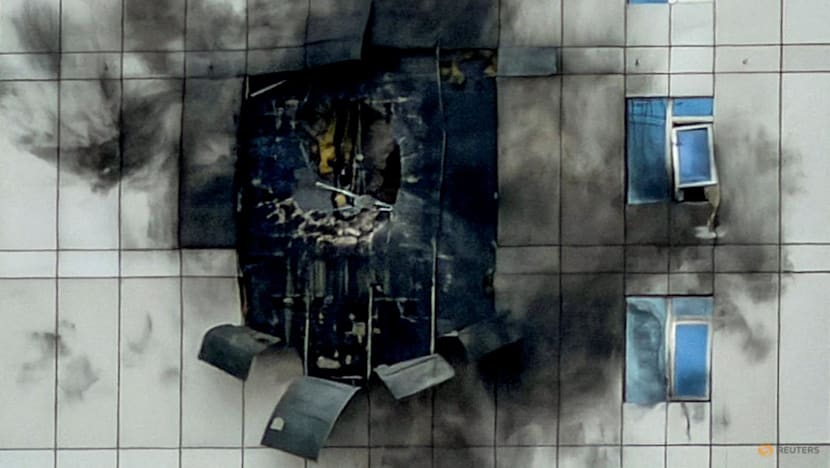 A building that was damaged by an Iranian drone attack in Juffair, Manama, Bahrain, on Mar 1, 2026. (File photo: Reuters/Hamad I Mohammed)
How crucial are Shahed drones in warfare?
Iranian drone designs have demonstrated their effectiveness in Ukraine, analysts said.
After reaching a deal with Tehran to import Shahed drones early in the Russia-Ukraine war, Russia later localised their production, investing US$2 billion in setting up a dedicated factory to produce these drone models.
Russian engineers have increased its altitude, made it more jamming-resistant and fitted it with more powerful warheads. The Russian defence ministry has also said it is turning its drone force into a separate military branch.
“It should come as little surprise that the United States would emulate this design as well,” Feldstein said in comments published on the website of Carnegie Endowment for International Peace.
By using large numbers in a single attack, Moscow’s strategists seek to overwhelm Ukrainian air defences. Russia has battered Ukraine with hundreds of drones in a single night – more than what were used during some entire months in 2024.
“These drones are causing extensive damage to Ukraine’s critical infrastructure and are a major problem for Ukraine’s defenders, based on the sheer volume,” said Dara Massicot, senior fellow at the Carnegie Endowment for International Peace.
The war in Ukraine has pushed the US and other countries towards a new strategy known as "affordable mass" - prioritising large quantities of relatively cheap systems.
If the conflict in the Middle East drags on, resource constraints will become a bigger factor, Feldstein said. Stockpiles of expensive air defence interceptors are finite - and difficult to replenish quickly - which could heighten the strategic value of cheaper, mass-produced drones.
RSIS' Liu said that while the drones are not powerful enough to bring down buildings, they can cause damage to utility and critical energy infrastructure.
She pointed to Iran's drone strike on Saudi Arabia's biggest domestic oil refinery on Monday, forcing it to halt operations.
"Shahed drones are and will continue to be an important feature of Iranian tactics in the Middle East conflict," Liu told CNA.
Are US and Middle East defences able to deal with Shahed drones?
Shahed drones are relatively slow and noisy compared with ballistic missiles, making them easier to detect and track.
Air defence systems such as the US-made Patriot, Israel’s Iron Dome and various short-range interceptors are capable of shooting them down. Fighter aircraft can also be used to intercept them mid-flight.
“The methods are effective, but targeting drones in this way is resource-intensive and expensive, and it will drain certain types of interceptors quickly,” Massicot noted.
“Patriot interceptors in particular must be used against ballistic missiles, and strains to stockpiles will emerge if they are used too extensively against Shaheds.”
So the challenge is less about capability and more about economics and scale.
Iran typically launches drones in waves, often alongside ballistic or cruise missiles. This forces defenders to divide attention and interceptors between multiple threats at once. Ballistic missiles - which travel much faster and pose a greater destructive risk - must take priority. That leaves cheaper drones competing for expensive defensive resources.
There is also the question of coverage.
While high-value military facilities are typically protected by layered air defence networks, critical infrastructure or softer targets may lack sufficient point defences.
“(The US military and its partners) still need additional low-cost point defences at key facilities, in order to complete layered defences against Shahed drones - particularly for a prolonged, high-intensity conflict,” Massicot said.
Liu pointed out that air defence systems alone may be insufficient to sustain a defence against protracted drone warfare or drone swarm attacks.
Other capabilities, such as electronic warfare equipment which can be used to jam and spoof drones, are needed to withstand such attacks, she said.