 3 months ago
205
3 months ago
205
Speaking to CNA at Ecosperity Week 2026, bank executives said growing climate shocks, energy demand and grid pressures are reshaping investment priorities across the region.
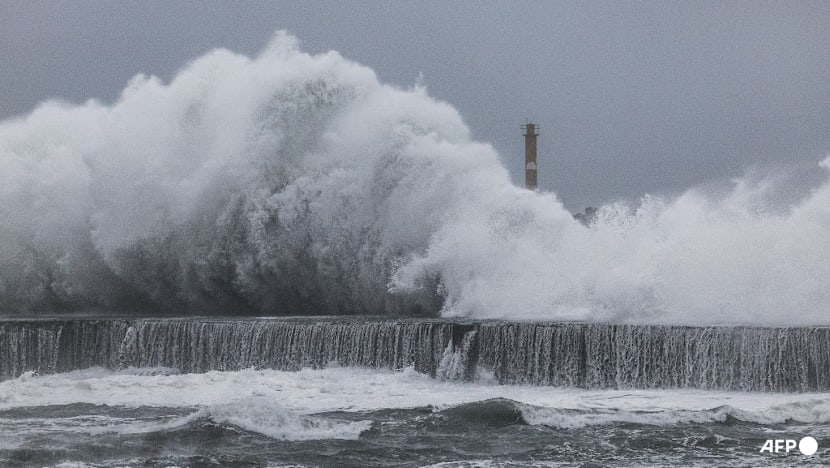
Strong waves crash against a sea wall in Yilan, Taiwan, on Nov 11, 2025. Banks say climate finance in Asia is increasingly shifting towards adaptation and resilience projects – including flood protection systems and coastal infrastructure – as climate risks intensify. (Photo: AFP/I-Hwa Cheng)
New: You can now listen to articles.

This audio is generated by an AI tool.

SINGAPORE: As Asia grapples with more adverse weather events and growing energy demand, banks say climate finance is increasingly shifting beyond projects aimed at cutting emissions towards climate resilience and energy security.
They are now placing greater emphasis on climate adaptation projects that help economies withstand the physical impacts of climate change, such as sea walls and flood protection systems.
Speaking to CNA on the sidelines of Ecosperity Week 2026 on Tuesday (May 19), banking executives also highlighted the growing need for investment in renewable energy in Asia amid rising electricity demand.
This shift comes as Southeast Asia faces what industry observers describe as a gap between climate targets and projects actually getting built.
A report by consulting firm Bain & Company and Standard Chartered, released on Monday, estimated that around 35 per cent of announced green capital expenditure in Southeast Asia remains unrealised, with grid bottlenecks, policy uncertainty and execution delays slowing deployment.
CLIMATE ADAPTATION MOVES UP THE AGENDA
For banks, climate adaptation is becoming more important as environmental risks increasingly affect the businesses and projects they finance.
“With the trajectory that the global society is going from an energy transition point of view, it would be remiss for governments, societies, and banks like ourselves not to think about climate adaptation and resilience,” said DBS’ chief sustainability officer Kelvin Wong.
“The weather is getting hotter. (There are) more natural disasters, floods, heatwaves. These events will present risks to banks as we do our financing,” Wong added.
“If we can help to finance and assess projects for whether they’re more resilient to the changing environment, as well as whether businesses are adapting to the changing climate, it will really help banks when we assess our financing to businesses.”
Still, adaptation projects remain difficult to finance because returns are often harder to quantify than traditional infrastructure or energy investments.
According to Bain and Standard Chartered’s Southeast Asia’s Green Economy Report 2026, Asia Pacific faces an annual adaptation funding gap of about US$186 billion, while Southeast Asia alone faces a US$18 billion shortfall each year.
The report also noted that private capital currently accounts for less than 8 per cent of adaptation spending.
Wong said the issue is not a lack of capital, but a shortage of “good projects”.
“It's always (about) finding those good projects first … We can work with our clients to think about climate adaptation projects, as well as climate resilience projects,” he added.
STRONGER CASE FOR RENEWABLES
At the same time, concerns over energy security are reinforcing the business case for renewable energy, especially in Asia, which remains heavily reliant on imported fossil fuels.
HSBC’s chief sustainability officer Julian Wentzel said current geopolitical tensions have “crystallised people’s thinking” around the need to shift energy systems.
Wentzel added that the demand for renewable energy to power data centres could also rise sharply in the coming years.
According to the report, more than 100 terawatt-hours of new electricity demand from data centres, electric vehicles and green industrial parks is expected by 2030.
Wentzel noted that renewable energy projects can often be deployed much faster than conventional large-scale power plants, which he said take “five to eight years to bring on stream”.
“Renewable energy, like for instance a photovoltaic solar farm or a wind farm, you can put that on stream in nine months, maybe 18 months at worst,” he added.
STRIKING A BALANCE BETWEEN CLIMATE GOALS AND GROWTH
But Southeast Asia’s power grids are struggling to keep up with rapidly rising electricity demand.
The report estimated the region faces an annual grid investment shortfall of around US$18 billion, threatening to slow the region’s green transition.
Bain & Company partner Dale Hardcastle described the region’s power grid as the “chokepoint” holding back broader green investment, adding that stronger investment in grid infrastructure could help attract significantly more capital.
Despite these challenges, Hardcastle said Southeast Asia’s green economy is still growing strongly. It is currently valued at about US$290 billion and projected to reach US$430 billion by 2030, the report said.
He noted that climate goals were increasingly being weighed against concerns over economic growth, energy affordability and geopolitical uncertainty.
One example is investment firm Temasek Holdings, which on Monday said was unlikely to meet its interim 2030 climate target.
It cited a more fragmented global environment, rising energy demand and the difficulties of decarbonising sectors such as aviation and power generation.
Hardcastle said while there is “greater pragmatism” over climate targets today, companies remained committed to investing in the green transition.
The bigger challenge is turning announced plans into projects on the ground.
“If the opportunities are there, I don't think it’s a question of capital, it's a question of execution and conversion,” Hardcastle added.