 3 months ago
82
3 months ago
82
SINGAPORE: Tunnel strengthening works on the Circle Line (CCL) have reached the halfway mark, with the Land Transport Authority (LTA) confirming on Tuesday (Feb 10) that the project remains on schedule for completion by April.
The scheduled service disruption, which began on Jan 17 and runs until Apr 19, has seen trains operating on a single platform between Mountbatten, Dakota and Paya Lebar stations.
LTA has completed the installation of steel plates on all 152 tunnel rings in the inbound tunnel towards HarbourFront station. However, finishing works – including welding, grouting and bolting – as well as testing procedures are still underway.
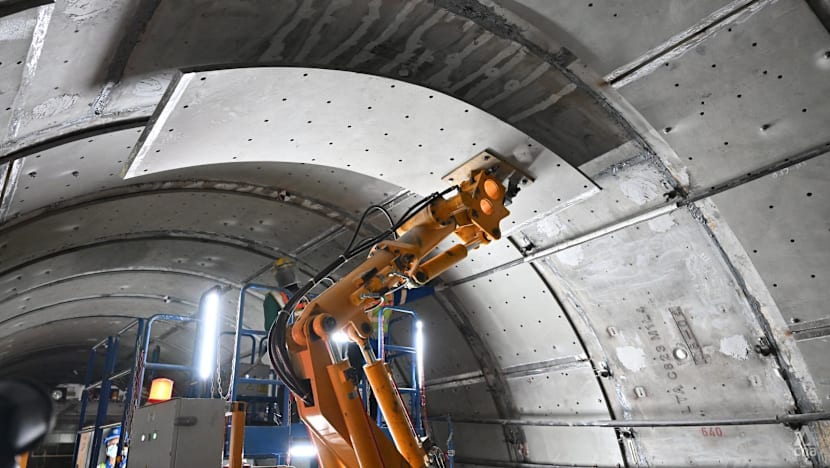 A steel plate is being lifted into place by a robotic arm as part of tunnel strengthening works along the Circle Line tunnel of Dakota MRT station. (Photo: CNA/Raydza Rahman)
These tests would confirm that the completed strengthened tunnel is robust and reliable for passenger services, said Mr Saiful Rasno, director of infrastructure enhancement at LTA.
Works on the outbound tunnel towards Dhoby Ghaut station are slated to begin later this month.
Mr Saiful assured commuters that train services will not be affected during this phase. "Commuters can follow the signage to board the shuttle trains from the opposite platform," he said.
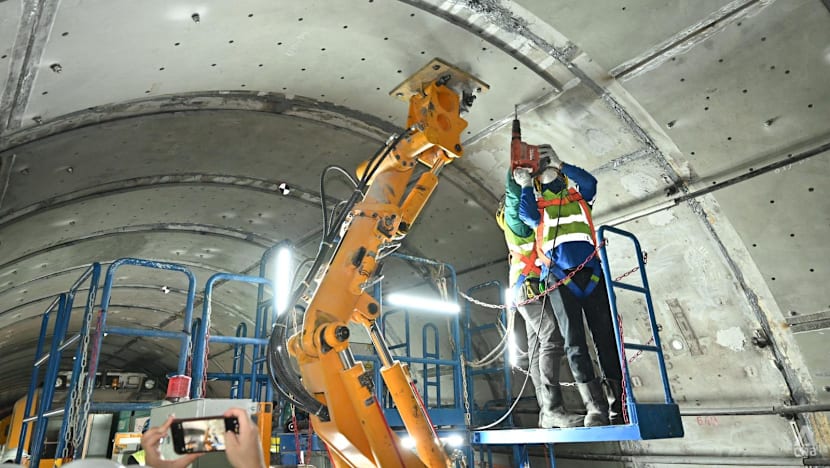 Workers bolting up and securing the steel plate on the Circle Line along the tunnel of Dakota MRT station. (Photo: CNA/Raydza Rahman)
By project completion, more than 300 tunnel rings across both tunnels will have been reinforced.
The strengthening works address a phenomenon known as "tunnel squatting", which affects several sections of the CCL tunnels. This occurs when soft marine clay beneath parts of the tunnel slowly compresses over time.
If left unaddressed, LTA said this could lead to long-term disruptions in train operations and structural defects in the tunnel.
A specialised robotic arm is being deployed to secure steel plates within the tunnel, freeing up space and allowing workers to focus on other critical tasks.
Without this technology, five to six workers would be needed to manually lift and place each plate – a process requiring significantly more manpower and time, LTA said.