 3 months ago
98
3 months ago
98
The broader diplomatic climate can directly affect how Chinese Canadians feel, especially after a surge in anti-Asian hate during the COVID-19 pandemic, said one expert.
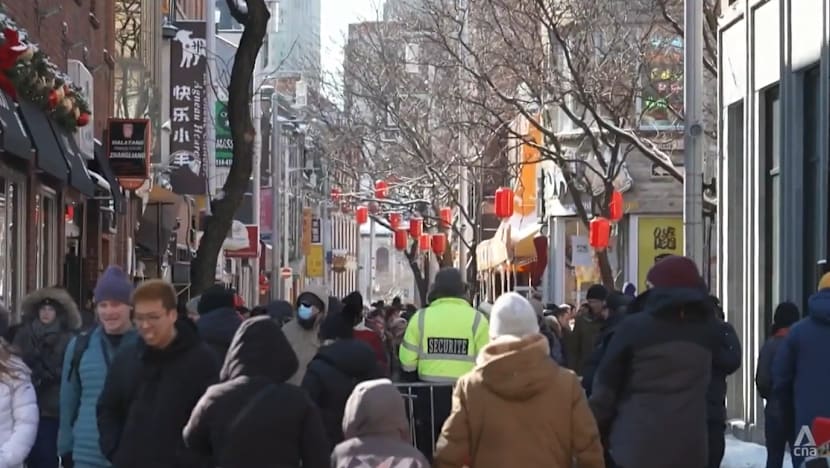
A street decked out in Chinese New Year decorations in Montreal, Quebec, Canada.
New: You can now listen to articles.

This audio is generated by an AI tool.

MONTREAL: Wang Jing still remembers the dumplings she used to make in Beijing before moving to Canada in 2019.
This Chinese New Year, she found herself making them once again – but this time, with fellow parents and students from a wide range of backgrounds inside Selwyn House, a private English boys’ school in Montreal.
For Wang, sharing dumplings – which she tailored to appeal to a wide range of palettes – is about more than food.
It is about preserving tradition while building community in a country she now calls home.
“Chinese New Year … is the most important festival in China, and even though we are in Canada here, we hope we can share these traditional activities with the community around us,” said Wang, whose son attends the school.
These holiday celebrations come at a time of improving diplomatic relations between Canada and China.
TRADITION SHARED ACROSS CULTURES
The dumpling-making session at Selwyn House brought together Chinese and non-Chinese students alike, teaching them not only how to prepare a traditional dish but also the cultural significance behind it.
For many Chinese immigrants, the annual ritual of making dumplings is a way to reconnect with the culture of their birth country while forging new bonds in Canada.
At the school, the workshop has become a highlight of the school year.
Eden Schwartz, the school’s diversity, equity and inclusion coordinator, said families have played a central role in shaping the celebration.
“Part of my job is helping the students bring their cultural celebrations to life, but I really lean on them to see what they want to do,” she added.
“For the past three years, we’ve had families who’ve really just jumped in and taken control of the event and the boys love it.”
The dumpling workshop was just one of several Chinese New Year events at the school. Students also watched a lion dance performance, learned about the Chinese zodiac and walked through halls decorated with red lanterns.
GROWING RECOGNITION
Chinese New Year is not a statutory holiday in Canada, but it is officially recognised in British Columbia and in the city of Toronto. Some school boards also allow excused absences for students observing the holiday.
National recognition of the festival has grown alongside Canada’s Chinese population. For example, for the past 12 years, Canada Post has issued special stamps marking the occasion.
Meanwhile, the Chinese Canadian population has doubled from under one million in the mid-1990s to more than 1.7 million in 2021.
In Montreal, Chinese New Year events in Chinatown continue to draw expanding crowds of all ages and backgrounds, reflecting the city’s multicultural character.
THAW IN DIPLOMATIC TIES
This year’s celebrations also come amid shifting diplomatic relations between Canada and China, which have been strained since the 2018 arrest of Huawei executive Meng Wanzhou.
But in January, Canadian Prime Minister Mark Carney visited Beijing and met with Chinese President Xi Jinping. The two sides issued a joint statement announcing a new strategic partnership.
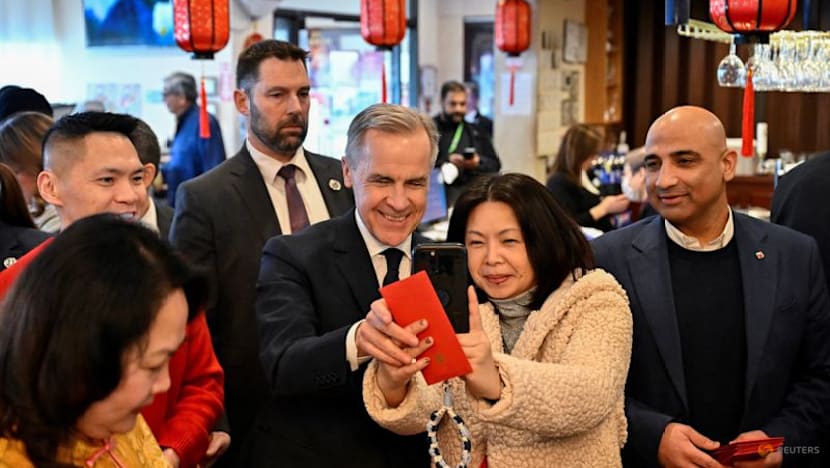 Canada's Prime Minister Mark Carney poses for a picture as he hands out red envelopes to members of the Chinese community to celebrate lunar new year at Continental Seafood Restaurant in Richmond, British Columbia, Canada, Feb 18, 2026. (Photo: Reuters/Jennifer Gauthier)
Paul Evans, professor emeritus at the University of British Columbia’s School of Public Policy and Global Affairs, described the move as measured.
“This was an important diversification of the areas in which Canada and China are going to try to cooperate (while) there’s recognition of guardrails. This isn’t a wide-open strategic alignment with China, but rather a partnership in some relatively carefully specified areas,” he added.
The meeting comes as Canada faces renewed economic pressure from the United States, including tariffs and political tensions.
Chen Xiaobei, a sociology professor at Carleton University, said the broader diplomatic climate can directly affect how Chinese Canadians feel, especially after a surge in anti-Asian hate during the COVID-19 pandemic.
“It does trickle down. I can feel on social media people saying, ‘Oh finally. Finally, something is turning and the ice is thawing’,” Chen said.
For many in Montreal’s Chinese community, the evolving diplomatic landscape adds another layer of meaning to this year’s Chinese New Year – a celebration rooted in tradition, but also in resilience and renewal.