 3 months ago
105
3 months ago
105
HANGZHOU, Zhejiang: China’s robots grabbed global attention at this year’s Spring Festival Gala with martial arts moves, backflips and a full-blown spectacle that blurred the line between science fiction and state ambition.
Videos of humanoids performing fully synchronised wushu routines with nunchucks and swords quickly went viral online. In one segment, the machines sparred in choreographed sequences alongside children.
The show has become a point of pride for Hangzhou, where homegrown firm Unitree Robotics’ G1 humanoids performed the kungfu segment at the nationally televised gala.
Known for its picturesque West Lake and as the birthplace of e-commerce giant Alibaba, the eastern Chinese city is positioning itself at the forefront of what Beijing calls its “industries of the future”.
Among them: embodied intelligence.
FROM STAGE TO STRATEGY
Embodied intelligence – the integration of artificial intelligence into physical forms such as robots, cars and smart devices – has emerged as a strategic priority for Beijing.
The push has been written into China’s latest Five-Year Plan, signalling policymakers’ determination to move AI beyond software and into the real world.
At this year’s National People’s Congress that concluded last Thursday (Mar 12), officials made clear they want intelligent machines to move beyond controlled demonstrations and into everyday life.
The vision is ambitious: humanoid robots working in factories, assisting in logistics, supporting healthcare, and helping with household chores.
But how close is that reality?
ROBOTS STILL “GROWING UP”
Industry insiders say the technology is advancing rapidly, but true general-purpose humanoid robots remain some distance away.
Yolanda Xie, marketing manager at Unitree Robotics, said today’s machines are still far from fully autonomous.
“Right now, robots are still like children or teenagers. They need more time to grow,” she told CNA, adding that cognition remains the biggest bottleneck.
“Robots still can’t really think or make decisions – like fetching a glass of water, or cleaning a room, that’s still hard for today’s humanoids,” she added.
“But that’s our ultimate goal: to develop a more general-purpose robot.”
GOOD ENOUGH FOR NOW
Even so, progress is tangible. Advances in machine learning mean robots can now mimic human movement far more naturally.
In many industrial settings, that level of capability is sufficient for now.
From its headquarters and 10,000-sqm factory in one of Hangzhou’s sprawling tech parks, Unitree provides the hardware platform while clients customise the software.
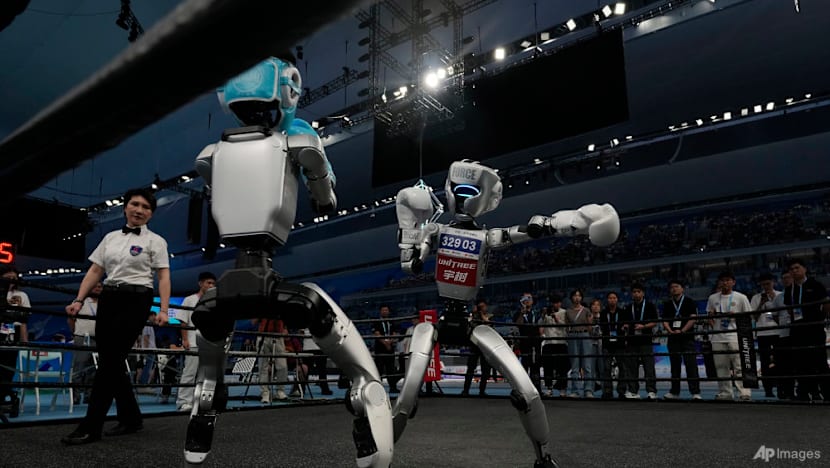 Robots compete at the Free Combat event of the World Humanoid Robot Games held in Beijing, China, Aug 15, 2025. (Photo: AP/Ng Han Guan)
“Customers can develop (their own) motion-control algorithms or build the robot’s so-called ‘brain’, and create different applications – from healthcare to logistics,” Xie said.
A major advantage for Chinese firms is cost, as much of the supply chain is domestic, she added.
“China’s manufacturing base is quite advanced and supply chains are very complete,” Xie noted. “Key parts like motors, radar, reducers, and controllers are developed in-house, and that helps control costs. We’re also mass-producing and delivering at scale.”
Some Unitree humanoid models start from as low as 85,000 yuan (US$12,000), roughly the price of a small car in China. As production expands, prices are expected to fall even further.
SPIKE IN DEMAND
At Wuhan Fengke Robot Technology, demand for humanoid robot rentals has more than doubled in recent weeks compared with the same period last year.
“The largest order we’ve received is for more than 30 robots for a large-scale performance. We believe that (such orders) next year may exceed 100 robots,” said the firm’s CEO Chen Jing.
But rentals and shows are not the company’s core business. The firm focuses mainly on developing hardware and software systems that can be adapted and customised across different robotic platforms.
“This includes robots serving as tour guides in scenic areas, employees in companies, security patrol officers in residential communities, inspection staff in parks, and even docents in exhibition halls,” said Chen.
Household humanoids, however, are still some way off.
Analysts say prices remain too high for mass consumers, while the robots’ intelligence and operating systems still require significant improvement.
“Humanoid robots are not really ready for real-world practice because they still need a lot of data and training,” said Tilly Zhang, an analyst at research firm Gavekal Dragonomics.
Instead, some technologies developed during humanoid research are already being applied elsewhere.
“For example, robotic features like dexterous hands can improve industrial robots, while mobility technologies could allow devices like robotic vacuum cleaners to climb stairs,” Zhang added.
THE CONSUMER FRONTIER
Even so, China is steadily expanding the consumer market for AI-powered devices.
Scroll through Chinese e-commerce platforms and a growing array of AI gadgets appears – from plush toys with built-in AI priced at around US$80, to health-monitoring devices costing roughly US$320.
Beijing believes the potential is enormous. Officials estimate the scale of China’s AI-related industries could exceed US$1.45 trillion by 2030.
China has been the world’s largest market for industrial robots since 2013, accounting for more than half of all robots installed globally.
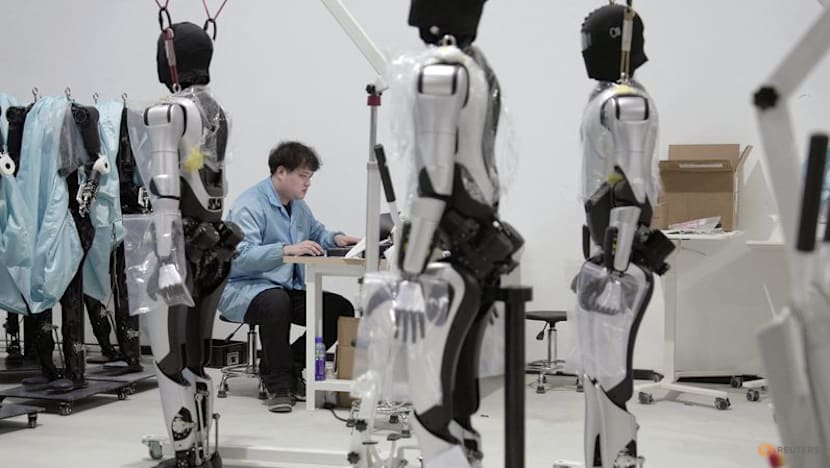 An engineer works on humanoid robots at an Agibot factory in Shanghai, China, Mar 12, 2025. (Photo: Reuters/Nicoco Chan)
In his Government Work Report, Chinese Premier Li Qiang highlighted the sector’s momentum, noting that China’s industrial robot output rose 28 per cent last year.
Yet rapid expansion has also raised concerns about excessive competition.
The number of AI companies in the country surpassed 6,200 last year, according to Minister of Industry and Information Technology Li Lecheng.
State planner Li Chao has urged firms to avoid repetitive, copycat models that crowd the market and squeeze research and development resources.
BEYOND THE TECH PARKS
On the ground in Hangzhou, capital of Zhejiang province, the excitement around robotics coexists with more immediate bread-and-butter concerns.
As China’s annual “Two Sessions” political meetings concluded last week, one issue stood out for many ordinary residents: rural pensions.
The latest Government Work Report announced a 20 yuan monthly increase in basic pension payments for rural residents for the third consecutive year, raising the national minimum to 163 yuan per month.
Critics argue the amount remains far from sufficient to live on.
One of China’s 10 richest cities, Hangzhou is home to about 12 million people. It is packed with migrants who left rural hometowns to make a living in the city. Many are often the only child supporting ageing parents back home.
About one-third of China’s population still lives in rural areas, where incomes on average are less than half those of urban residents. That disparity matters because Beijing wants domestic consumption to drive economic growth.
Some economists argue that raising rural pensions could help stimulate spending. Greater financial security for parents may also free their children working in cities to spend more confidently.
Building a stronger domestic market is Beijing’s top economic priority this year. While the future may be robotic, for many, the present and today’s pain points remain deeply human.