 3 months ago
111
3 months ago
111
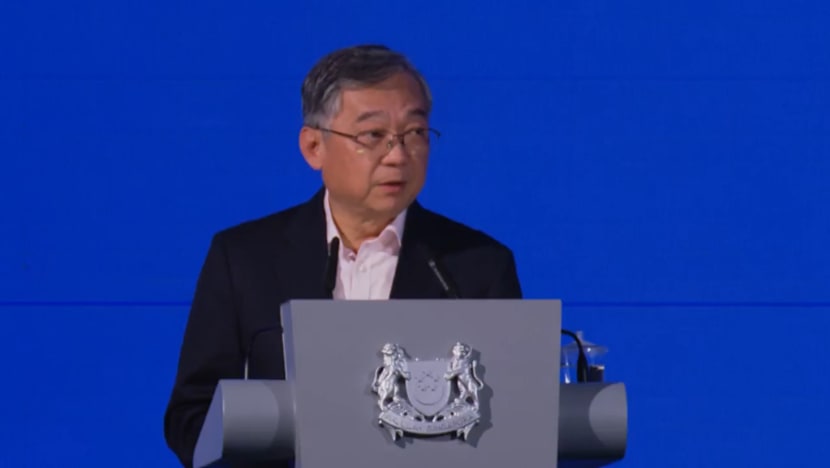
Deputy Prime Minister Gan Kim Yong speaking at the Singapore Maritime Week on Apr 21, 2026. (Photo: CNA)
New: You can now listen to articles.

This audio is generated by an AI tool.

SINGAPORE: In a time when pressures are pulling systems apart, maritime hubs that anchor connectivity, standards and trust become even more important, said Deputy Prime Minister Gan Kim Yong on Tuesday (Apr 21).
Mr Gan was speaking at the Singapore Maritime Week at Suntec Singapore Convention and Exhibition Centre, where he spoke on the developments in the Strait of Hormuz and what Singapore can do as a maritime hub.
He said that in a “fragmented system” amid the global geopolitical situation, “trust carries a premium”.
“Shipping depends not only on infrastructure, but also on confidence - that confidence that international frameworks will be respected, that ports will operate reliably, that rules will be applied consistently, and that contracts will be honoured,” he said.
“Singapore's maritime ecosystem is built on these foundations - strong rule of law, transparent governance is very ecosystem of maritime services such as finance, insurance, legal and arbitration.”
For much of the past 50 years, maritime networks have operated within a system that was “broadly stable”, underpinned by navigational rights and freedoms enshrined in the United Nations Convention on the Law of the Sea (UNCLOS), said Mr Gan.
“These rights and freedoms are existential, not only to Singapore status as a maritime power, but also to the growth and functioning of the global economy.”
He noted that Singapore was one of the architects of UNCLOS, which “clearly stipulates the right of transit passage for all ships and aircraft through straits used for international navigation.
“This right is important for all nations around the world that depend on maritime connectivity and trade.”
While UNCLOS continues to be the important for the "international rules-based maritime order”, the system is now “increasingly fragile”.
Developments in the Strait of Hormuz stemming from the Middle East conflict have “brought this reality into sharp focus”.
“In recent days, the US and Iran have sent mixed messages about the status of the strait, underscoring just how volatile and fluid the situation has become,” said Mr Gan.
What began as a disruption in a narrow waterway has “quickly cascaded across the global economy”, said Mr Gan. This can be seen through energy prices, transport costs and production chains.
“This is not just a regional disruption - it is a systemic shock, a reminder that instability at a single maritime chokepoint can transmit quickly across the global economy within days, with its knock-on effects lasting for months or longer,” he said.
It is thus not surprising that interdependence is "increasingly seen through a different lens”.
“Not just as efficiency, but as exposure. Not just as connectivity, but vulnerability,” he said.
THREE SHIFTS IN THE GLOBAL SYSTEM
Mr Gan touched on three “structural shifts” in the global system.
First is that trade and connectivity are no longer “purely economic”, but are increasingly shaped by strategic and security considerations.
Supply chains are being reconfigured not just for efficiency, but for resilience, with governments and firms reassessing dependencies, diversifying sources of supply, and in some cases, building redundancy into their networks, he said.
Export controls, sanctions and investment restrictions are becoming more common, and maritime routes are evaluated not only for efficiency, but also for risk and reliability.
“As a result, the maritime system is becoming more contested, and more closely intertwined with geopolitical competition,” he said.
Second, there has been a fragmentation of rules, with a global trading system that has long depended on shared rules, common standards and effective institutions coming under strain.
“Coordination of responses to crises is becoming more difficult,” said Mr Gan. “For maritime actors, this means greater uncertainty and complexity.”
Third, there are transitions taking place in aspects such as digitalisation of trade flows, green energy and the use of artificial intelligence (AI).
The shifts will introduce greater challenges but also open up new opportunities, said Mr Gan.
Firms that can adapt quickly will be better positioned to compete, he said. They will need to redesign their operations, diversify their networks, and adopt digital and AI-enabled solutions.
For workers, this will translate into new roles and capabilities - from data and AI specialists supporting logistics and port operations, to engineers and technicians working on new fuels and sustainable infrastructure, said Mr Gan.
“But to seize these opportunities, we will need to keep systems connected, interoperable and trusted,” he said.
WHAT SINGAPORE IS DOING
The disruption in the Strait of Hormuz has led to rerouting, delays and congestion, said Mr Gan.
Such shocks increase the importance of hubs that can provide flexibility and optionality, enabling flows to be redirected quickly and efficiently, he added.
Singapore is an example of such a hub, he said, noting that it is the world’s busiest transshipment port and a “key node in global maritime networks”.
“In a more volatile world, such connectivity is not just an economic asset — it is a crucial part of resilience not only for ourselves, but for the rest of the world,” he said.
Singapore is also working with partners to advance standards in digitalisation and decarbonisation.
Mr Gan said the launch of OCEANS-X at the Singapore Maritime Week is such an example.
OCEANS-X is a unified digital platform enabling data sharing between the government and the maritime industry, and also between ports.
“By providing common, standards-based data, we improve operational efficiency today, while laying the foundation for future innovation,” said Mr Gan.
Singapore has also taken early steps to develop multiple net-zero fuel pathways to support the maritime industry’s green transition.
Such standards enable interoperability, improve efficiency and build trust, said Mr Gan.
“They are also a source of influence. Countries that help define and align standards can shape how systems connect and scale,” he said.
This will become even more important when AI is deployed at scale, as such systems depend on trusted, shareable data across ecosystems.
Singapore has embarked on developments such as the Maritime Digital Twin, which is a virtual model of the Port of Singapore that uses real-time data to optimise efficiency and strengthen safety and security.
It is also developing a platform called the Next Generation Vessel Traffic Management System, which will enable real-world applications of AI - from optimising vessel turnaround to dynamically routing flows in response to disruptions.
“In this way, AI can help make maritime networks not just more efficient, but also more adaptive and more resilient,” he said.