 3 months ago
127
3 months ago
127
BEIJING: The lowest economic growth target since 1991. Public spending set to surpass 30 trillion yuan (US$4.3 trillion). And a rare candid admission that 2025 had been one of China’s hardest years in recent memory.
The country’s most important political event kicked off this week under heavy grey skies and snow - bringing together thousands of delegates from provinces, autonomous regions and municipalities.
Delivering the annual government work report on Thursday (Mar 5), Premier Li Qiang laid out Beijing’s economic and policy priorities for 2026 - while also acknowledging persistent headwinds from weak domestic demand, a struggling property market and rising geopolitical risks.
“Rarely have we encountered such a grave and complex landscape, where external shocks and challenges were intertwined with domestic difficulties and tough policy choices,” Li said.
This year’s gathering notably carries added significance as the world’s second-largest economy embarks on its ambitious 15th Five-Year Plan, the sweeping policy blueprint that will shape its economic and social development through 2030.
Against that backdrop, several themes stand out from the opening day of the National People’s Congress (NPC).
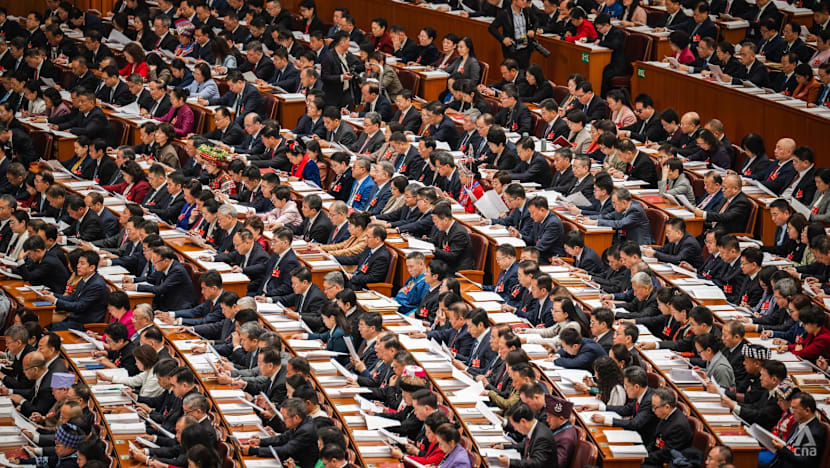 Delegates listen to Chinese Premier Li Qiang delivering a work report during the opening session of the National People's Congress at the Great Hall of the People in Beijing, China, on Mar 5, 2026. (Photo: CNA/Hu Chushi)
ECONOMY: QUALITY OVER QUANTITY
China cut its annual economic growth target to a range of 4.5 to 5 per cent - the first downgrade since 2023 and its lowest since 1991 - signalling more than a modest trimming of ambition.
Analysts said it marks a deliberate, more pragmatic shift from Beijing to better match economic realities.
Dong Ximiao, chief researcher at Merchants Union Consumer Finance, said the range should not be read as a retreat.
“This does not mean abandoning growth,” he told CNA, also noting that the lower bound of 4.5 per cent must be “firmly safeguarded as the bottom line” for stabilising employment and ensuring a strong start to the five-year plan.
The lower range instead reflects a move “from a ‘speed-first’ approach to a ‘quality-first’ approach”, Dong said - creating room for industrial upgrading, green transformation and risk resolution that a rigid higher target would not allow.
Li himself spoke about the pressures driving that reset.
“Some enterprises are facing difficulties in their operations and it is more challenging for people to secure employment and earn more,” he said.
Xu Tianchen, a senior economist at the Economist Intelligence Unit in Beijing, said that policymaking is increasingly about delivering results that "people really want", citing income increases, access to public services and human capital development.
He also pointed to exports as an underappreciated support for this year’s target - particularly the rise of AI-related goods, from components to infrastructure equipment.
“(China’s) AI story could last for quite a while,” Xu said.
Gary Ng, a senior economist at Natixis, said this year’s lower target sent two clear messages.
“The Chinese government has accepted the reality that growth is decelerating further than expected - and it also signals the amount of capital it is willing to inject into its economy in the short term,” Ng said.
Even as spending remains elevated, discipline will be tightened, said Li, addressing delegates in the Great Hall of the People.
“Every cent we save must be spent on solving critical development problems and meeting people’s urgent needs,” he said.
The 2026 government work report lends weight to both points.
On deceleration, Li acknowledged that “consumption and investment lacked adequate growth momentum” in 2025 and that the economy faced an “imbalance between strong supply and weak demand”.
On the stimulus scale, the report's fiscal settings tell their own story: while the deficit-to-GDP ratio holds at 4 per cent and spending will break the 30 trillion yuan threshold for the first time, the report stated that room has been left for “structural adjustments, risk prevention and reform”.
To channel more precise spending, Beijing has created a new special fiscal-financial coordination fund of 100 billion yuan to facilitate domestic demand expansion - while 4.4 trillion yuan in local government special-purpose bonds have been earmarked mainly for major projects and debt replacement.
Lin Han-Shen, China director at The Asia Group, said the report was “surprisingly candid” - that consumption had been a problem rather than a strength in 2025.
He said the frank admission that demand had lagged set a deliberately low baseline - one that reflected a clear-eyed assessment of where China’s economy actually stood rather than where Beijing might wish it to be.
MORE INCOME, MORE SPENDING
What’s clear as well is that Beijing is putting fresh focus on household spending as external demand comes under pressure.
Li said the government will roll out an income growth plan for urban and rural residents.
Measures will aim to raise low-income earnings, increase property income and improve wages and social security. Support for childcare, elderly care and housing will also be strengthened.
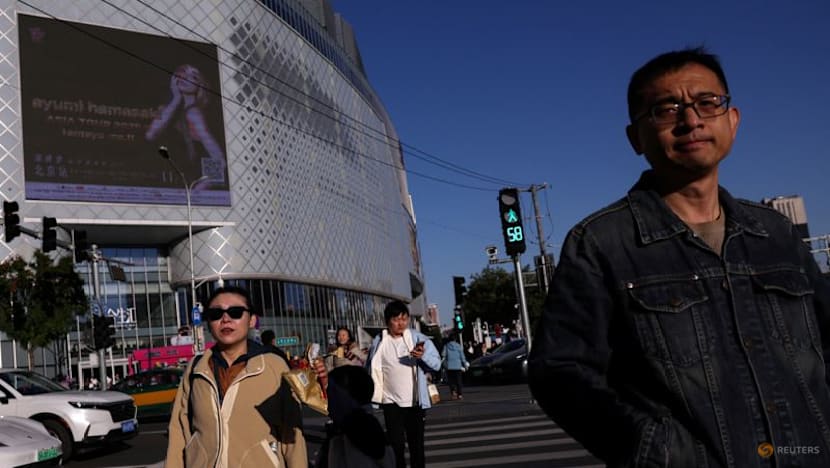 People walk on a street near a shopping mall in Beijing, China Oct 19, 2025. (Photo: Reuters/Tingshu Wang)
To boost consumption directly, the government will set aside 250 billion yuan this year for consumer goods trade-in programmes.
That is lower than the 300 billion yuan allocated in 2025, when funding was doubled from its 2024 launch. Last year’s expanded scheme generated more than 2.6 trillion yuan in sales, showing strong public demand.
Kenneth Goh, director of private wealth management at UOB Kay Hian, said the lower allocation does not necessarily signal weaker support.
“The headline reduction is less significant than the composition shift,” he told CNA, noting that the scheme now emphasises electric vehicles, energy-efficient appliances and smart digital products.
“The programme also front-loads disbursement, with an initial 62.5 billion yuan tranche already released,” Goh said.
“Beijing is moving toward more targeted spending on better products rather than a broad fiscal push.”
Authorities also pledged to abolish all “excessive restrictions” on consumption and unlock spending in areas such as culture, tourism, sports and healthcare.
Spring and autumn holidays will be introduced for primary and secondary school students where conditions permit, alongside staggered paid leave arrangements, as laid out in the government work report.
The move builds on earlier measures to support families and boost spending, including nationwide childcare subsidies and the addition of two extra public holidays last year.
Dong from Merchants Union Consumer Finance said the shift reflects a broader change in approach.
“The focus of fiscal policy is shifting from investing in ‘things’ to investing in ‘people’, with the aim of fundamentally strengthening the economy’s internal growth momentum,” he said.
But even as Beijing renews policy support to boost consumption and incomes, analysts cautioned that key challenges remain.
Goh said higher incomes may help at the margin, but confidence remains closely tied to the property market, which remains mired in a prolonged downturn.
He cited a 2019 People’s Bank of China survey showing housing accounts for nearly 70 per cent of urban household assets.
“When property prices are adjusting, the wealth effect turns negative and precautionary saving rises,” he said.
“Support for childcare and elderly care may matter more than direct income transfers. These reduce uncertainty about future costs rather than just adding to today's income.”
Su Yue, chief China economist at the Economist Intelligence Unit (EIU), said job uncertainty is likely to continue weighing on consumer confidence.
“Measures to boost incomes and employment are a positive step, but their impact may be limited without sufficient fiscal resources attached,” she said.
She added that enforcement could also prove challenging as technological shifts driven by artificial intelligence (AI) disrupt the labour market, while authorities must balance job support with maintaining corporate confidence.
DEFENCE SPENDING MARCHES ON
The defence budget is a key watchpoint from the Two Sessions, as it is viewed as a gauge of China’s strategic priorities and military trajectory.
A 7 per cent increase has been announced this year, extending past a decade of steady, single-digit growth in military outlays and bringing the pot to 1.91 trillion yuan.
The increase is slightly below last year’s 7.2 per cent and marks the lowest rate since 2021’s 6.8 per cent rise.
Since ending double-digit growth in 2016, China’s defence budget has expanded at a measured pace that has generally exceeded the GDP growth target set for the same year.
This year’s adjustment comes amid persistent tensions in the Taiwan Strait and South China Sea, intensifying Sino-US rivalry and broader global instability - including the widening conflict in the Middle East.
Analysts said the marginal dip to 7 per cent aligns with broader economic recalibration.
Zeno Leoni, a lecturer in defence studies at King’s College London, said China’s defence growth typically tracks macroeconomic targets.
“China's strategic documents kind of impose a defence budget growth that is appropriate compared to GDP growth,” he told CNA, referring to the slight downward revision in this year’s economic outlook.
In that sense, the latest rise signals continuity rather than restraint as China presses ahead with military modernisation.
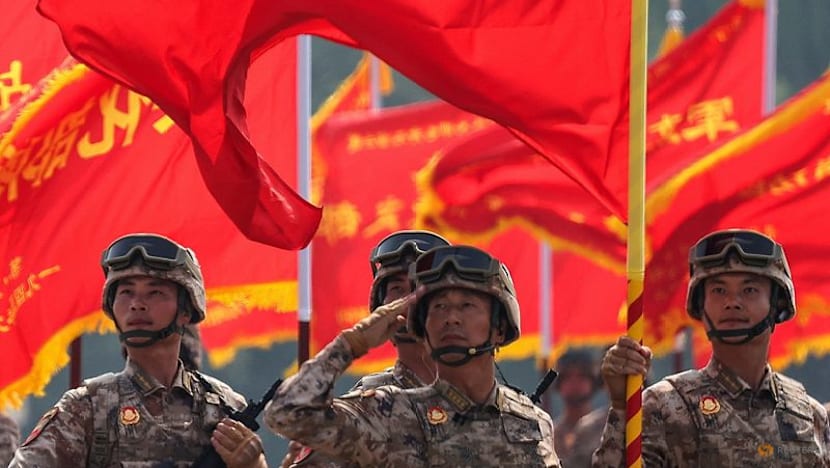 Flags flutter as soldiers participate in a military parade to mark the 80th anniversary of the end of World War II, in Beijing, China, Sep 3, 2025. (Photo: Reuters/Maxim Shemetov)
In his Thursday address, Li lauded progress in modernising national defence and the armed forces and pledged to boost combat readiness and strategic capabilities.
“(China will) continue striving to achieve the centenary goals of the People’s Liberation Army,” Li said. The PLA marks its 100th anniversary in 2027.
Still, experts cautioned that the topline figure reveals little about operational priorities. China does not publish a detailed breakdown of military spending.
“Like other defence budgets … it is always useful to follow the money to ascertain priorities,” said Michael Clarke, an associate professor at Deakin University’s Centre for Future Defence and National Security.
“In the PLA's case, the bulk of the budget is accounted for by three core areas - equipment, personnel and training, and maintenance,” Clarke told CNA.
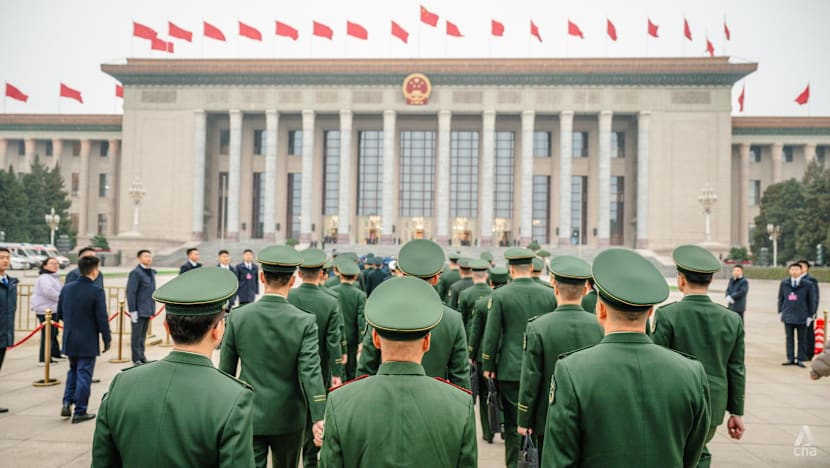 Military delegates arriving outside the Great Hall of the People before the opening sessions of the annual Chinese People's Political Consultative Conference (CPPCC) and National People's Congress (NPC), in Beijing, China, on Mar 4, 2026. (Photo: CNA/Hu Chushi)
Leoni from King’s College London added that more telling indicators include “munitions and fuel stockpiling, logistics and mobilisation funding, joint training tempo, Taiwan-related language, and references to discipline or rectification”.
The spending hike also comes amid a sweeping anti-corruption campaign in the PLA, including recent investigations into senior figures in the Central Military Commission, the country’s top military decision-making body.
“In the short term, purges disrupt procurement continuity and decision-making. In the longer term, they may reinforce modernisation by tightening Party control,” Leoni said.
Analysts said the steady funding rise and emphasis on political discipline underscore Beijing’s twin priorities: strengthening military capabilities while reinforcing Communist Party control.
DOUBLING DOWN ON TECH
Another key takeaway is that technology, especially AI, remains at the heart of China’s growth plans.
In his speech, Li said China will accelerate the use of AI across key industries.
“We will support the development of open-source AI communities and build a vibrant open-source ecosystem,” Li said.
China has set a goal of becoming a global AI leader by 2030, following the launch of its AI development plan in 2017.
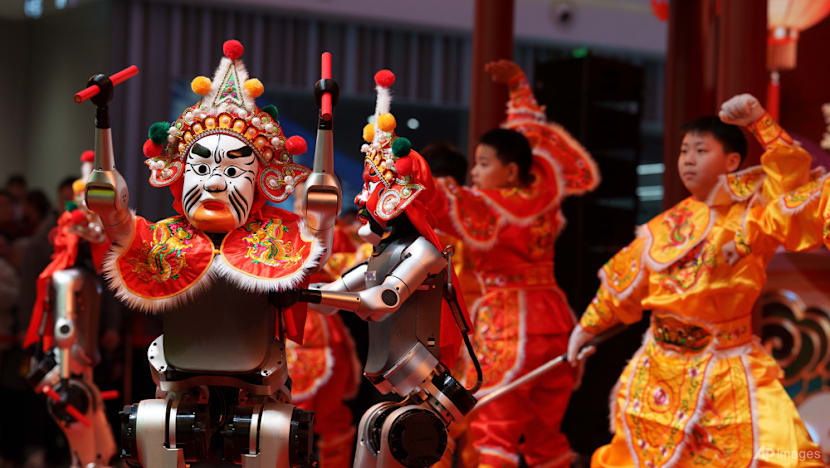 Humanoid robot performers dressed in traditional costume join dancers in a performance during Chinese New Year celebrations in Beijing, China, Feb 19, 2026. (Photo: AP/Vincent Thian)
EIU’s Su said open source has become a distinctive feature of China’s AI development model.
“It helps accelerate technology diffusion so that advances in AI benefit a wider range of industries and the broader economy,” she said.
As the term suggests, open source is where the source code is freely accessible, allowing anyone to use, modify, and distribute it. In contrast, closed source is where access to the source code is restricted, preventing external alterations and extensions.
Both have their merits and drawbacks. Open-source models promote collaboration but may lack resources, while closed-source models provide greater control and monetisation potential but restrict transparency and flexibility.
UOB Kay Hian’s Goh said the open-source push has several strategic aims, including boosting domestic innovation and supporting tech self-reliance amid tighter chip export controls.
“Standards follow adoption, and open source is how China drives adoption,” he said.
Beyond AI, Beijing is stepping up support for strategic sectors such as integrated circuits, quantum technology, embodied AI, brain-computer interfaces and 6G.
The government will build large-scale computing centres to provide the processing power needed for advanced AI systems.
Beijing also pledged to deepen capital market reforms to channel more funding into core technology firms.
Source: CNA/xy/mc/gs(ht/ws)