 2 months ago
82
2 months ago
82
In Hong Kong’s Mid-Levels, on Stubbs Road, there is a condominium that appears to twist as it rises. It is Opus Hong Kong, Frank Gehry’s first residential project in Asia, developed by Swire Properties.
Its twisting form gives each apartment a distinctive floor plan and view. A helical exterior structure around a central core reduces the need for load-bearing interior walls, allowing the facade to be largely glazed for uninterrupted views.
Opus Hong Kong is one of Gehry’s iconic works, and it reflects his often deconstructivist approach through sinuous, sculptural volumes. Gehry died on Dec 5, 2025, in Santa Monica, California, after a brief respiratory illness. He was 96.
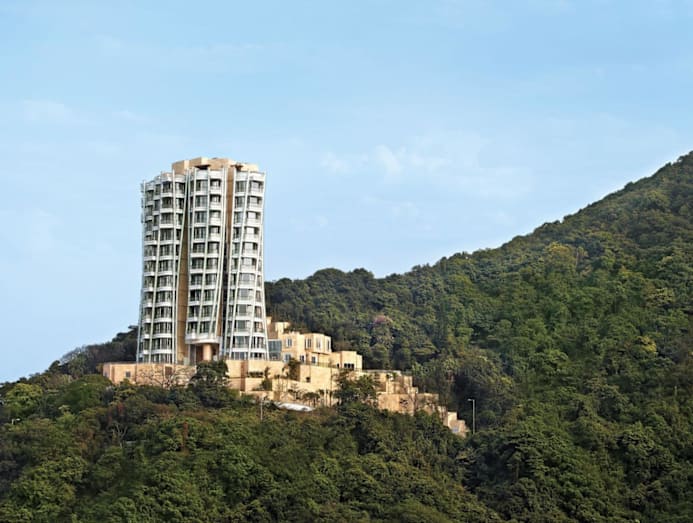 Opus Hong Kong. (Photo: Swire Properties)
Born in Toronto in 1929, Gehry later settled in Los Angeles with his family. He studied architecture at the University of Southern California, then urban planning at Harvard’s Graduate School of Design. In 1962, he established Frank O. Gehry & Associates, beginning a career that challenged modernism’s safe square boxes with a spirited, risk-taking design language.
Crumpled, sculptural, organic, even chaotic – Gehry’s buildings drew plenty of descriptors. Many, such as the skyscraper 8 Spruce Street in New York and the Guggenheim Museum Bilbao, are clad in glossu materials like titanium or stainless steel that augmented their presence.
The architect also lent his talent to smaller scales, designing jewellery and objects for Tiffany & Co (such as the “Fish” Ring), and creating the Cross Check furniture line for Knoll, inspired by basket weaving.
So dynamic and alluring were his buildings that they often became instant landmarks. The Guggenheim Museum Bilbao is one example: it helped cement his global “starchitect” status and turned Bilbao into a major cultural destination after opening in 1997. Throngs of visitors boosted economic and social development in the city, popularising the term “the Bilbao Effect”.
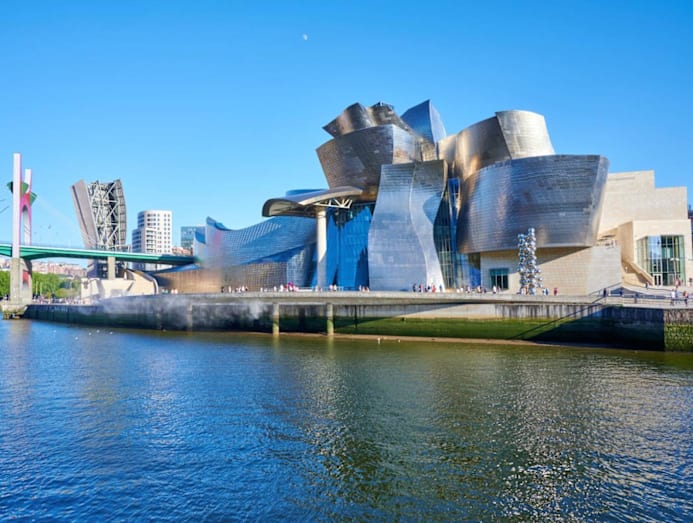 The Guggenheim Museum Bilbao. (Photo: Guggenheim Museum Bilbao)
While avant-garde, Gehry’s work was also user-focused, and addressed the culture and context of their locations – proof that form didn’t have to forget function. It is not surprising then that over a six-decade career, he received major honours including the 1989 Pritzker Prize, the Golden Lion for Lifetime Achievement at the Venice Architecture Biennale (2008), and the Royal Gold Medal from the Royal Institute of British Architects (2000), as well as the inaugural Frederick Kiesler Prize (1998).
He also received the 1992 Praemium Imperiale Award by the Japan Art Association, and was appointed Chevalier and later the higher rank of Commandeur (2014) of the National Order of the Legion of Honour – France’s highest honour for military and civil merits. He was awarded the Presidential Medal of Freedom in 2016. Pop culture noticed too: Gehry even voiced himself on The Simpsons.
Yet despite his commercial success, Gehry also took on pro bono work – such as a facility for Children’s Institute, Inc, a Los Angeles nonprofit supporting children and families affected by trauma and violence. He also worked on the Judith and Thomas L Beckmen YOLA Center in Inglewood, a home for the LA Philharmonic Youth Orchestra Los Angeles (YOLA), which provides free music education.
Truly, Gehry left his mark in all ways and places. While he designed many private projects, there are also many public works you can visit. Here are nine to experience the late-architect’s genius.
THE TOWER (LUMA ARLES)
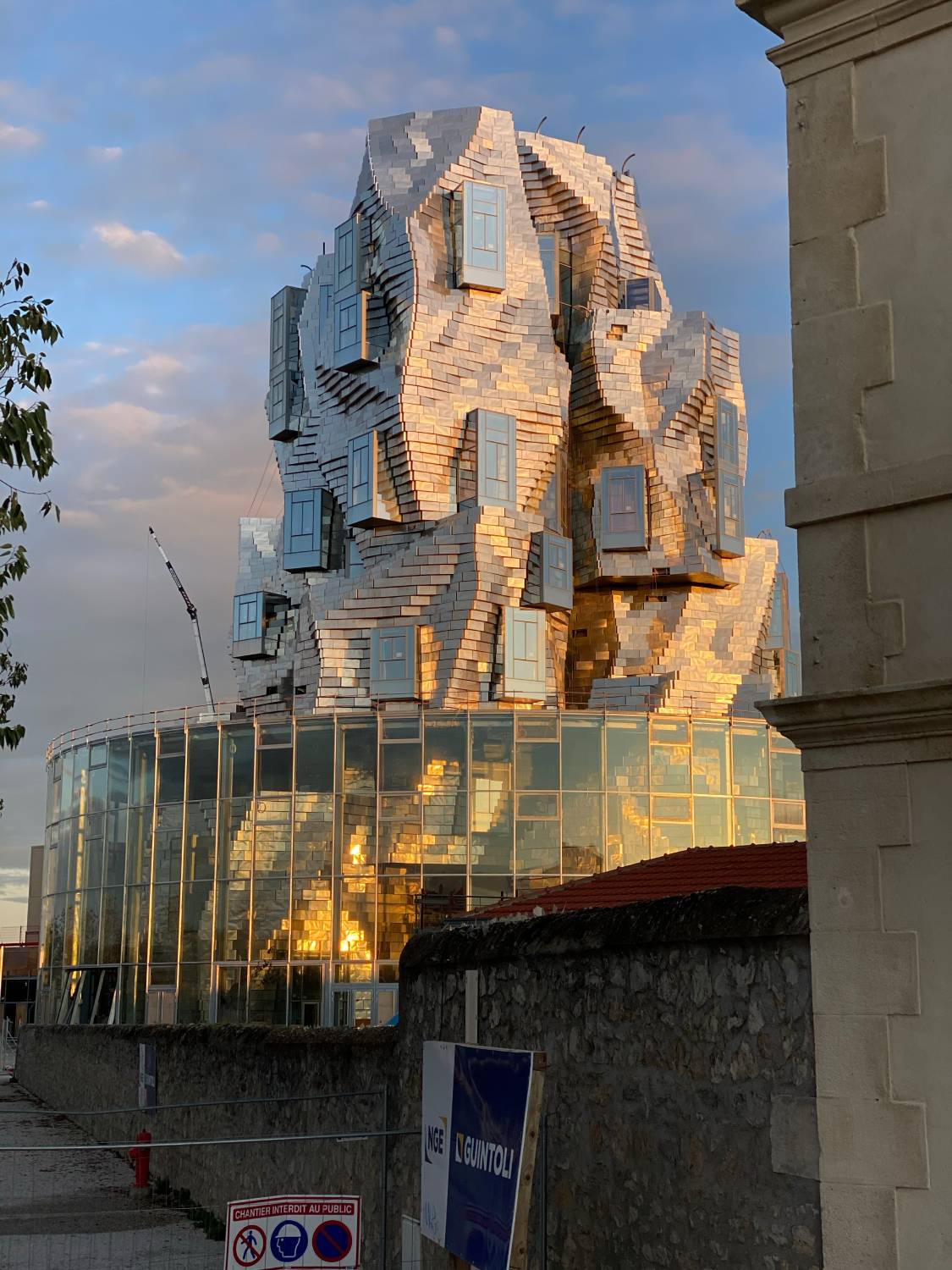 The Tower. (Photo: Frank O. Gehry and Gehry Partners, LLP)
Located in Arles in southern France, The Tower houses the LUMA Arles arts centre. It is clad in roughly 11,000 organically shaped stainless-steel panels, giving it a mountain-like presence. The striking structure rises above many 17th century stucco-and-stone townhouses.
Gehry designed the tower with Arles’ Roman architecture, the nearby Alpilles lanscape and Vincent van Gogh’s Starry Night painting in mind (the artist’s work was painted nearby and these peaks were the subjects). Like a canvas, The Tower reflects the colours of the region’s changing skies throughout the day.
GUGGENHEIM MUSEUM BILBAO
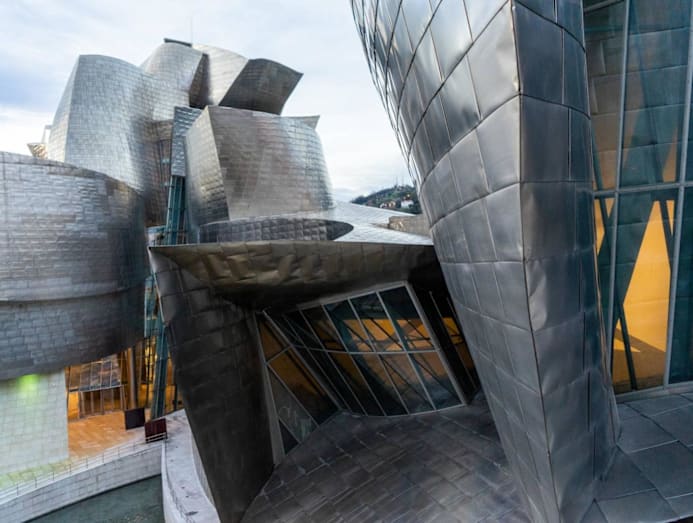 The Guggenheim Museum Bilbao. (Photo: Guggenheim Museum Bilbao)
Completed in 1997, the Guggenheim Museum Bilbao is a 24,000 sq m landmark of titanium, limestone, and glass on the Nervion River. Gehry clad the building in around 33,000 titanium plates attached to a galvanised steel structure to ‘catch the light’. Aerospace design software CATIA software helped translate his sketches and models into buildable form.
Inside are 19 gallery spaces, nine of which have dynamic shapes mirrored on the architecture. Richard Serra’s installation, The Matter of Time, has a permanent home in the largest gallery. It was a run-down port area until the Guggenheim Museum Bilbao was constructed – tourism dollars followed, jobs for locals were created, investment for infrastructure projects came, and the river was cleaned up and transformed into a vibrant public space.
FONDATION LOUIS VUITTON
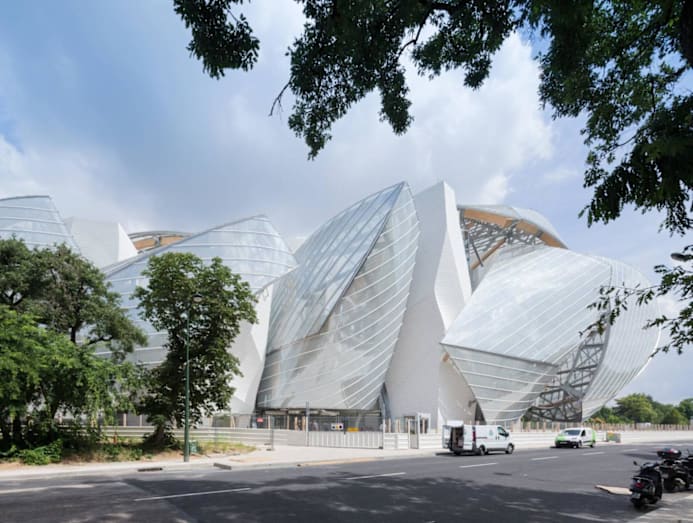 Fondation Louis Vuitton. (Photo: Iwan Baan)
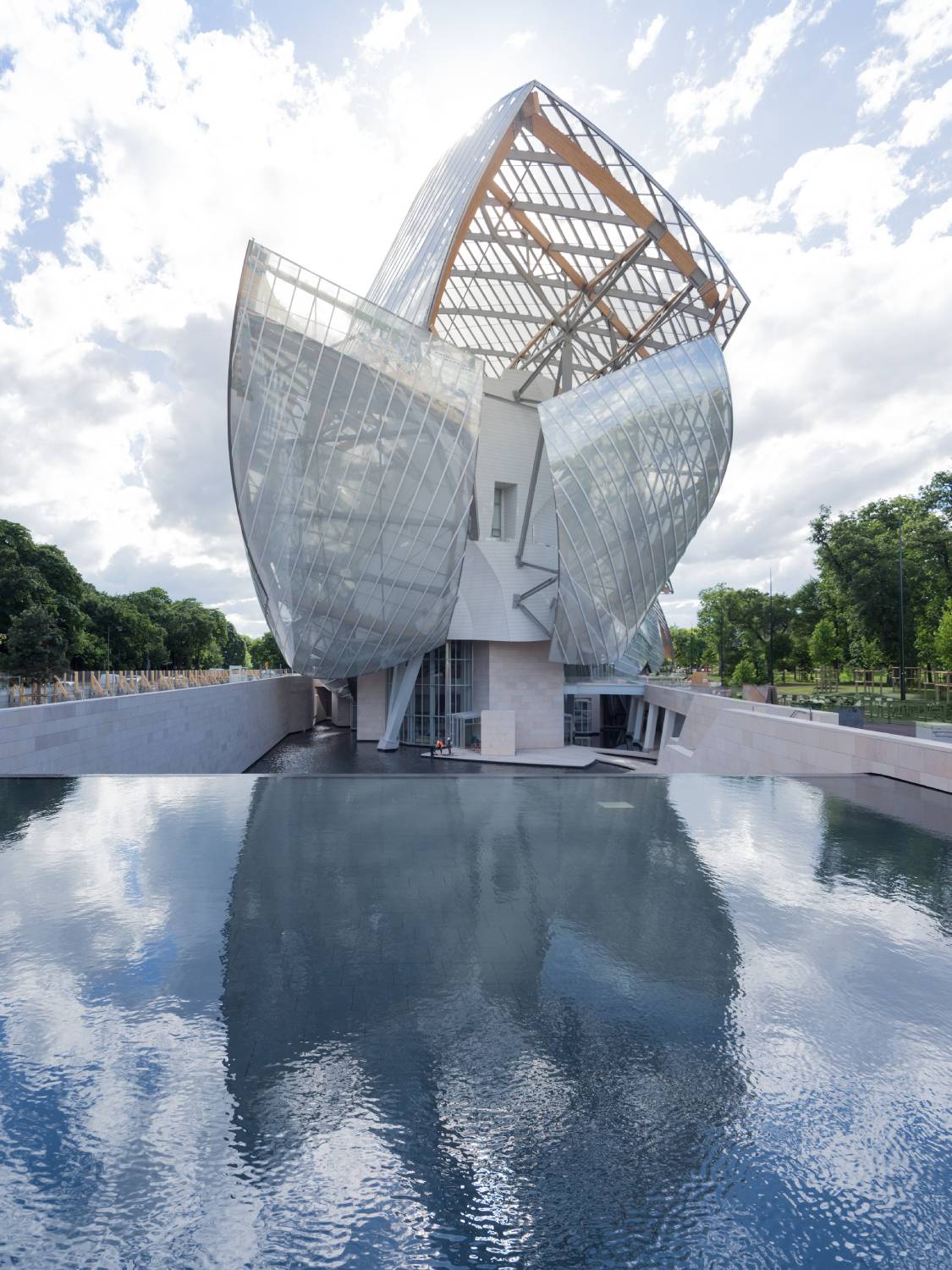 Fondation Louis Vuitton. (Photo: Iwan Baan)
The Louis Vuitton Foundation (or Fondation Louis Vuitton) is an art museum and cultural centre on the edge of the Bois de Boulogne, running separately as a non-profit to LVMH (Louis Vuitton Moet Hennessy). The building opened in 2014; Gehry Partners worked with Studios Architecture as the local architect to deliver the project.
Gehry envisioned a building inspired by historic glass-and-iron landmarks such as the Grand Palais. There are 11 galleries as well as spaces for events and outdoor art exhibitions. The architecture mimics the form of sailboats’ sails puffed up by the wind. Exhibitions have featured artists such as Jean-Michel Basquiat, Jeff Koons, and Olafur Eliasson.
WALT DISNEY CONCERT HALL
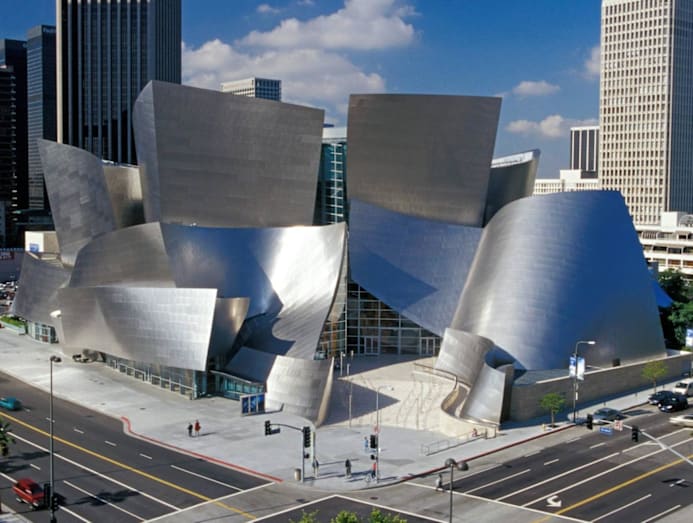 Walt Disney Concert Hall. (Photo: Frank O. Gehry and Gehry Partners, LLP)
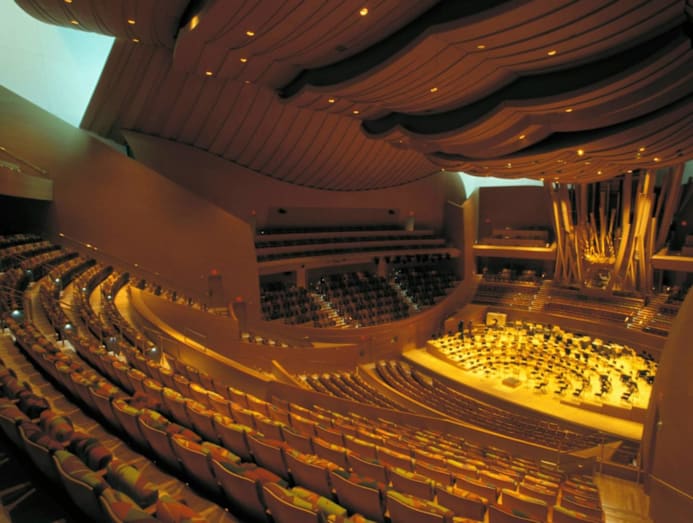 The interior of Walt Disney Concert Hall. (Photo: Frank O. Gehry and Gehry Partners, LLP)
Walt Disney Concert Hall is home to the LA Philharmonic and Los Angeles Master Chorale. In 1987, Lillian Disney made an initial US$50 million (S$642.13 million) gift to build a performance space for the citizens of LA, and to pay homage to Walt Disney’s dedication to both the arts and the city. The hall opened in 2003 in downtown LA.
Like the Guggenheim Museum Bilbao, the building’s exterior is clad with stainless-steel panels. Instead of the usual box and balcony seats, the hall features a more democratic design with the audience seated on each side of the stage. The hall is renowned for its acoustics, shaped by acoustician Minoru Nagata and later overseen by Yasuhisa Toyota, alongside Gehry’s sculpted interior surfaces.
VITRA DESIGN MUSEUM
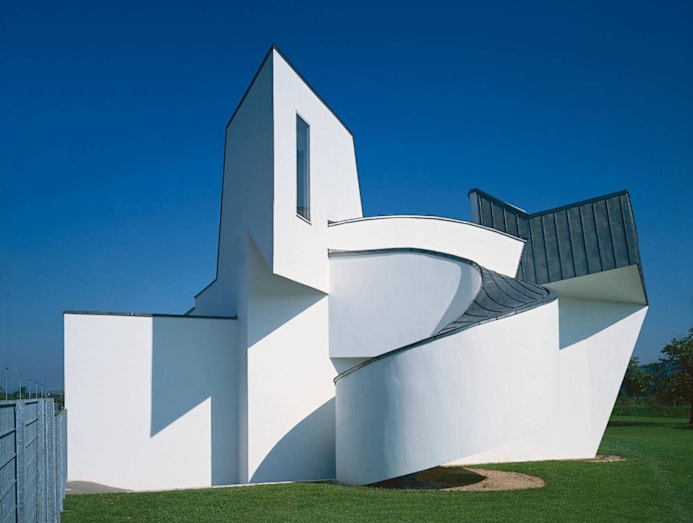 Vitra Design Museum. (Photo: Thomas Dix)
The Vitra Design Museum in Weil am Rhein, Germany, sits on the Vitra Campus – home to several landmark buildings. This was Gehry’s first completed project in Europe. While the building features his trademark curves, it has a more subdued presence due to the use of white plaster and titanium-zinc alloy.
The museum originally housed Vitra’s design collection, including works associated with designers such as Charles and Ray Eames, George Nelson, and Alvar Aalto. Much of the collection later moved to the nearby Schaudepot (opened in 2016). Gehry’s building now hosts temporary exhibitions.
BIOMUSEO
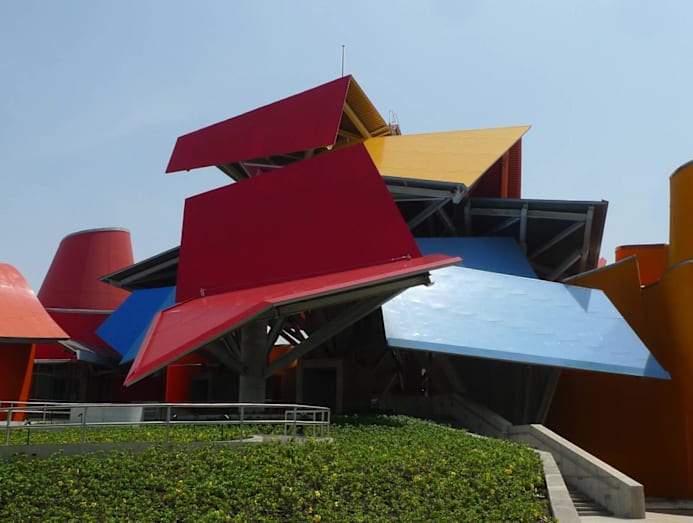 Biomuseo. (Photo: Frank O. Gehry and Gehry Partners, LLP)
It’s hard to miss the Biomuseo on Panama City’s Amador Causeway, near the entrance to the Panama Canal. Gehry’s curves and colour reference the emergence of the Isthmus of Panama, which connected two continents and reshaped global biodiversity.
Completed in 2014, the building’s chromatic metal canopies shelter an open public atrium from frequent rain. Outside, the Park of Biodiversity extends the museum experience into the landscape with educational stations. This is Gehry’s first project in Latin America.
MUSEUM OF POP CULTURE (MOPOP)
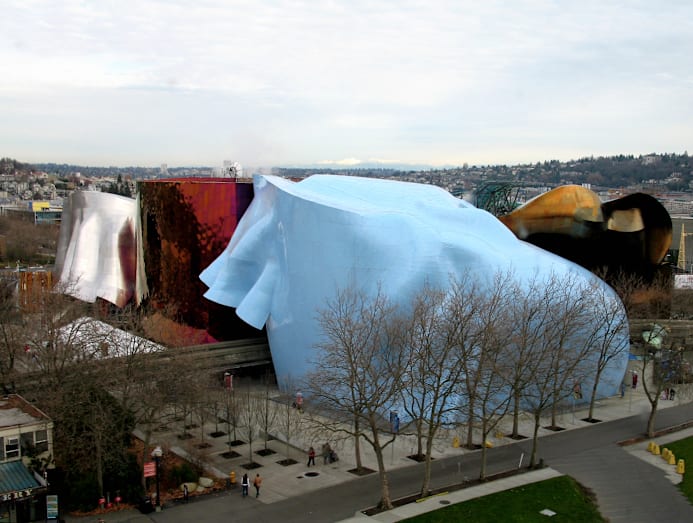 Museum of Pop Culture. (Photo: Frank O. Gehry and Gehry Partners, LLP)
The Museum of Pop Culture or MOPOP – formerly the Experience Music Project and Science Fiction Museum and Hall of Fame, and later the EMP Museum – nonprofit museum in Seattle founded by Microsoft co-founder Paul Allen in 2000. Compared by some to a smashed-up guitar, its exuberant form has also drawn criticism.
The 140,000-square-foot building hosts exhibitions spanning pop culture – from fantasy and horror to video games. Also on exhibit are interesting items, including the world’s largest collection of artefacts, hand-written lyrics, personal instruments and original photographs celebrating Seattle musician Jimi Hendrix and the band Nivana.
HOTEL MARQUES DE RISCAL, A LUXURY COLLECTION HOTEL, ELCIEGO
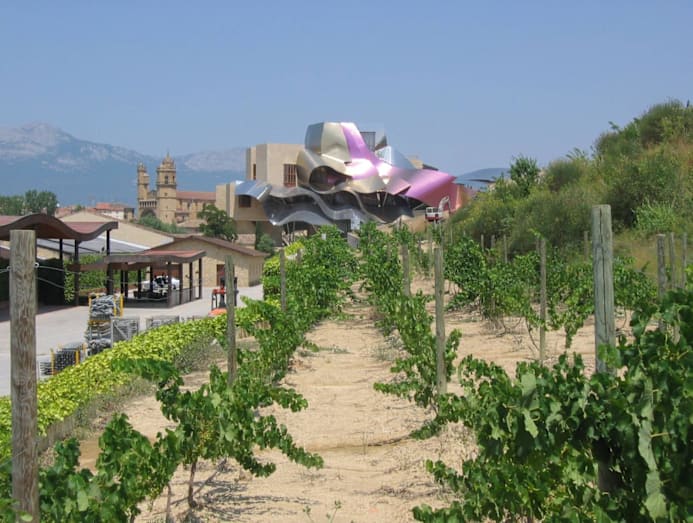 Hotel Marques de Riscal. (Photo: Frank O. Gehry and Gehry Partners, LLP)
Hotel Marques de Riscal, a Luxury Collection Hotel (Marriott International), sits in Elciego in Rioja Alavesa, in Spain’s Basque Country. Set within the Marques de Riscal wine estate, it includes guestrooms, houses Michelin-starred, molecular-gastronomy restaurant Marques de Riscal (named after the hotel), and a Caudalie vinotheraphy spa.
Gehry’s rippling ribbons of pink and gold titanium and mirror-finish stainless steel are often read as references to wine culture – echoing red wine tones and details associated with the Marqués de Riscal bottle. Set against the historic winery, the building’s form suggests twisting vines. Like the Guggenheim Museum Bilbao, this building revitalised the region, turning it into a destination for oenophiles.
DANCING HOUSE
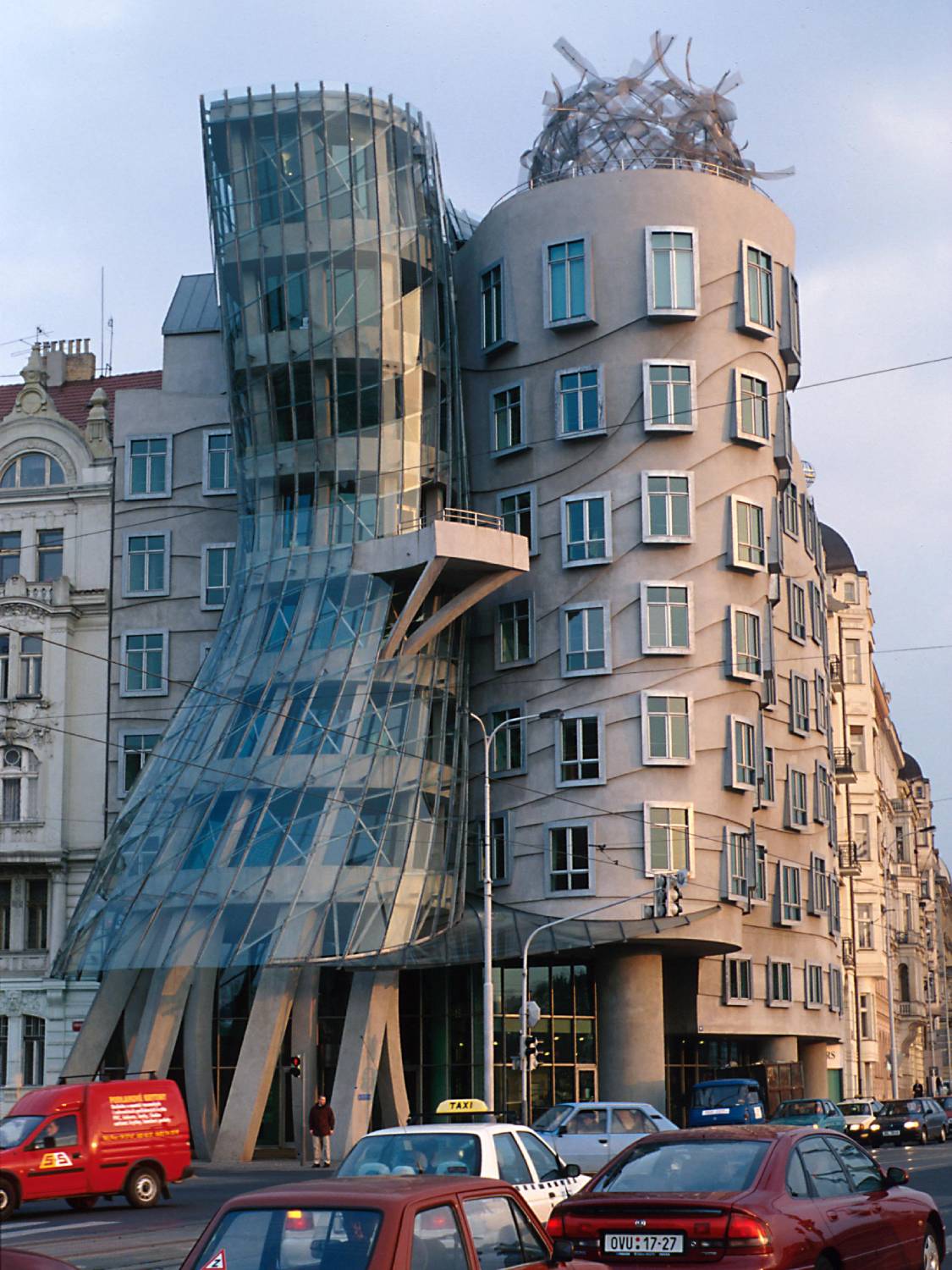 The Dancing House. (Photo: Frank O. Gehry and Gehry Partners, LLP)
Nicknamed the Dancing House, the plot was owned by the family of the first president of the Czech Republic, Vaclav Havel. His neighbour was Croatian-Czech architect Vlado Milunic, who collaborated with Gehry to design a building with two parts: a glass tower supported by curved pillars and a stone structure with undulating mouldings and unaligned windows.
The building is also known as “Ginger and Fred,” after the famous dancing duo, because it resembles two intertwined figures. Built originally as offices, two floors were converted into the 21-room Dancing House Hotel in 2016. Today the Ginger & Fred restaurant operates on the seventh floor, with a glass bar on the eighth and an art gallery below.